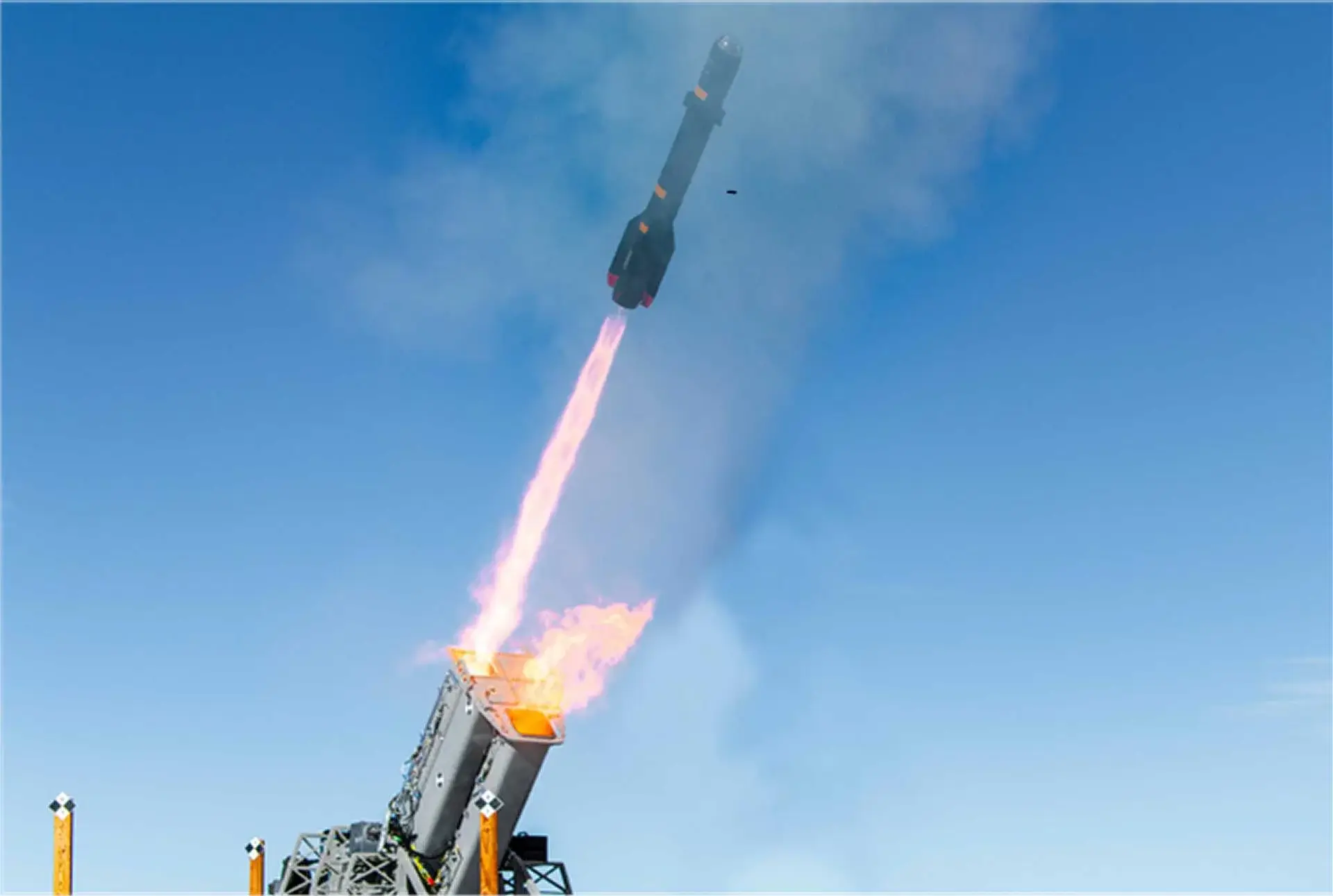
The United States has taken a significant step forward in counter-drone warfare with the successful first-ever vertical launch of the Joint Air-to-Ground Missile, or JAGM, from a ground-based platform. Conducted in January 2026 at Naval Air Weapons Station China Lake in California, the live-fire test confirmed that a weapon traditionally associated with air-to-ground strike missions can be adapted into a precise, flexible, and lethal counter-unmanned aerial system (C-UAS) solution. The test culminated in the missile intercepting and destroying a drone target, validating a new operational role for one of the Pentagon’s most important next-generation precision weapons.
This demonstration reflects a broader shift in U.S. defense priorities as unmanned aerial threats proliferate across modern battlefields. From reconnaissance drones and loitering munitions to coordinated swarm attacks, adversaries are increasingly relying on low-cost, agile aerial systems to challenge conventional forces. Against this backdrop, the successful vertical launch of JAGM marks a notable expansion of U.S. layered air defense options, particularly for forward-deployed and expeditionary units that require mobility without sacrificing precision.
A Historic First for JAGM Ground-Based Vertical Launch
The January test represented the first 90-degree vertical launch of JAGM from a surface platform, a capability previously associated with naval air defense missiles rather than air-to-ground weapons. Lockheed Martin, the U.S.-based defense contractor responsible for JAGM, conducted the demonstration using its newly developed JAGM Quad Launcher (JQL). Mounted on a 6×6 tactical vehicle, the launcher carried four ready-to-fire missiles and executed a clean vertical ejection before the missile transitioned into powered flight, acquired its target, and achieved a direct intercept.
This vertical-launch profile is more than a technical novelty. It enables 360-degree engagement, allowing forces to respond to aerial threats approaching from any direction without reorienting the launcher. In environments where reaction time is critical and threats are unpredictable, such as forward operating bases or naval task groups, this capability significantly enhances survivability and responsiveness.
From Air-to-Ground Workhorse to Counter-Drone Asset
JAGM was originally conceived as the U.S. Department of Defense’s next-generation air-to-ground missile, intended to replace legacy systems such as the AGM-114 Hellfire, AGM-65 Maverick, and BGM-71 TOW. Its design focused on defeating armored vehicles, fortified positions, and fast-moving ground targets while simplifying logistics through a single, common missile family.
What has now become clear is that JAGM’s underlying architecture lends itself naturally to counter-UAS missions. The missile’s multi-mode seeker, combining semi-active laser (SAL) guidance with millimeter-wave (MMW) radar, provides the flexibility required to track and engage small, fast, and low-signature aerial targets. During the China Lake test, this seeker package demonstrated its ability to acquire a drone target rapidly after vertical launch, a critical requirement for effective air defense at short ranges.
Advanced Seeker Technology Enables Precision Intercepts
At the core of JAGM’s adaptability is its sophisticated seeker system. The MMW radar allows the missile to operate in all weather conditions and degraded visual environments, autonomously tracking targets without continuous external guidance. This makes it particularly effective against drones attempting to exploit poor visibility or electronic clutter to evade defenses.
Complementing this is the semi-active laser channel, which enables highly precise engagements against designated targets. In a networked battlespace, drones, ground observers, or forward air controllers can provide laser designation, allowing JAGM to strike high-value or maneuvering aerial threats with exceptional accuracy. This dual-mode approach gives commanders the option to tailor engagements based on mission requirements, threat characteristics, and available sensors.
Modular JAGM Quad Launcher Expands Deployment Options
The JAGM Quad Launcher used in the test is a key enabler of the missile’s new role. Designed with modularity in mind, the launcher can be integrated onto a wide range of platforms, from tactical ground vehicles to maritime vessels and potentially even fixed or containerized launch sites. Its compact footprint and four-missile capacity make it well-suited for environments where space, weight, and mobility are constrained.
The successful vertical launch also demonstrates compatibility with naval-style launch concepts, opening the door for future integration aboard ships, littoral combat platforms, and expeditionary sea bases. For forces operating in contested maritime regions, this capability offers a cost-effective way to bolster close-in air defense against drones and low-flying threats.
Addressing the Growing Challenge of Small and Medium UAS
Small and medium-sized drones, often categorized as Group 2 and Group 3 UAS, have become a defining challenge for modern militaries. These systems are inexpensive, difficult to detect, and increasingly capable of carrying sensors or explosive payloads. Traditional short-range air defense systems can struggle to engage them efficiently, either due to cost mismatches or limitations in tracking small radar cross-section targets.
JAGM occupies a compelling middle ground. It offers precision and lethality without the expense associated with larger air defense interceptors, while delivering far greater accuracy and reach than many gun- or jammer-based counter-drone solutions. Its ability to engage both static and maneuvering targets makes it particularly relevant against drones conducting reconnaissance or loitering attacks over friendly forces.
Implications for Joint and All-Domain Operations
The vertical-launch JAGM test also aligns with the U.S. military’s emphasis on Joint All-Domain Command and Control (JADC2). JAGM’s digital backbone and network-enabled targeting allow it to integrate seamlessly into layered defense architectures, sharing data with radars, electro-optical sensors, electronic warfare systems, and other shooters.
In a future operational environment defined by rapid data exchange, JAGM could function as a responsive node within a broader defensive web. A detected drone threat could be cued by one sensor, assigned to JAGM as the most appropriate effector, and neutralized within seconds, all without manual intervention. This level of integration is essential for countering saturation attacks and coordinated drone swarms.
Strategic Significance for Expeditionary and Naval Forces
For the U.S. Navy and Marine Corps, the implications of this test are particularly significant. Expeditionary forces operating from austere bases or island positions require mobile, compact, and reliable air defense systems. The vertical-launch JAGM configuration meets these needs by combining precision engagement with minimal infrastructure requirements.
Naval vessels, especially those operating in littoral zones, face an increasing risk from low-altitude drones launched from shore or small boats. Integrating JAGM into shipboard launchers could provide an additional defensive layer, enhancing protection without displacing existing weapons systems. The ability to launch vertically also improves survivability, as launchers can be positioned below deck or behind protective structures.
From Incremental Evolution to Multi-Domain Capability
The JAGM program has evolved deliberately over time, expanding its platform compatibility through incremental upgrades rather than radical redesigns. Initially fielded on rotary-wing platforms such as the AH-64 Apache and unmanned systems like the MQ-1C Gray Eagle, JAGM has steadily matured into a versatile precision weapon.
The January 2026 test represents a pivotal milestone in this evolution. By proving that JAGM can function effectively as a surface-launched, vertically fired interceptor, Lockheed Martin has demonstrated that the missile is no longer confined to its original air-to-ground niche. Instead, it is emerging as a reconfigurable, cross-domain weapon system capable of addressing a wide spectrum of threats.
A Glimpse Into the Future of Counter-Drone Defense
As drone technology continues to advance and proliferate, militaries will require adaptable solutions that can evolve alongside emerging threats. The successful vertical-launch JAGM intercept suggests a future in which existing precision weapons are repurposed and networked to meet new challenges, rather than relying solely on entirely new systems.
With JAGM already in full-rate production and now validated in a counter-UAS role, the missile is well-positioned to become a cornerstone of future short-range air defense architectures. The China Lake demonstration confirms that JAGM is not merely an upgrade over legacy missiles, but a flexible, multi-domain tool capable of delivering decisive effects in an increasingly contested and drone-saturated battlespace.