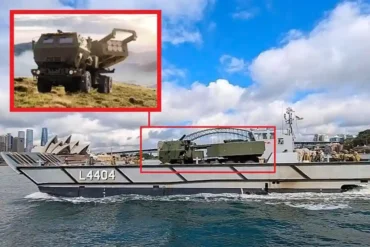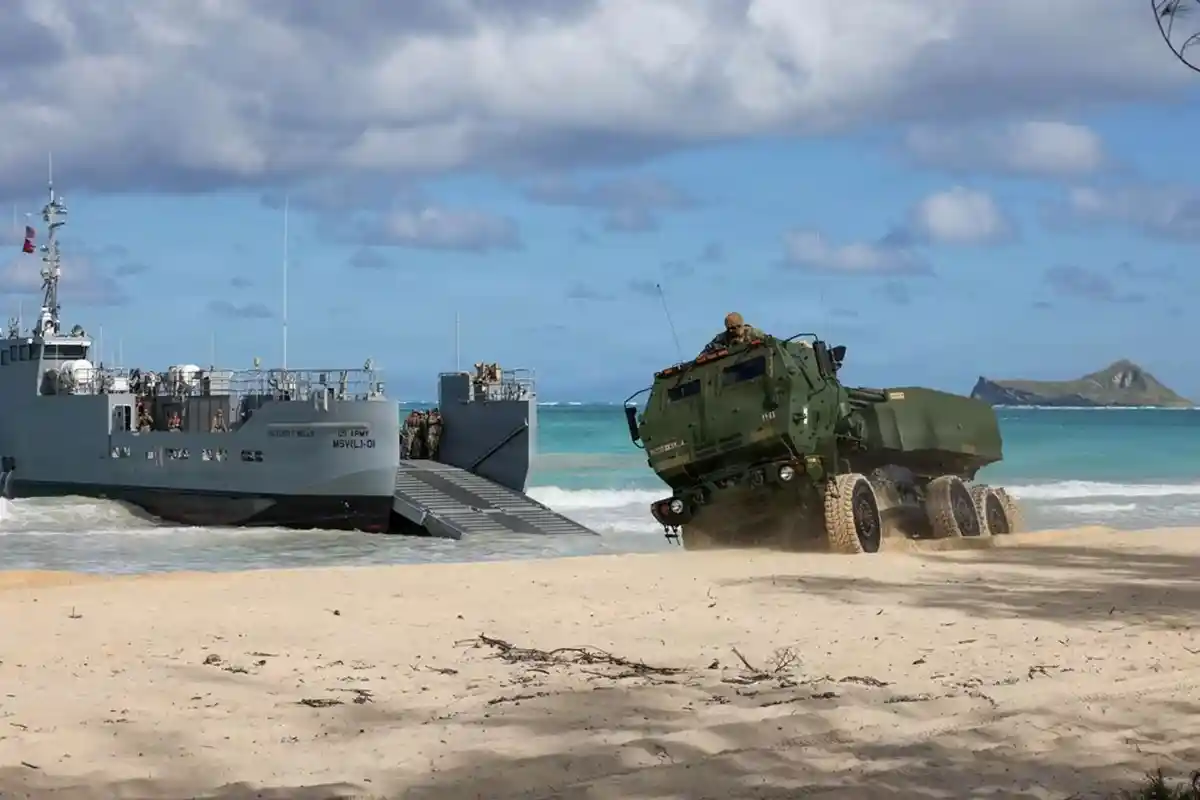
The U.S. Army has taken a decisive step toward redefining how land-based rocket artillery operates across the vast maritime terrain of the Indo-Pacific. In late February 2026, Army units in Hawaii successfully validated a sea-based launch concept for the M142 High Mobility Artillery Rocket System (HIMARS), loading and deploying the launcher aboard the new Maneuver Support Vessel Light (MSV Light) during a littoral rapid infiltration operation on Oahu. The demonstration signals a strategic evolution in how long-range precision fires can be maneuvered between islands without reliance on fixed ports or vulnerable airfields.
The event unfolded at Bellows Air Force Station, where Soldiers from the 7th Transportation Brigade coordinated closely with the 2nd Battalion, 11th Field Artillery Regiment, part of the 25th Infantry Division. Their objective was clear: prove that HIMARS, already renowned for its agility and accuracy on land, can integrate seamlessly with a shallow-draft vessel purpose-built for austere coastal operations. The result was not simply a successful load-and-offload drill, but a tangible demonstration of how precision fires can remain survivable and unpredictable inside a contested theater.
Reinventing the “Shoot-and-Scoot” Doctrine for the Littorals
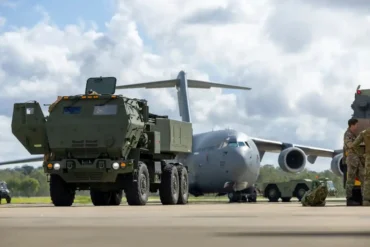
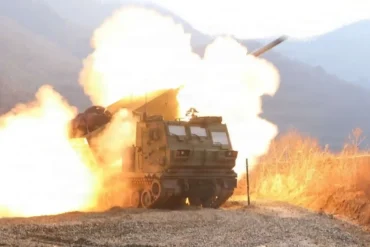
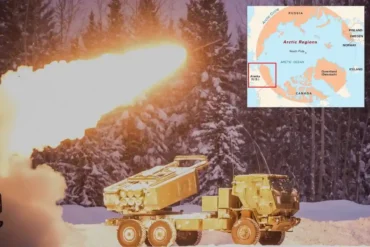
HIMARS has earned its battlefield reputation through speed. Mounted on the Family of Medium Tactical Vehicles (FMTV) 5-ton truck chassis, the launcher can set up in under 20 seconds, fire a six-rocket salvo in less than a minute, and rapidly displace before enemy counterfire can be directed at its previous position. This “shoot-and-scoot” approach has been central to modern precision artillery operations, particularly in environments saturated with drones and counter-battery radars.
What the Hawaii demonstration achieved was an expansion of that doctrine beyond roads and airstrips. By embarking HIMARS onto the MSV Light, the Army effectively added a maritime maneuver axis to its precision fires playbook. Instead of relying solely on airlift to reposition launchers between islands, commanders now possess a surface-based option capable of moving heavy rocket artillery through shallow coastal waters and directly onto unimproved beaches.
In a region defined by archipelagos, narrow straits, and dispersed landmasses, this flexibility carries strategic weight. Fixed ports can be mined or targeted. Runways can be cratered. Predictable logistics nodes become magnets for long-range missile strikes. A fast, shallow-draft landing craft, operating outside traditional harbor infrastructure, disrupts that targeting logic.
MSV Light: The Army’s New Littoral Connector
At the center of this operational shift is the MSV Light, the Army’s first major watercraft acquisition in over two decades. Designed to replace aging Vietnam-era LCM-8 landing craft, the 117-foot aluminum vessel represents a generational leap in speed, payload capacity, and beach accessibility.
The MSV Light features a tribow monohull design paired with waterjet propulsion, enabling it to maintain stability while sustaining high transit speeds. Fully laden, the vessel can reach approximately 21 knots and exceed 30 knots when unladen. Its range extends beyond 360 nautical miles, granting significant operational reach between dispersed island chains. Three 2,600-horsepower engines power three waterjets, offering precise maneuverability in confined waters and a fully loaded draft of roughly four feet. This shallow profile allows direct beach landings without the need for piers or developed infrastructure.
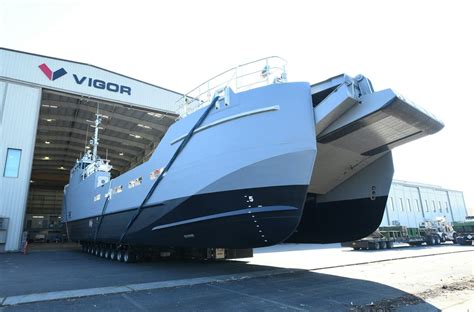
The vessel’s payload rating of approximately 82 tons is particularly relevant for artillery mobility. It can carry an M1 Abrams main battle tank or multiple lighter armored vehicles. For HIMARS, the reinforced deck and drive-through loading configuration enable rapid roll-on, roll-off operations. A bi-fold bow ramp facilitates direct beach access, while integrated tie-down grids secure combat vehicles during transit in varying sea states. The MSV Light is also designed with provisions for remotely operated weapon stations, enhancing self-protection against small surface threats or unmanned systems during approach and offload.
HIMARS Capabilities and Expanding Strike Depth
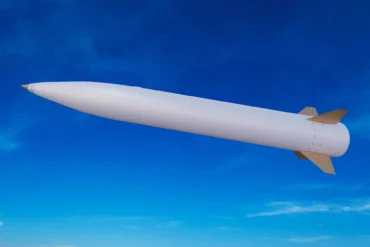
The M142 HIMARS remains one of the most versatile precision fires systems in the U.S. arsenal. Standard launcher pods carry six 227 mm Guided Multiple Launch Rocket System (GMLRS) rockets, delivering precision strikes at ranges exceeding 70 kilometers, depending on variant. The system is also capable of firing the Army Tactical Missile System (ATACMS) and is transitioning toward the next-generation Precision Strike Missile (PrSM) family, which significantly extends deep-strike reach.
This layered munitions architecture enables tailored effects. Tactical suppression of enemy artillery, interdiction of logistics hubs, targeting of air defense systems, and even maritime strike missions fall within the expanding envelope of HIMARS capabilities. As PrSM variants optimized for maritime targets mature, the combination of sea mobility and long-range missiles enhances the Army’s contribution to joint sea denial and control operations.
The Hawaii operation underscored how mobility amplifies range. A launcher capable of striking 70 kilometers inland becomes exponentially more unpredictable when it can also relocate dozens or hundreds of nautical miles along a coastline. The geometry of the battlefield changes. Potential firing positions multiply. Enemy targeting cycles stretch thinner.
Distributed Fires in a Contested Indo-Pacific
Modern precision warfare revolves around detection and reaction speed. Sensors cue shooters. Data networks compress timelines. The side that lingers too long in a single location risks rapid destruction. Against this backdrop, distributed fires and infrastructure-independent maneuver are no longer optional—they are survival mechanisms.
By integrating HIMARS with MSV Light, the Army demonstrated an alternative to airlift-centric rapid infiltration. While air transport remains a critical capability, aircraft are limited assets and airfields are highly visible targets. Surface maneuver through shallow waters introduces redundancy into the mobility equation. It forces adversaries to monitor not only runways and ports but vast stretches of coastline and littoral terrain.
For the 25th Infantry Division, stationed in Hawaii and oriented toward Indo-Pacific contingencies, this demonstration reinforces its evolving role as a mobile precision fires force. For the 7th Transportation Brigade, it validates the operational relevance of modernized Army watercraft as more than logistical connectors. Together, they form a distributed network in which shooters and sustainment elements can maneuver fluidly across land and sea.
Strategic Implications for Archipelagic Warfare
The Indo-Pacific theater presents a geographic puzzle of dispersed islands, narrow maritime chokepoints, and long distances between key terrain. Traditional land campaigns centered on contiguous fronts do not neatly apply. Instead, mobility across water becomes inseparable from land operations.
The HIMARS sea launch validation suggests a template for archipelagic campaigning. Launchers can embark from one island, transit rapidly under maritime cover, disembark onto an unimproved beach, execute precision strikes, and displace again before counterfire solutions are fully developed. As longer-range munitions enter service, including extended-range PrSM variants, this mobility directly enhances deterrence by expanding the credible reach of land-based fires across maritime approaches.
In practical terms, this complicates adversary planning. Targeting calculus must account for mobile launchers capable of appearing along unexpected coastlines. Efforts to neutralize U.S. precision fires cannot focus solely on fixed infrastructure. The operational map becomes dynamic rather than static.
The Hawaii demonstration represents more than a technical milestone. It embodies a broader transformation in how the U.S. Army conceives maneuver and fires integration in maritime theaters. By pairing the proven lethality of HIMARS with the speed and beach accessibility of the MSV Light, the Army has demonstrated a credible pathway to sustain long-range precision fires even when traditional ports and airfields are contested or degraded.
In a region where geography dictates strategy, the ability to move rockets across water as readily as across highways may prove decisive. The range of the missile remains critical, but increasingly, it is the mobility of the launcher—its capacity to appear, strike, and vanish along a complex littoral—that defines survivability and strategic leverage in the Indo-Pacific.