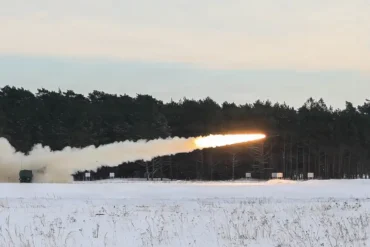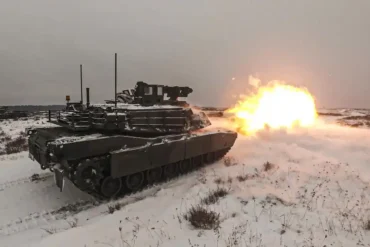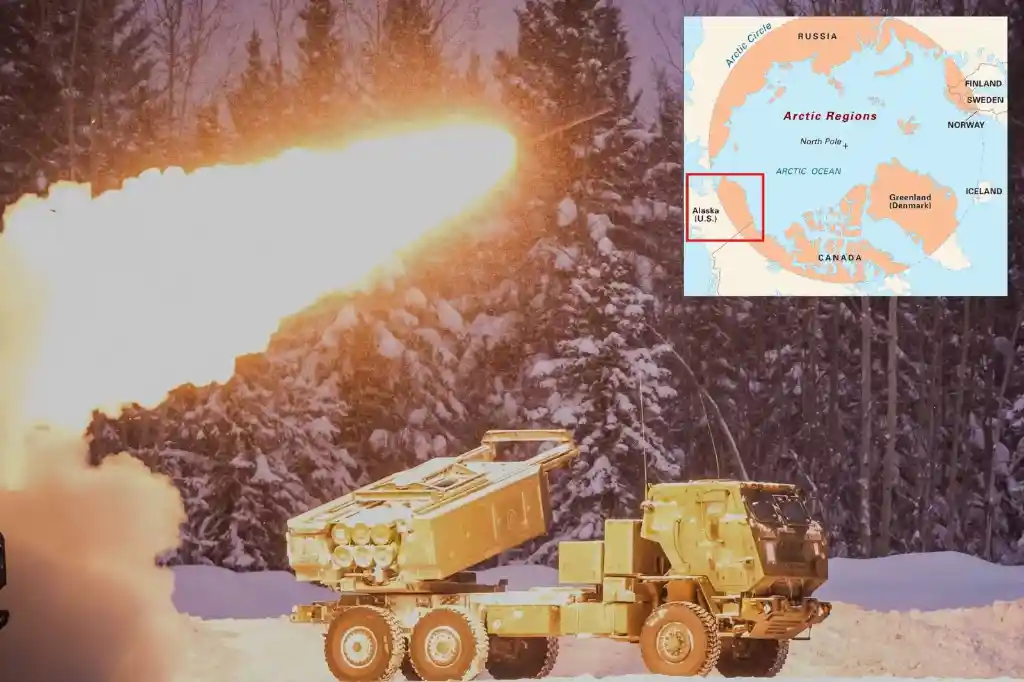
The U.S. Army has taken a decisive step in transforming its Arctic warfighting posture, refining HIMARS rocket artillery tactics under some of the harshest environmental conditions on Earth. During Joint Pacific Multinational Readiness Center (JPMRC) 26-02 in Alaska’s Tanana Flats Training Area, Soldiers from the 17th Field Artillery Brigade conducted a live-fire ground raid designed not merely as a demonstration, but as a rigorous validation of long-range precision fires in extreme cold. The exercise underscores a strategic reality: the High North is no longer a peripheral theater. It is a contested frontier where mobility, survivability, and extended-range strike capability define operational advantage.
The February 2026 live fire, executed in support of the 11th Airborne Division, served as both technical stress test and doctrinal proving ground. Arctic operations introduce variables that no temperate training environment can fully replicate—sub-zero temperatures that freeze hydraulic systems, snow-covered terrain that limits maneuver corridors, reduced daylight, and constrained communications infrastructure. In this unforgiving context, the Army sought to refine tactics, techniques, and procedures (TTPs) that allow High Mobility Artillery Rocket System (HIMARS) units to infiltrate, strike, and displace before an adversary can react.
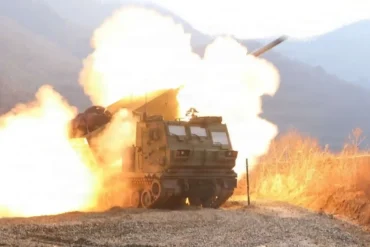
Rather than static firing from prepared positions, the brigade executed what the Army describes as an “Arctic ground raid”—a maneuver-centric profile built around rapid movement, dispersed operations, and immediate displacement. HIMARS launchers traversed snow-packed routes, established austere firing positions, delivered precision effects at extended ranges, and rapidly relocated to avoid simulated counter-battery and air threats. The event replicated a high-end conflict scenario in which U.S. forces must project power deep into contested Arctic terrain while remaining elusive under persistent surveillance.
HIMARS in the Arctic: Extending Precision Fires to the Polar Edge
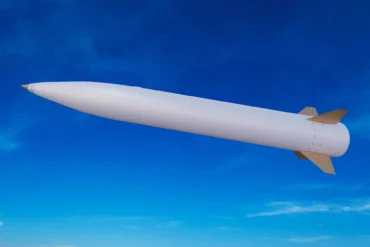
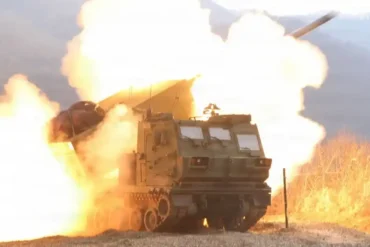
The M142 HIMARS, mounted on a Family of Medium Tactical Vehicles (FMTV) chassis, is engineered for rapid deployment and high mobility. It carries a single launch pod capable of firing six Guided Multiple Launch Rocket System (GMLRS) rockets to ranges of approximately 80–90 kilometers. Extended-range variants are pushing that envelope toward 150 kilometers, while the system can also deploy ATACMS missiles and the emerging Precision Strike Missile (PrSM), projected to exceed 300 kilometers in range.
Operating at the edge of its environmental envelope, HIMARS in Alaska faced a set of challenges rarely encountered in other theaters. Extreme cold affects electronic components, fire-control systems, lubricants, batteries, and hydraulic assemblies. Even minor temperature-induced malfunctions can disrupt firing timelines in a high-tempo engagement. During the exercise, Arctic temperatures reportedly froze key launcher components, threatening operational readiness.
Mitigation required coordinated logistical innovation. The 17th Field Artillery Brigade worked closely with the 11th Airborne Division and the 354th Operations Support Squadron’s Airfield Operations Flight to secure heated hangar space and external power solutions. Maintaining operational temperature proved essential to preserving the system’s digital fire-control precision and long-range strike capability. Arctic readiness is not simply about rugged hardware—it demands synchronized sustainment, infrastructure support, and adaptive maintenance procedures.
Refining Ground-Raid Doctrine for Multi-Domain Arctic Warfare
The ground-raid concept tested during JPMRC 26-02 aligns with evolving expeditionary fires doctrines such as HIMARS Rapid Infiltration (HIRAIN). Under this framework, launchers are inserted via C-17 or C-130 aircraft into austere airstrips, execute time-sensitive strikes, and exfiltrate before adversary targeting cycles mature. Transposed into Arctic conditions, this model becomes more complex and more consequential.
In Alaska, units rehearsed the full digital targeting chain: target acquisition, mission processing, and rapid salvo execution. Distributed command and control at long distances—often with degraded line-of-sight communications—was central to the scenario. Snow-limited mobility required disciplined march techniques and deliberate route planning to avoid predictable patterns that could be exploited by peer adversaries.
This refinement of Arctic TTPs is not incremental tinkering. It is a recalibration of how long-range fires integrate into division-level maneuver in the High North. By embedding HIMARS within the 11th Airborne Division’s operational scheme, the Army validated synchronization between air-mobile infantry and long-range rocket artillery in a multi-domain operations (MDO) framework tailored to polar geography.
Survivability and Tempo in a Contested Northern Theater
The Arctic environment imposes unique survivability challenges. Snow and ice can conceal movement but also restrict it. Limited infrastructure reduces redundancy. Electromagnetic conditions and terrain can degrade communications. In such an environment, the ability to fire and displace—often referred to as “shoot-and-scoot”—becomes more than tactical prudence; it is operational necessity.
HIMARS’ mobility and precision create dilemmas for adversaries. Launchers dispersed across vast terrain, operating from concealed positions, complicate targeting solutions. When linked through joint fires networks and potentially future Joint All-Domain Command and Control (JADC2) architectures, distributed rocket artillery units can sustain deep fires without presenting lucrative massed targets.
The Alaska live fire demonstrated that long-range precision effects can support Arctic maneuver forces by holding adversary logistics hubs, assembly areas, and airfields at risk. This capability enhances operational tempo even when traditional tube artillery mobility is constrained by terrain or climate. In essence, HIMARS becomes a theater-level fires asset that reinforces deterrence through credible, responsive strike options.
Strategic Context: Arctic Competition and Deterrence by Denial
The Arctic is undergoing profound geostrategic transformation. Melting sea ice is opening maritime routes, while reduced geographic buffers compress warning times for aerospace and missile threats. Major powers are recalibrating their northern postures, investing in infrastructure, surveillance systems, and military capabilities suited for cold-weather operations.
The U.S. Army’s Arctic Strategy calls for forces that are trained, equipped, and postured to compete—and if required, fight and win—in the region. Long-range land-based fires deployed from Alaska’s interior contribute directly to this objective. By covering key approaches, chokepoints, and infrastructure nodes, HIMARS units provide a layer of deterrence rooted in denial: the credible capacity to disrupt or neutralize adversary operations before they gain momentum.
Exercises such as JPMRC 26-02 and Arctic Edge represent iterative steps in translating policy into executable combat power. They stress not only equipment but organizational endurance, leadership adaptability, and joint integration. Arctic dominance is not achieved through hardware alone; it requires cohesive operational ecosystems capable of sustained performance under extreme stress.
Operational Lessons from Alaska’s Tanana Flats
The Tanana Flats Training Area offered a realistic laboratory for confronting the friction of Arctic warfare. Units faced limited daylight, snow-bound maneuver corridors, and cold-induced mechanical strain. These conditions exposed vulnerabilities that peacetime simulations cannot fully replicate.
Commanders emphasized that Arctic iterations force formations to solve complex problems in real time. Logistics chains must adapt to slower ground movement. Crew endurance becomes a factor when operating in prolonged cold. Digital systems must remain reliable despite temperature fluctuations that can compromise batteries and circuitry.
Each friction point becomes a data set. Each adjustment becomes doctrinal refinement. The Army’s objective is not merely to confirm that HIMARS can fire in the cold—it is to institutionalize a set of best practices that make Arctic long-range fires predictable, sustainable, and survivable in conflict.
HIMARS Evolution: From Expeditionary Asset to Arctic Anchor
Since its introduction in 2005, HIMARS has evolved from a light expeditionary rocket system into a strategic instrument of precision warfare. Combat operations in Iraq, Syria, and Afghanistan demonstrated its responsiveness. More recently, its battlefield impact in Ukraine underscored how precision rockets can reshape operational depth by striking logistics hubs and command nodes far behind front lines.
The Arctic ground raid extends this evolution. It fuses expeditionary agility with polar endurance. Airliftability, road mobility, and precision strike capacity are now being tested against the constraints of snow, ice, and limited infrastructure. In doing so, the Army is expanding HIMARS’ operational vocabulary—from desert and steppe to tundra and frozen marsh.
From Policy to Combat Power on the Northern Frontier
The February 2026 HIMARS live fire in Alaska illustrates a larger shift in U.S. military posture. Arctic readiness is no longer symbolic. It is operational, measurable, and increasingly integrated into joint and multi-domain planning. By proving that long-range precision rocket artillery can deploy, sustain, and deliver accurate fires under extreme cold, the 17th Field Artillery Brigade and the 11th Airborne Division have anchored a tangible fires-based deterrent along the northern frontier.
The High North demands resilience, adaptability, and speed. Through the refinement of ground-raid tactics and cold-weather sustainment procedures, the U.S. Army is demonstrating that its long-range fires architecture is not confined to temperate battlefields. It is engineered to operate where infrastructure is sparse, climate is unforgiving, and competition is intensifying.
In the Arctic, distance magnifies both risk and opportunity. With HIMARS integrated into an Arctic-ready division, the United States is shaping a battlefield geometry where precision, mobility, and rapid displacement define the terms of engagement.