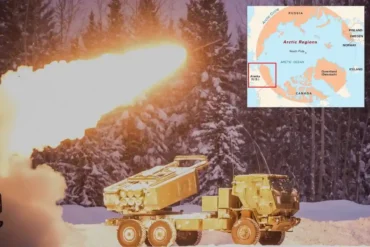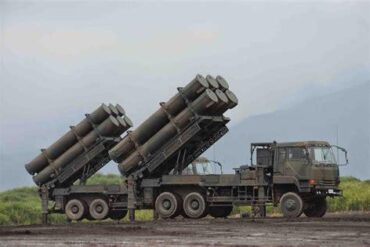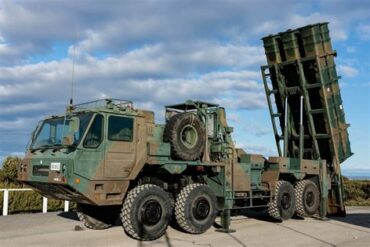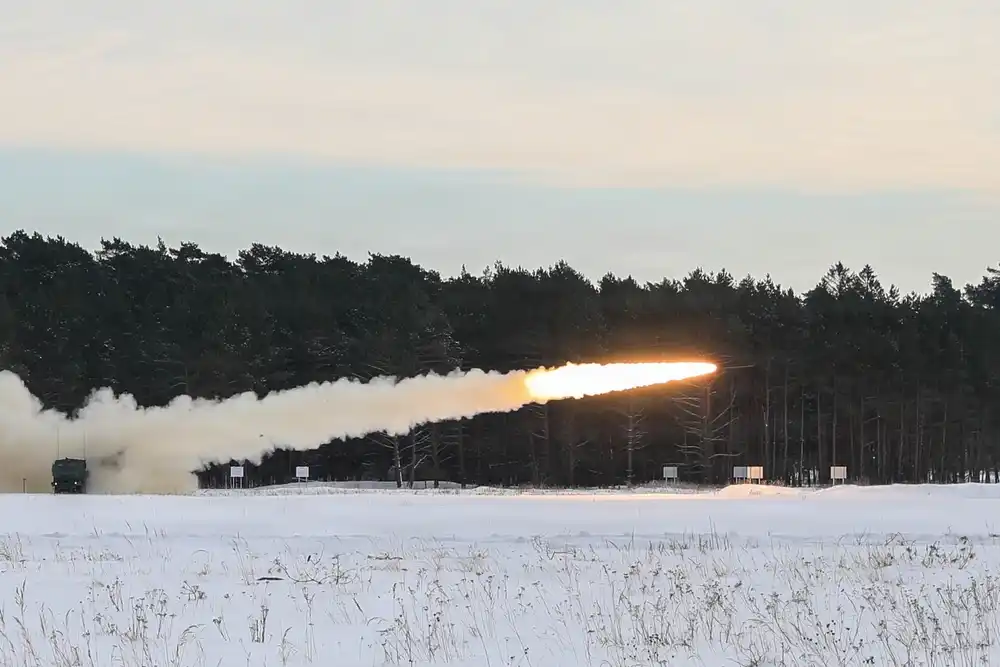
A sharp winter wind swept in from the Baltic Sea as U.S. Army M142 HIMARS rocket launchers rolled into firing positions near Klaipėda, Lithuania, on 3 February 2026, marking a visible and deliberate reinforcement of NATO’s eastern flank. The live-fire exercise, conducted jointly with the Lithuanian Armed Forces, was not simply another scheduled drill. It was a calibrated demonstration of long-range precision firepower, alliance interoperability, and strategic restraint, executed at a moment when security calculations along NATO’s northeastern frontier remain tightly balanced.
The exercise unfolded against a backdrop of heightened regional sensitivity. Lithuania sits at the crossroads of NATO’s eastern defenses, bordered by the Russian exclave of Kaliningrad to the southwest and Belarus to the east. In this context, every movement of major weapons systems carries strategic meaning. By deploying HIMARS to Lithuania and conducting live launches into a maritime impact area, Washington signaled both commitment and control: commitment to collective defense, and control over escalation dynamics.
For Lithuanian forces, the event carried additional weight. The country is in the final stages of preparing to field its own HIMARS capability, following a landmark procurement agreement with the United States. The Klaipėda exercise offered Lithuanian soldiers the opportunity to train shoulder to shoulder with experienced U.S. crews, observing the full operational cycle of a system that will soon become central to their national deterrence posture.
Strategic Geography and the Choice of Klaipėda
The decision to conduct the live-fire exercise near Klaipėda was neither accidental nor merely logistical. Lithuanian and U.S. planners deliberately ruled out inland training areas closer to Vilnius, citing proximity to the Belarusian border—roughly 15 kilometers in some sectors—as an unacceptable risk for live rocket launches. In an environment saturated with surveillance, misinformation, and rapid escalation pathways, even a routine artillery drill could be mischaracterized or exploited politically.
Klaipėda, by contrast, offered a clean maritime safety corridor. Rockets could be fired safely into the Baltic Sea, with declared danger areas and controlled shipping lanes ensuring both civilian safety and diplomatic clarity. This coastal geometry allowed NATO forces to demonstrate real combat capability without introducing ambiguity or unnecessary friction. Lithuania has used similar maritime firing corridors in the past, but the presence of HIMARS elevated the signaling effect significantly.
The coastal setting also underscored a broader strategic reality. The Baltic Sea is not a peripheral space; it is an operational domain where land-based fires, naval maneuver, and air defense intersect. By firing precision rockets seaward, the exercise quietly highlighted how land forces can influence maritime battlespace, reinforcing NATO’s layered deterrence concept in the region.
HIMARS as a Tool of Modern Deterrence
The M142 High Mobility Artillery Rocket System occupies a unique position in modern warfare. Mounted on a 6×6 Family of Medium Tactical Vehicles (FMTV) chassis, HIMARS compresses long-range strike capability into a platform that is fast, mobile, and logistically efficient. Its wheeled configuration allows rapid movement on paved roads and reasonable cross-country performance, making it well suited to the dense infrastructure and mixed terrain of Northern and Eastern Europe.
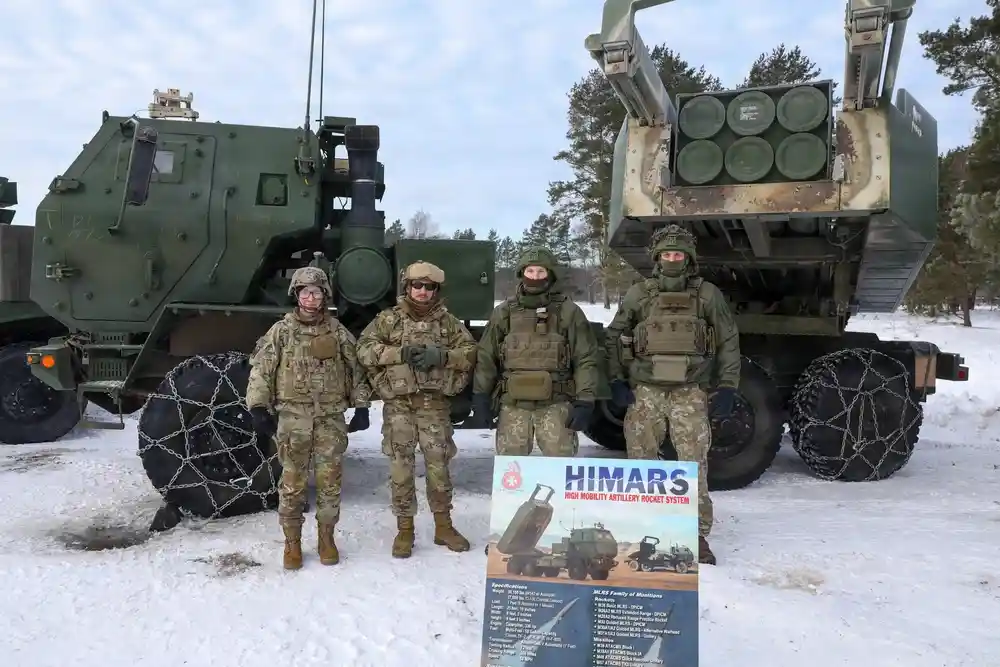
A typical HIMARS crew consists of three soldiers, operating from a protected cab that can be fitted with additional armor depending on threat conditions. The system is designed for expeditionary use, capable of being transported by C-130 aircraft and driven directly into firing positions upon arrival. This ability to deploy quickly and operate with minimal support is a core reason why HIMARS has become a preferred tool for rapid reinforcement missions.
What truly defines HIMARS, however, is its shoot-and-scoot philosophy. The launcher can receive a digital fire mission, align, fire, and displace within minutes. In regions where counterbattery radar coverage is dense and response times are short, survivability depends on this tempo. A HIMARS launcher is not meant to linger; it is meant to appear, strike precisely, and vanish before an adversary can react.
Digital Fires and the Sensor-to-Shooter Chain
HIMARS is as much a networked system as it is a weapon. Its onboard fire control system integrates GPS-aided inertial navigation, ballistic computation, and automated safety checks, allowing crews to process complex missions rapidly and with reduced risk of human error. This digital backbone enables HIMARS to plug seamlessly into broader command-and-control architectures.
In operational terms, HIMARS rarely acts alone. It functions as the shooter within a sensor-to-shooter chain, receiving target data from a variety of sources. These can include forward observers, counterbattery radars, unmanned aerial systems, and joint or allied intelligence feeds. The speed at which data flows through this chain is decisive. The faster the loop closes, the more valuable HIMARS becomes against time-sensitive targets such as mobile command posts, air defense radars, or logistics convoys.
During the Klaipėda exercise, Lithuanian and U.S. crews rehearsed not just the physical act of firing, but the digital processes that precede it. Mission planning, clearance procedures, and post-launch displacement were executed as they would be in combat, reinforcing habits that will be critical once Lithuania fields its own launchers.
The Modular Launcher and Rapid Reload Concept
At the heart of HIMARS lies its modular Launch Pod Container (LPC) concept. Rather than loading individual rockets at the firing point, the system uses sealed pods that are preloaded at ammunition supply points. Each pod can carry six 227 mm rockets or a single large missile such as ATACMS or the emerging Precision Strike Missile.
This approach dramatically simplifies logistics under fire. Reloading involves swapping an entire pod using the launcher’s organic hydraulic system, a process that can be completed in minutes by a trained crew. The predictability and speed of this reload cycle allow commanders to plan sustained fires without exposing personnel to prolonged vulnerability at the gun line.
From a deterrence perspective, the modular design also complicates enemy targeting. An adversary is not tracking individual rounds or reload vehicles; they are attempting to locate a highly mobile launcher that can fire, reload, and relocate repeatedly across a wide area. In the Baltic context, where distances are short but infrastructure is dense, this mobility is a strategic advantage.
Precision Munitions and Expanding Reach
The true power of HIMARS lies in its munitions family, which gives a single launcher the ability to influence battles at multiple depths. At the tactical-operational level, the Guided Multiple Launch Rocket System (GMLRS) provides precision effects out to 70 kilometers, with extended-range variants pushing that envelope to 150 kilometers.
The M31A2 GMLRS Unitary round delivers a single high-explosive warhead with exceptional accuracy, making it ideal for hardened point targets where collateral damage must be minimized. The M30A2 GMLRS Alternative Warhead trades the unitary blast for a controlled fragmentation effect, optimized for engaging dispersed troops, light vehicles, and air defense elements without relying on legacy submunitions.
For deeper strikes, HIMARS can fire the Army Tactical Missile System (ATACMS), a semi-ballistic missile with a range of up to 300 kilometers and a heavy unitary warhead. ATACMS transforms HIMARS from an artillery system into a deep-strike asset capable of threatening bridges, ammunition depots, headquarters, and critical infrastructure far beyond the forward line.
The next evolutionary step is the Precision Strike Missile (PrSM), designed to exceed 400 kilometers in range while offering improved survivability against modern air and missile defenses. As PrSM enters service, the strategic calculus for any potential adversary in the region will shift. Rear areas that once felt secure will fall within the reach of mobile launchers operating from allied territory.
Lithuania’s HIMARS Acquisition and Force Transformation
Lithuania’s decision to acquire HIMARS represents one of the most significant upgrades to its land forces since joining NATO. Through the U.S. Foreign Military Sales process, Vilnius is purchasing eight HIMARS launchers in a package valued at approximately $495 million, approved in late 2022. The deal includes not only launchers, but a comprehensive suite of munitions, command-and-control systems, training, and long-term sustainment support.
Lithuanian defense officials have emphasized that the acquisition is not about symbolism, but about credible deterrence. Long-range precision fires allow a small country to impose disproportionate costs on a potential aggressor, complicating planning and raising the threshold for conflict. By integrating HIMARS into NATO’s fire control networks, Lithuania ensures that its launchers will operate as part of a collective system rather than in isolation.
The first Lithuanian HIMARS units are expected to arrive in 2025, with training pipelines already underway. Lithuanian soldiers are embedded with U.S. units to gain hands-on experience, while infrastructure and maintenance capabilities are being developed at home. The Klaipėda exercise served as both a rehearsal and a preview of this future force.
The Role of the 41st Field Artillery Brigade
Central to U.S. Army long-range fires in Europe is the 41st Field Artillery Brigade, the only dedicated U.S. Army fires brigade aligned permanently with the European theater. Based in Germany, the brigade plans and executes precision strike missions while integrating joint and multinational partners.
Within the framework of Operation Atlantic Resolve, the 41st Field Artillery Brigade plays a dual role. Operationally, it provides immediate long-range firepower to reinforce NATO’s eastern defenses. Institutionally, it acts as a hub for allied training, standard-setting, and interoperability. Exercises like the one near Klaipėda are a natural extension of this mission, blending deterrence with capacity building.
By training alongside Lithuanian forces, the brigade helps ensure that future multinational fire missions will be seamless. Shared procedures, common digital interfaces, and mutual trust are as important as hardware when seconds matter and margins for error are thin.
Deterrence Without Provocation
One of the most striking aspects of the Klaipėda deployment was its careful balance between strength and restraint. By avoiding inland firing ranges near sensitive borders, NATO forces demonstrated an acute awareness of escalation dynamics. The message was clear: capability is present, readiness is real, and intent is defensive.
This approach aligns with NATO’s broader strategy on its eastern flank. Deterrence is achieved not through constant provocation, but through predictable, transparent demonstrations of combat-ready forces. Live-fire exercises, when conducted responsibly, reduce the risk of miscalculation by removing doubt about capability while avoiding unnecessary surprises.
The maritime firing profile also reinforced NATO’s integrated view of security in the Baltic region. Land-based precision fires, naval presence, and air defense form a mutually reinforcing triad. HIMARS, though a land system, fits squarely into this architecture.
A Signal That Resonates Beyond Lithuania
The deployment of HIMARS to Lithuania resonates far beyond the Baltic coast. For NATO allies, it is reassurance that Article 5 commitments are backed by tangible capability. For potential adversaries, it is a reminder that the Alliance can deploy advanced systems quickly, integrate them seamlessly, and employ them responsibly.
For Lithuania itself, the exercise marked another step in a deliberate transformation from a consumer of security to a provider of deterrence. As its own HIMARS units come online, the country will possess a tool that amplifies its voice within NATO planning circles and strengthens its national defense in a very real, measurable way.
In the cold air over the Baltic Sea, three rockets arced outward and disappeared into controlled impact zones. The launches were brief, precise, and disciplined. Their significance, however, will linger far longer, shaping calculations and confidence along NATO’s eastern flank for years to come.