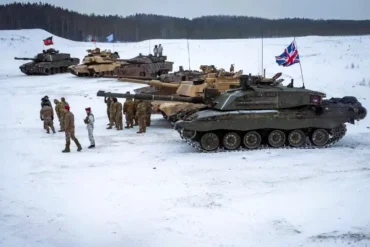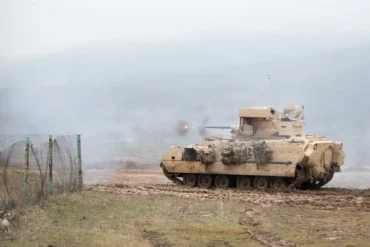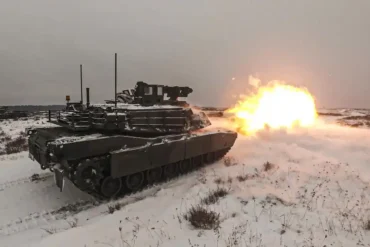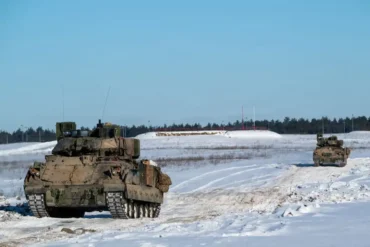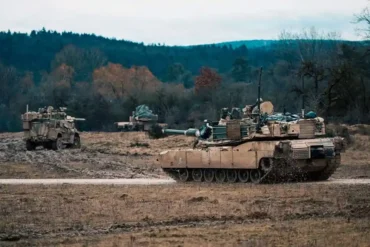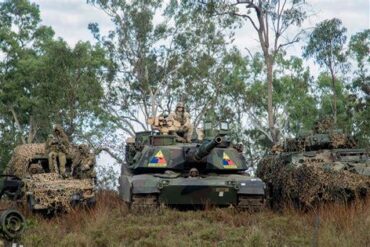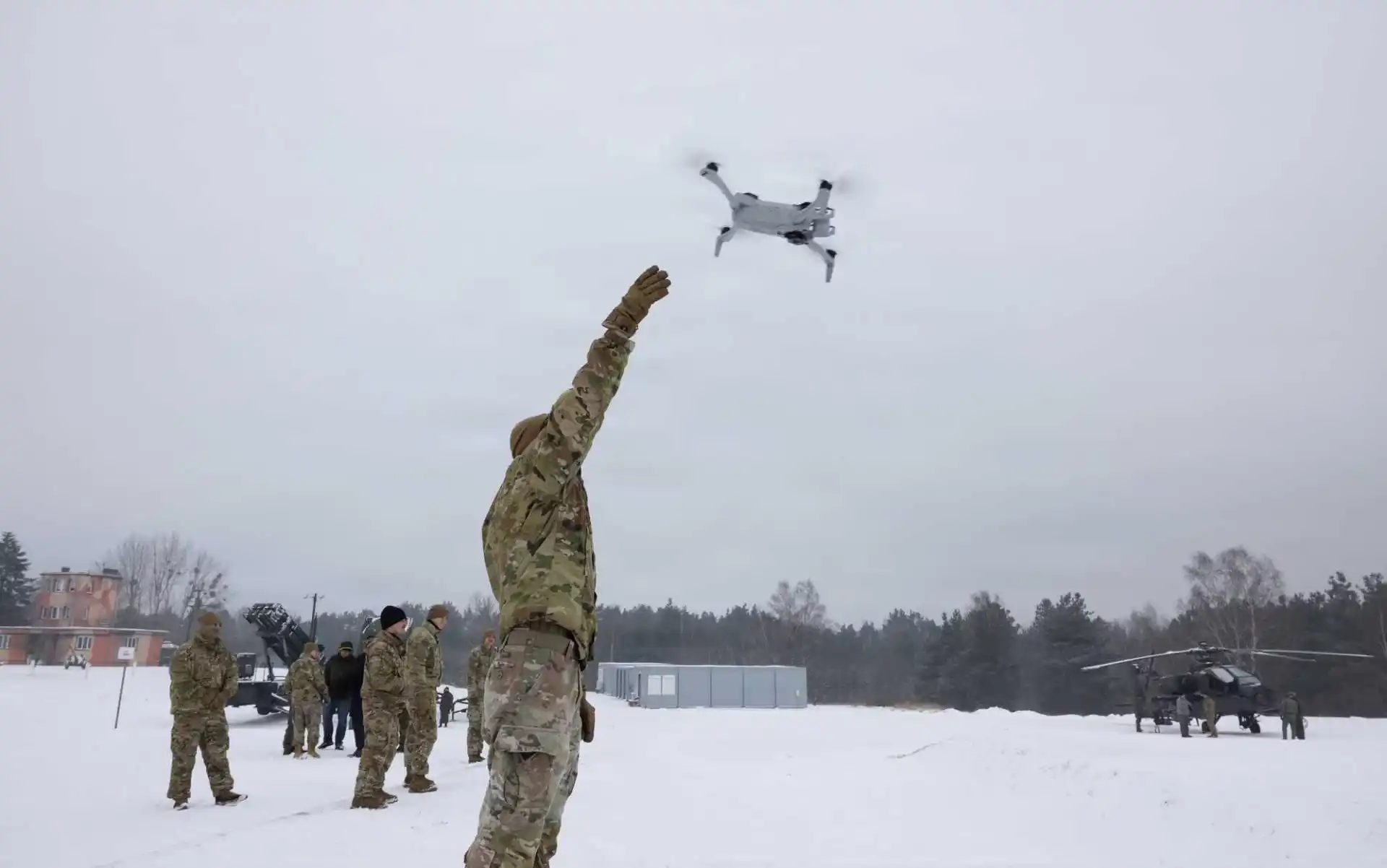
The U.S. Army’s latest armored exercise in Poland offered a sharp, unambiguous signal about how NATO expects to fight and win future high-intensity conflicts. During Operation Winter Falcon 26, American M1A2 Abrams tanks conducted live-fire maneuvers while operating in continuous coordination with aerial drones, transforming what was once a purely armored engagement into a layered, digitally informed battle sequence designed for speed, precision, and survivability.
Held at the Drawsko Pomorskie training complex, one of Europe’s most demanding live-fire ranges, the drill unfolded as a tightly synchronized demonstration rather than an experiment. Unmanned aerial systems were launched directly from maneuver elements, feeding real-time intelligence to tank crews as they advanced, halted, and engaged targets. The result was a battlefield rhythm where observation, decision, and firepower merged into a single operational loop.
For NATO planners, the setting mattered as much as the technology. Poland sits on the alliance’s eastern flank, a region shaped by the lessons of Ukraine’s ongoing war and the accelerating pace of drone-centric combat. Winter Falcon 26 reflected a deliberate shift away from static deterrence toward mobile, networked formations able to sense threats early and respond decisively under pressure.
The integration of drones with Abrams tanks was not a futuristic concept on display. It was a practical response to the reality that modern battlefields are saturated with sensors, loitering munitions, and electronic warfare effects that punish slow or isolated units.
Drone-Driven Targeting Reshapes Armored Engagements
The most striking feature of the exercise was how seamlessly unmanned aerial systems were woven into tank operations. Small tactical drones launched by cavalry and armored units provided overhead surveillance, terrain mapping, and enemy position confirmation before any round was fired. This intelligence allowed Abrams crews to refine firing solutions, choose optimal hull-down positions, and avoid exposure to simulated anti-tank threats.
Rather than relying solely on line-of-sight optics, crews received a layered picture of the battlefield that extended beyond ridgelines and forested cover. The effect was a measurable increase in engagement speed and accuracy, compressing the time between detection and destruction.
U.S. Army officers overseeing the drill emphasized that this approach reflects hard lessons learned from recent conflicts where armored units lacking drone support suffered disproportionate losses. By contrast, drone-enabled formations gain early warning and tactical flexibility, turning potential ambush zones into manageable risks.
Poland’s Abrams Milestone Signals Strategic Transformation
Operation Winter Falcon 26 also marked a symbolic moment for Poland’s armed forces. For the first time, Polish M1A2 SEPv3 Abrams tanks fired live rounds alongside their U.S. counterparts, underscoring Warsaw’s rapid transition away from legacy Soviet-era platforms. Poland’s decision to acquire more than 250 Abrams tanks has reshaped its armored doctrine, anchoring it firmly within U.S.-led NATO standards.
Polish crews trained shoulder to shoulder with American units, sharing digital feeds, fire coordination procedures, and counter-drone tactics. This level of interoperability is no longer aspirational. It is operationally necessary for any credible defense of the region.
Defense analysts observing the drill noted that Poland is emerging as a frontline innovator rather than a passive host for allied forces. The integration of Abrams tanks, drones, and networked fires demonstrates a national commitment to deterrence built on capability, not symbolism.
Counter-Drone Measures Protect the Armored Spearhead
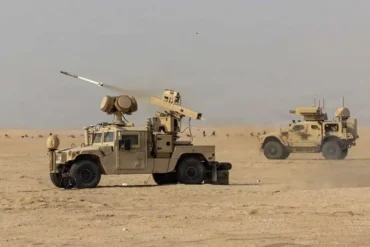
As drones become indispensable, they also become targets. Winter Falcon 26 devoted significant attention to counter-UAS operations, reflecting the reality that adversaries will attempt to blind or disrupt drone-dependent forces. Both U.S. and Polish units deployed electronic jamming systems, radar-based detection assets, and kinetic interceptors designed to neutralize hostile aerial threats.
These defenses operated in close proximity to armored formations, creating a protective bubble that allowed friendly drones to function while denying airspace to simulated enemy systems. The exercise demonstrated how electronic warfare and armored maneuver are increasingly inseparable disciplines on the modern battlefield.
Commanders described this layered protection as essential for maintaining momentum during offensive operations, where a single exposed moment can invite precision strikes from above.
Multi-Domain Firepower Amplifies Battlefield Control
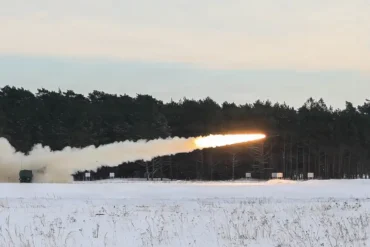
Beyond tanks and drones, Winter Falcon 26 showcased a broader ecosystem of firepower. Polish M142 HIMARS rocket launchers and AH-64 Apache attack helicopters participated in coordinated strike sequences, illustrating how armored units fit into a wider web of joint and combined arms.
Drones played a critical role here as well, cueing long-range fires and providing post-strike assessment. This ability to connect sensors and shooters across domains compresses decision cycles and overwhelms adversary defenses through speed rather than sheer volume.
The exercise reinforced NATO’s evolving doctrine, which prioritizes connectivity and resilience as much as raw lethality. Every platform becomes both a contributor and a consumer of battlefield data.
Abrams SEPv3 as a Digital Warfare Platform
The M1A2 SEPv3 variant proved central to this integration. Its upgraded communications architecture, improved power management, and enhanced survivability features allow it to operate as a digital node rather than a standalone weapon. Sensor data flows into the tank, decisions flow out, and supporting systems respond in near real time.
This transformation redefines the Abrams not just as a main battle tank, but as a command-enabled combat system capable of thriving in contested environments. Military observers noted that this adaptability gives NATO a qualitative edge against peer adversaries investing heavily in drone swarms and electronic attack.
NATO’s Eastern Flank Prepares for the Future Fight
With additional multinational exercises planned across Poland and the broader region in 2026, Winter Falcon 26 stands as a preview of NATO’s future posture. The alliance is aligning its forces around speed, shared awareness, and technological resilience, recognizing that deterrence now depends on the ability to fight effectively from the first moment of contact.
The image of Abrams tanks advancing under the watchful guidance of drones is more than a snapshot of modern warfare. It is a declaration that NATO’s armored forces are evolving, learning, and preparing for a battlefield where information is as decisive as armor and firepower.