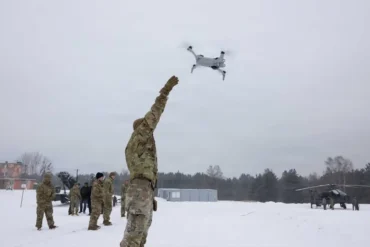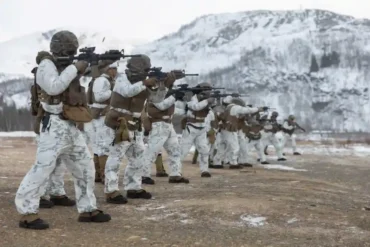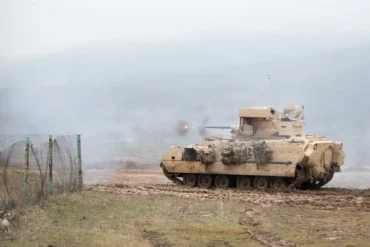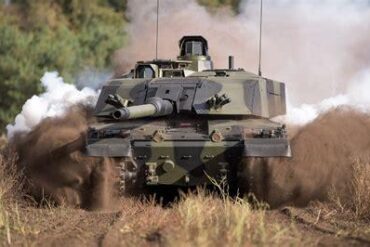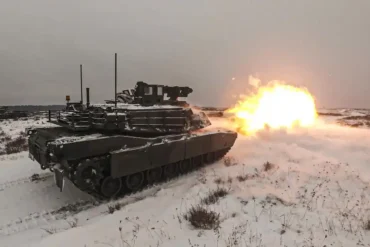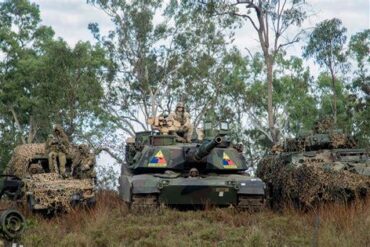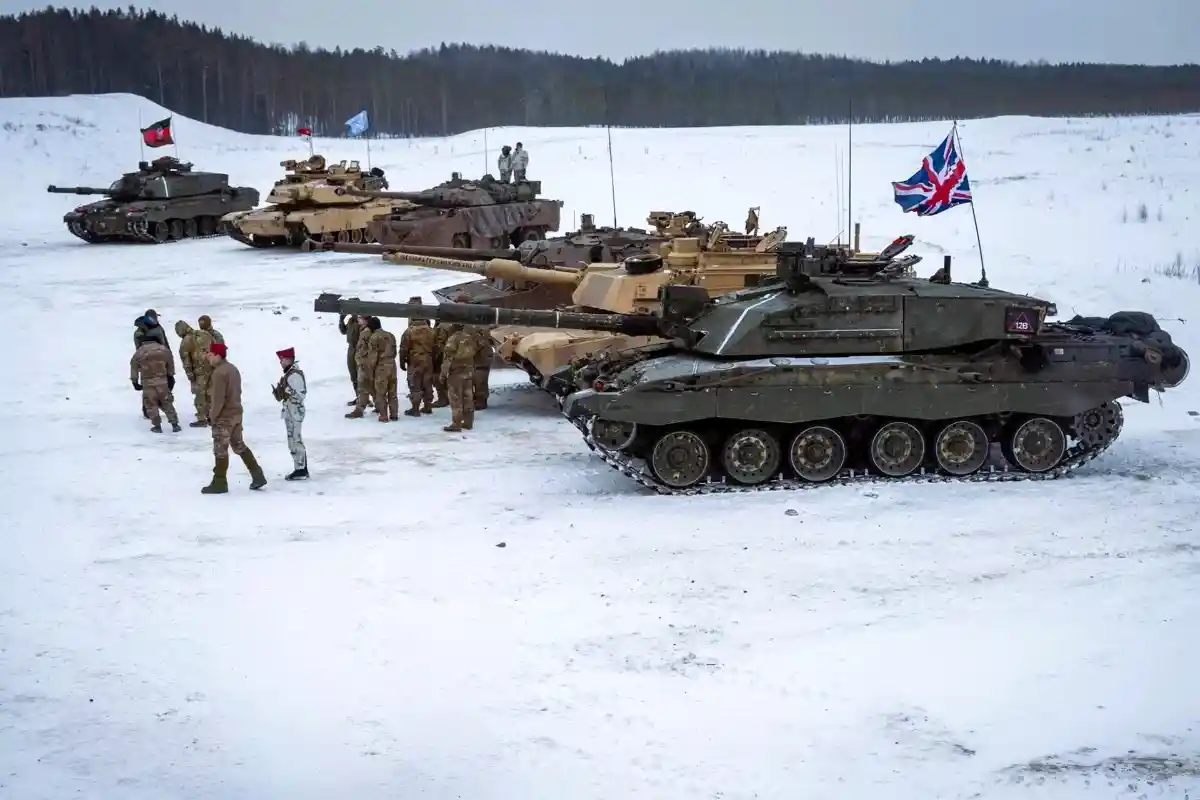
NATO’s eastern flank witnessed a concentrated display of allied armored strength as U.S. M1 Abrams, UK Challenger 2, and French AMX-10 RC vehicles maneuvered and fired together during a combined arms live-fire exercise (CALFEX) in Estonia on February 28, 2026. The multinational drill, confirmed through imagery released by the French Armed Forces’ official operations account, represented more than routine training. It marked a deliberate and visible demonstration of armored interoperability, combat readiness, and collective deterrence at one of the alliance’s most strategically sensitive frontiers.
The exercise unfolded against the geopolitical backdrop of Estonia’s proximity to Russia, where terrain, climate, and compressed reaction timelines demand seamless coordination among allied forces. The CALFEX phase served as the culmination of progressive integration training, requiring crews, commanders, and support units from three NATO nations to operate within a single tactical framework under live-fire conditions. The sight of American, British, and French armored vehicles advancing in formation was not symbolic pageantry—it was operational validation.
By integrating heavy tracked main battle tanks with fast wheeled reconnaissance platforms, NATO demonstrated a layered and flexible combat architecture designed to respond to high-intensity threats. The exercise coincided with International Tank Day, adding commemorative resonance, yet its operational significance far outweighed ceremonial undertones.
NATO CALFEX in Estonia: Validating the Full Combat Kill Chain
A Combined Arms Live-Fire Exercise (CALFEX) is among the most demanding training events conducted within NATO’s land forces structure. It is not a simple gunnery practice. Instead, it is engineered to validate the entire operational kill chain—from reconnaissance and target acquisition to engagement, battle damage assessment, and re-engagement if necessary.
In Estonia’s winter environment, multinational contingents were required to synchronize:
- Target detection and identification under shared rules of engagement
- Real-time command-and-control coordination
- Fire support integration
- Engineer mobility and obstacle breaching
- Medical evacuation procedures
- Sustainment and battlefield recovery operations
The significance lies in compression of time. Modern armored warfare punishes hesitation. A delay in confirming grid coordinates, a mismatch in radio procedure, or an incompatible reporting format can fracture momentum at precisely the wrong moment. CALFEX is designed to expose and eliminate those fractures.
Operating in freezing temperatures further stress-tested maintenance cycles, fuel logistics, recovery capability, and crew endurance. Cold-weather operations are unforgiving; engines, hydraulics, optics, and electronics must function flawlessly under strain. Estonia’s terrain and climate transform theoretical interoperability into measurable performance.
U.S. M1 Abrams: Shock Action and Decisive Counterattack Capability
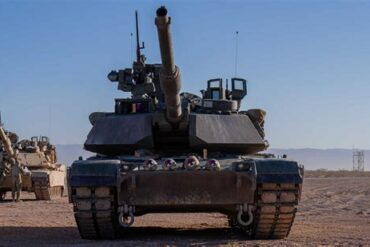
The M1 Abrams remains the U.S. Army’s primary instrument of armored dominance. Armed with a 120 mm smoothbore cannon, integrated advanced fire-control systems, and reinforced composite armor protection, the Abrams is engineered for rapid concentration of combat power.
In the Baltic context, its role is twofold. First, it anchors defensive lines with overwhelming direct-fire capability. Second, it serves as a rapid counterattack force capable of sealing breaches or exploiting enemy vulnerabilities. Its powerful turbine engine provides acceleration and maneuverability that allow repositioning across constrained operational corridors—critical in the narrow strategic depth of the Baltic region.
Within the CALFEX framework, Abrams crews executed coordinated fire missions while integrating with British and French counterparts. The exercise reinforced hunter-killer targeting techniques, ammunition handling discipline, and rapid engagement drills—all essential in high-intensity mechanized warfare.
UK Challenger 2: Sustained Firepower and Defensive Resilience
The Challenger 2, Britain’s main battle tank, contributed complementary strengths centered on protection, precision, and sustained engagement capacity. Equipped with a rifled 120 mm main gun and robust armor architecture, the Challenger 2 excels in holding key terrain and maintaining direct-fire superiority in defensive engagements.
In Estonia, British crews trained in close alignment with Abrams units, demonstrating that differences in equipment do not preclude operational unity. Harmonized fire commands, shared tactical graphics, and synchronized maneuver drills ensured that U.S. and UK tanks could exchange target data and reposition under a unified command structure.
This interoperability extends beyond gunnery. It encompasses casualty evacuation procedures, fault recovery protocols, and logistical integration. True combat effectiveness emerges when allied formations can absorb friction without losing tempo.
French AMX-10 RC: Mobility, Reconnaissance, and Tactical Agility
France’s AMX-10 RC introduces mobility and reconnaissance depth into the armored formation. Although not classified as a main battle tank, its 105 mm gun and wheeled configuration provide speed and operational flexibility suited for reconnaissance-in-force and rapid flanking maneuvers.
During the exercise, AMX-10 RC vehicles extended the formation’s sensor reach. By probing routes, identifying obstacles, and exposing simulated enemy positions, French crews effectively tightened the sensor-to-shooter loop—the critical interval between detection and engagement.
This pairing of heavy tracked armor with agile wheeled reconnaissance units reflects modern doctrinal evolution. Heavy tanks deliver decisive firepower; wheeled reconnaissance platforms expand situational awareness and reduce uncertainty. Together, they create a more adaptive and information-driven force.
Interoperability Beyond Symbolism
The most significant message from the Estonian CALFEX was not the individual capability of each platform but the collective synchronization achieved under live-fire conditions. Interoperability is often invoked rhetorically in alliance discussions. In Estonia, it was measured in radio transmissions, maneuver timings, fire control alignment, and adherence to NATO-standard procedures.
Executing a joint live gunnery phase within a unified tactical scheme proves that:
- Communication systems are compatible
- Engagement protocols are harmonized
- Sustainment chains can function across national boundaries
- Tactical decision-making can flow seamlessly through multinational command structures
These elements convert alliance presence into operational credibility. An adversary observing the eastern flank does not merely see separate national units stationed in proximity; it sees a cohesive formation capable of acting as one.
Estonia’s Strategic Significance on NATO’s Eastern Flank
Estonia’s geography amplifies the relevance of such exercises. Bordering Russia and positioned within the Baltic security architecture, the country occupies a frontline role in NATO’s deterrence strategy. Rapid reinforcement and integrated defense are essential pillars of regional stability.
Forward-deployed armored units reduce ambiguity. Their readiness signals that escalation would immediately involve multiple NATO members, raising the threshold for coercion. Live-fire exercises translate political commitment into tangible capability.
The winter CALFEX thus functioned simultaneously as readiness validation and strategic communication. It conveyed a disciplined message: the alliance’s eastern flank is protected by forces trained to operate together under pressure.
Collective Deterrence Through Integrated Armored Power
The integration of U.S. Abrams, UK Challenger 2, and French AMX-10 RC vehicles in Estonia underscores a broader transformation in NATO’s land warfare posture. Modern deterrence relies not solely on the presence of advanced equipment but on the demonstrated ability to combine that equipment into a unified combat system.
Live-fire validation ensures that multinational formations can detect, decide, and engage in alignment with shared doctrine. It exposes friction before crisis conditions arise and refines standard operating procedures under realistic constraints.
As global security dynamics remain fluid, the Baltic region continues to occupy strategic prominence. Exercises of this scale and intensity reinforce confidence among allies while communicating resolve externally. By proving that armored formations from three leading NATO nations can maneuver and fight within a single operational framework, the alliance strengthens both its defensive depth and its deterrent clarity.
In Estonia’s winter training grounds, heavy steel, advanced optics, and disciplined crews converged into a cohesive armored force. The message projected beyond the firing ranges was precise: NATO’s eastern defenses are integrated, practiced, and prepared to act with speed and unity should circumstances demand it.