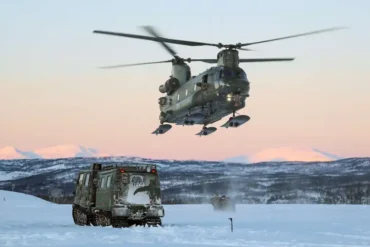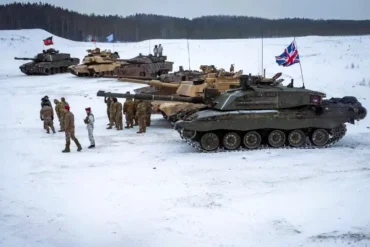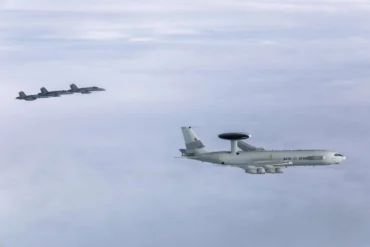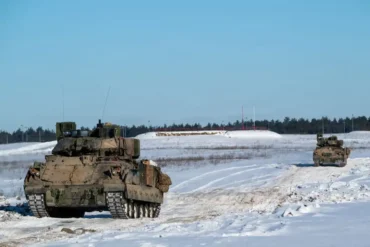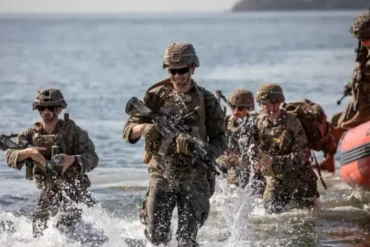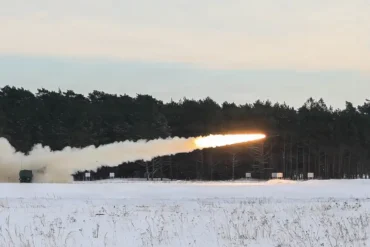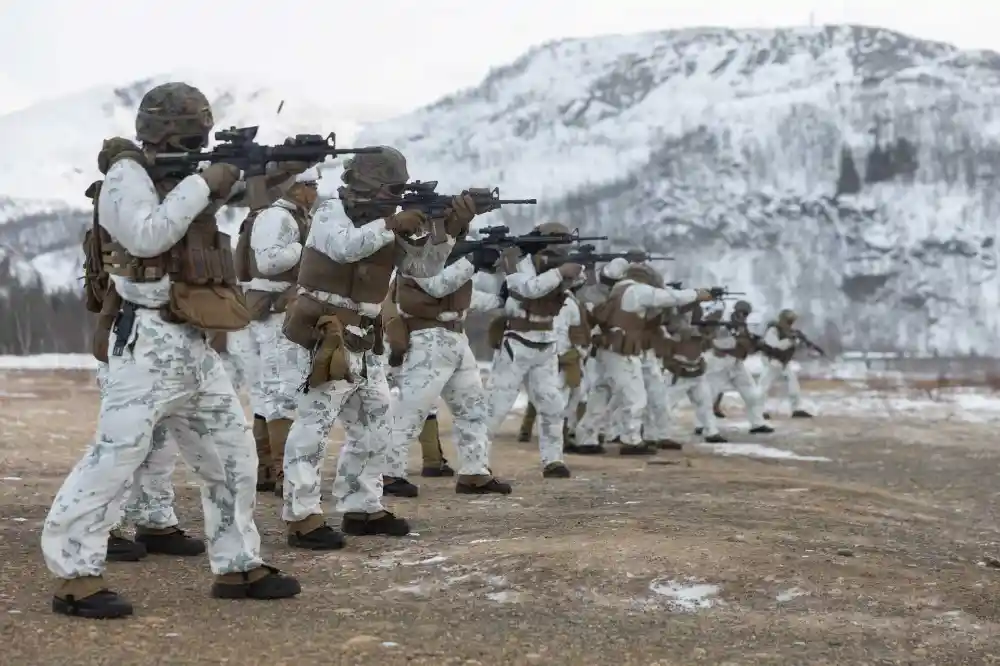
The subzero stillness of northern Norway has a way of stripping warfare down to its essentials. Breath crystallizes in the air, metal bites exposed skin, and every movement costs more energy than it should. Against this unforgiving backdrop, U.S. Marines and Sailors from the 2nd Distribution Support Battalion executed live-fire rifle training at Elvegardsmoen, Norway, in preparation for Exercise Cold Response 26. The drills fused marksmanship with cold-weather mobility, sustainment, and survivability tasks, validating the Marine Corps’ ability to project and sustain combat power across NATO’s northern flank, where winter is not a season but a constant operational constraint.
Arctic Live-Fire Training Tests Combat Power Under Extreme Conditions
Live-fire training in Arctic terrain is not a ceremonial show of readiness. It is a practical audit of whether people, weapons, and logistics can function when temperatures plunge, daylight fades, and terrain punishes the smallest mistake. At Elvegardsmoen, Marines operated in snowbound firing positions, maneuvered in layered cold-weather gear, and rehearsed weapons handling procedures adapted for freezing conditions. Frozen ground changes recoil dynamics, heavy gloves dull trigger sensitivity, and brittle materials expose weaknesses in standard load-bearing equipment. The training demanded disciplined weapon maintenance routines to counter lubrication thickening, optics fogging, and battery degradation, all of which can quietly erode combat effectiveness if left untested.
The environment reshaped movement as much as it reshaped marksmanship. Snow depth altered firing stances and limited rapid repositioning. White terrain compressed concealment margins, forcing Marines to relearn how contrast, shadow, and silhouette behave in a world dominated by snow and ice. These details matter in high-latitude combat, where visibility can stretch across open valleys and wind scours away cover that would be reliable in temperate zones. The drills were built to make these constraints routine rather than surprising, converting discomfort into competence.
Logistics Units Prove Their Role as Frontline Enablers in the High North
The participating unit, 2nd Distribution Support Battalion under Combat Logistics Regiment 27, 2nd Marine Logistics Group, represents the connective tissue of combat power. Logistics formations rarely headline Arctic exercises, yet they determine whether any forward force can endure. At Elvegardsmoen, sustainment Marines validated that their mission does not pause in extreme cold. Ammunition handling in freezing temperatures risks cracked casings and sluggish feed mechanisms. Fuel thickens, hoses stiffen, and vehicle seals lose elasticity. Maintenance cycles lengthen as tools slip in gloved hands and exposed components fracture under thermal stress.
By integrating cold-weather logistics with live-fire drills, the battalion tested the full loop of combat sustainment under Arctic pressure. Marines practiced defending supply elements while maintaining throughput of ammunition, rations, and maintenance support. This dual-role reality reflects modern expeditionary warfare, where logistics nodes are no longer rear-area sanctuaries but contested spaces requiring organic protection and rapid displacement. The training reinforced a simple truth: endurance is a tactical skill, and logistics units must fight to sustain the fight.
Weapons, Physiology, and the Physics of Cold-Weather Combat
Cold is an enemy that targets both machines and metabolism. Standard service rifles such as the M4 carbine and the M27 Infantry Automatic Rifle demand altered lubrication regimes to prevent sluggish cycling in subzero temperatures. Optics fog as warm breath condenses on cold glass. Battery-powered accessories bleed charge faster as chemical reactions slow. Marines adapted by refining maintenance rhythms, sheltering critical components from exposure, and rehearsing malfunction drills with numb fingers.
Physiology adds another layer of friction. Caloric burn spikes as the body fights heat loss. Dehydration becomes stealthy when thirst signals dull in cold air. Fine motor control degrades in insulated gloves, stretching reaction times and complicating reloads. The Elvegardsmoen training placed Marines in conditions where these frictions were unavoidable, forcing practical adaptations in stance, grip, and movement. Repetition under stress rewires habits, ensuring that cold-weather friction becomes an expected variable rather than a mission-stopping surprise.
Cold Response 26 and NATO’s Arctic Sentry Framework
Exercise Cold Response 26, led by Norway within NATO’s Arctic Sentry vigilance activity, is designed to rehearse collective defense across the High North. The exercise environment reflects a strategic reality that is no longer theoretical. Northern approaches to Europe sit near critical sea lines of communication and in proximity to Russia’s Northern Fleet bases on the Kola Peninsula. Increased military activity, emerging Arctic maritime routes, and competition over access and surveillance corridors have turned cold-weather competence into a strategic currency.
U.S. Marine participation signals a commitment to rapid reinforcement of NATO’s northern allies. The training at Elvegardsmoen sharpened the Marine Corps’ ability to integrate with Norwegian, British, and allied forces under shared cold-weather doctrine. Interoperability in the Arctic is not just about radios and command structures. It hinges on compatible sustainment practices, standardized cold-weather equipment interfaces, and a mutual understanding of how terrain and climate warp tactics. Repeated deployments to Norway deepen familiarity with prepositioned equipment stocks, reducing strategic lift demands and compressing response timelines in a crisis.
Force Design 2030 and the Logic of Distributed Arctic Operations
The Marine Corps’ Force Design 2030 modernization agenda emphasizes distributed operations, resilient sustainment, and the ability to persist in contested environments. Arctic training makes these ideas tangible. Distributed operations in the High North require logistics units that can establish and defend supply nodes across austere terrain with minimal infrastructure. Communications must survive freezing temperatures and limited daylight. Power generation systems must function when cold saps efficiency and maintenance windows shrink.
Live-fire readiness within a logistics battalion supports this design logic by ensuring that sustainment elements can defend themselves while maintaining operational tempo. The Arctic magnifies every dependency in a supply chain. Roads disappear under snowdrifts, airfields close in storms, and sea access narrows as ice conditions shift. Units trained to operate with redundancy, improvisation, and cold-weather discipline are better positioned to absorb disruption without losing momentum. The Elvegardsmoen drills validated these principles at the tactical level, where small efficiencies compound into operational endurance.
Deterrence by Denial in the World’s Coldest Theater
Arctic readiness carries a strategic message that is quieter than rhetoric and louder than press statements. Deterrence by denial depends on convincing potential adversaries that aggression would fail to achieve its objectives. In the High North, denial rests on the ability to deploy, fight, and sustain forces in terrain that punishes unpreparedness. Live-fire training in Norway signals that U.S. Marines are not visitors to the Arctic but students of its rules.
Elvegardsmoen offered no theatrical victory lap. It offered proof of competence earned through frozen fingers, disciplined maintenance, and logistics executed under pressure. As Cold Response 26 scales these lessons across thousands of troops, the cumulative effect is a more credible NATO posture along its northern frontier. The Arctic is not an exotic edge case in modern security planning. It is a demanding classroom, and the Marines training there are learning its lessons the hard way, where every mistake freezes into memory and every success builds the quiet confidence that sustains deterrence.