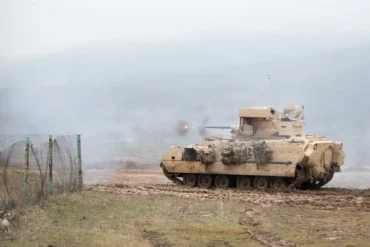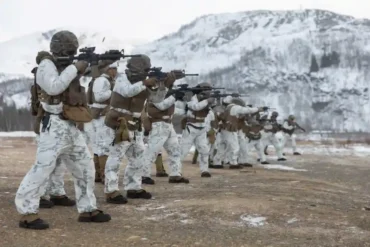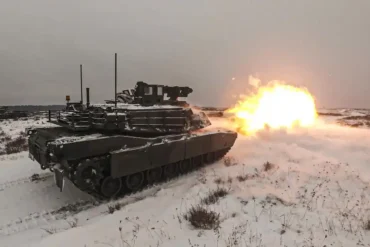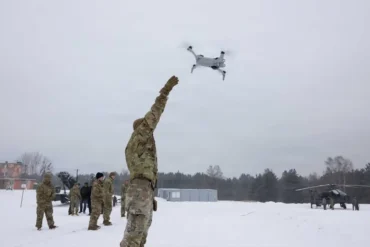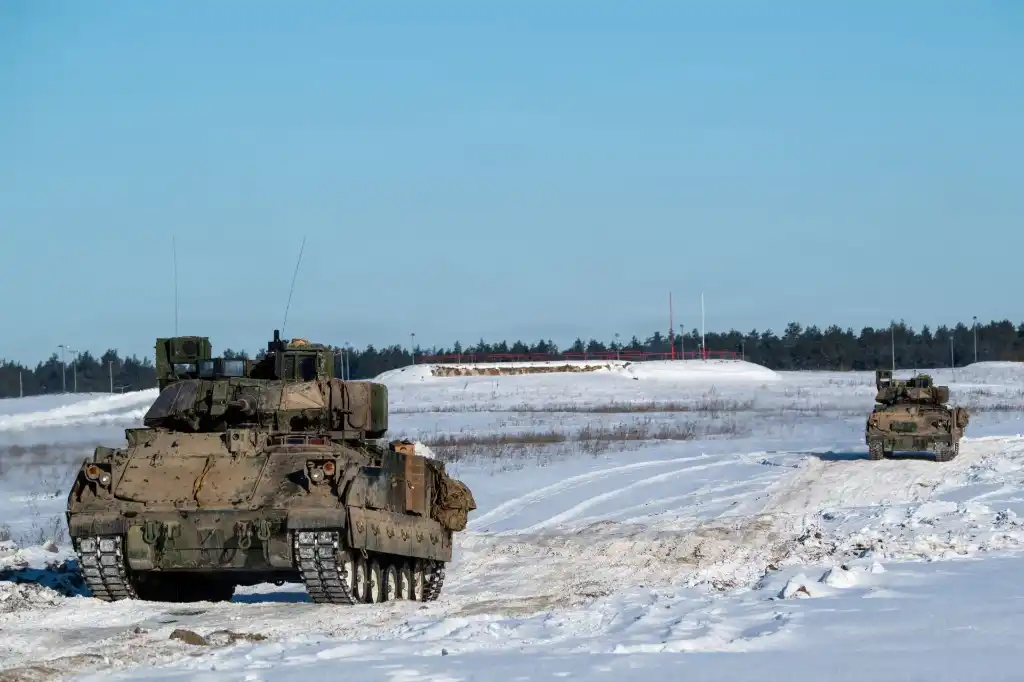
The U.S. Army has conducted a high-intensity live-fire winter exercise featuring M2A3 Bradley Fighting Vehicles in Poland, underscoring the service’s commitment to sustained combat readiness in Europe and reinforcing NATO’s deterrence posture along its eastern flank. The exercise, carried out by Soldiers from the 3rd Battalion, 8th Cavalry Regiment, unfolded under sub-zero conditions at the Bemowo Piskie Training Area, a location increasingly central to allied armored training in northeastern Europe.
Held on January 31, 2026, the operation placed Bradley crews in realistic winter combat conditions, maneuvering through snow-covered mounted maneuver lanes while engaging targets with live ammunition. The emphasis was on disciplined formation movement, precise command and control, and the integration of fires while maintaining tempo in an environment that punishes hesitation and magnifies small errors. Cold weather, reduced traction, and degraded visibility transformed standard gunnery into a complex combined-arms rehearsal, mirroring the challenges likely to be faced in a real-world contingency.
These drills serve a dual purpose. At the tactical level, they validate the ability of mechanized infantry units to fight effectively in extreme cold. At the strategic level, they deliver a visible signal of U.S. and NATO resolve, demonstrating that allied forces can generate credible armored combat power year-round on alliance territory. In a security environment shaped by persistent tension on NATO’s eastern borders, such visibility carries weight.
Winter Maneuver as a Measure of Combat Credibility
Operating armored vehicles in winter conditions is a demanding test of both machines and people. Snow and ice alter braking distances, reduce track grip, and complicate route planning, while sub-zero temperatures affect engines, hydraulics, and electronic components. Optics must contend with condensation and shifting thermal contrast, and crews face physical strain that can erode concentration over long hours. The live-fire exercise in Poland deliberately embraced these frictions rather than mitigating them, using winter as a forcing function to stress doctrine and habits.
For the 3rd Battalion, 8th Cavalry Regiment, the focus on vehicle spacing and formation discipline was not merely procedural. Modern battlefields are saturated with sensors, and clustered vehicles present lucrative targets for precision fires. Maintaining spacing while coordinating movement and fires in poor traction conditions requires rehearsed communication and trust in digital command-and-control systems. The exercise highlighted how winter training sharpens these skills, ensuring that formations can move predictably and fight cohesively even when environmental factors conspire against them.
The M2A3 Bradley’s Role in Modern Mechanized Warfare
The M2A3 Bradley Fighting Vehicle remains a cornerstone of U.S. mechanized infantry, valued for its balance of mobility, protection, and firepower. In its A3 configuration, the Bradley incorporates digital architecture upgrades that enhance situational awareness and accelerate the sensor-to-shooter loop. Crews can detect, identify, and engage targets faster, a decisive advantage when operating under time pressure and limited visibility.
The vehicle’s primary weapon, the 25mm M242 Bushmaster chain gun, uses a dual-feed system that allows rapid switching between ammunition types. This flexibility enables effective engagement of lightly armored vehicles, fortified positions, and dismounted infantry without breaking maneuver. A coaxial 7.62mm M240C machine gun provides close-in suppression, while twin BGM-71 TOW missile launchers give the Bradley a potent anti-armor capability at extended ranges. In live-fire winter conditions, this layered armament allows crews to transition between target sets smoothly, maintaining momentum despite environmental challenges.
Survivability in a Threat-Dense Environment
Protection remains a defining feature of the Bradley’s relevance. The vehicle employs spaced laminate armor, and with armor upgrades it is commonly assessed as providing all-around protection against rocket-propelled grenades and 30mm APDS threats, while significantly reducing vulnerability to artillery shell splinters, including those from 155mm-class munitions. Depending on mission requirements, the Bradley can also be fitted with additional passive armor or Explosive Reactive Armour (ERA), improving survivability against shaped-charge weapons.
In the context of live-fire maneuver lanes, these protection levels shape tactical decision-making. Commanders can accept calculated risk, allowing vehicles to occupy firing positions long enough to deliver decisive fires without exposing crews unnecessarily. Winter conditions amplify the importance of this balance, as reduced mobility can increase exposure time. The exercise in Poland validated that the Bradley’s protection suite, combined with disciplined tactics, supports sustained combat operations even when movement is constrained by terrain and weather.
Technical Performance Under Cold Stress
From a mechanical perspective, winter training places unique demands on the Bradley. The vehicle typically operates at around 29,030 kilograms, increasing to approximately 32,659 kilograms when fitted with additional armor packages. This weight affects ground pressure and handling on snow-covered terrain, making throttle control and braking discipline critical. While the Bradley’s maximum road speed reaches about 61 km/h, tactical movement in winter is governed by safety margins rather than peak performance.
Operational planning also accounts for the Bradley’s range of roughly 400 kilometers, a figure that informs fuel logistics and route selection in European theaters where distances between secure support nodes can be significant. Cold weather can increase fuel consumption and slow refuel cycles, lessons that are best learned in training rather than during crisis response.
Digital Systems and Command in Harsh Conditions
The M2A3 Bradley integrates advanced thermal day/night vision systems, enabling target acquisition in low-light and obscured conditions typical of winter operations. A laser rangefinder supports accurate fire control, while navigation is maintained through a combination of GPS and inertial navigation systems, ensuring orientation even when terrain features are masked by snow or fog.
Equally important are the vehicle’s communication and battle management systems. Vehicular intercommunication systems and integrated combat command-and-control software allow rapid dissemination of orders and shared situational awareness across formations. In winter, when verbal communication outside the vehicle is limited and physical movement is restricted, these digital links become the backbone of coordinated maneuver. The Poland exercise demonstrated that technology, when paired with disciplined crew drills, sustains tempo under environmental stress.
Bemowo Piskie as a Strategic Training Hub
The Bemowo Piskie Training Area has emerged as a critical node for rotational U.S. Army units and allied forces operating in Eastern Europe. Its expansive maneuver space and established infrastructure allow armored units to conduct complex live-fire exercises without compressing risk into short, artificial lanes. This freedom of maneuver is particularly valuable for winter training, where extended distances are needed to replicate realistic engagement timelines and logistics flows.
By hosting repeated armored exercises, Bemowo Piskie contributes to a growing body of shared experience among NATO forces. Units rotate through with different equipment and national doctrines, but the environmental challenges remain constant. The result is a gradual harmonization of tactics and expectations, strengthening interoperability across the alliance.
Strategic Signaling on NATO’s Eastern Flank
Beyond tactical proficiency, the live-fire winter exercise carries strategic implications. Training with armored vehicles on Polish territory sends a clear message that NATO treats its eastern flank as an integral part of collective defense, not a peripheral concern. Conducting such exercises in winter reinforces the point that allied forces are prepared to operate year-round, denying any assumption that harsh weather could delay or deter a response.
For regional security, this normalization of high-end training on the eastern flank shapes adversary calculations. Deterrence is built not only on declarations but on observable capability and readiness. Repeated, well-publicized exercises like this one demonstrate that NATO’s forward posture is sustained by practiced units, robust logistics, and equipment proven under realistic conditions.
Readiness Through Repetition and Realism
The winter live-fire trials of the M2A3 Bradley in Poland illustrate how readiness is cultivated through repetition and realism. Crews learn how systems degrade in cold, how long maintenance takes when metal contracts and fluids thicken, and how to sustain human performance in demanding environments. Leaders refine their understanding of tempo, logistics, and risk acceptance, lessons that cannot be fully replicated in temperate training.
As the U.S. Army continues to rotate forces through Europe, such exercises anchor deterrence in demonstrated capability. The Bradley, though a mature platform, remains a credible and adaptable tool when paired with modern digital systems and disciplined tactics. In the snow-covered lanes of Bemowo Piskie, that credibility was tested and reaffirmed, reinforcing NATO’s message that its armored forces are ready to fight and win, regardless of season or climate.