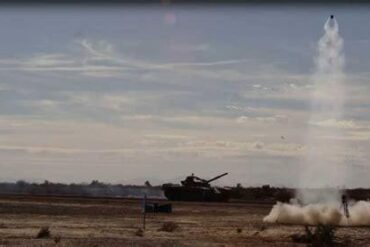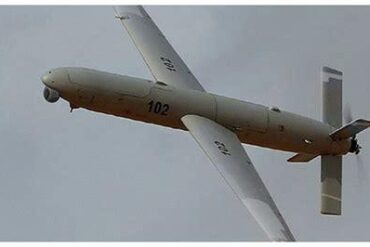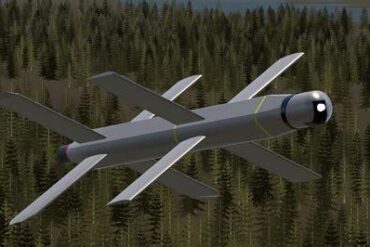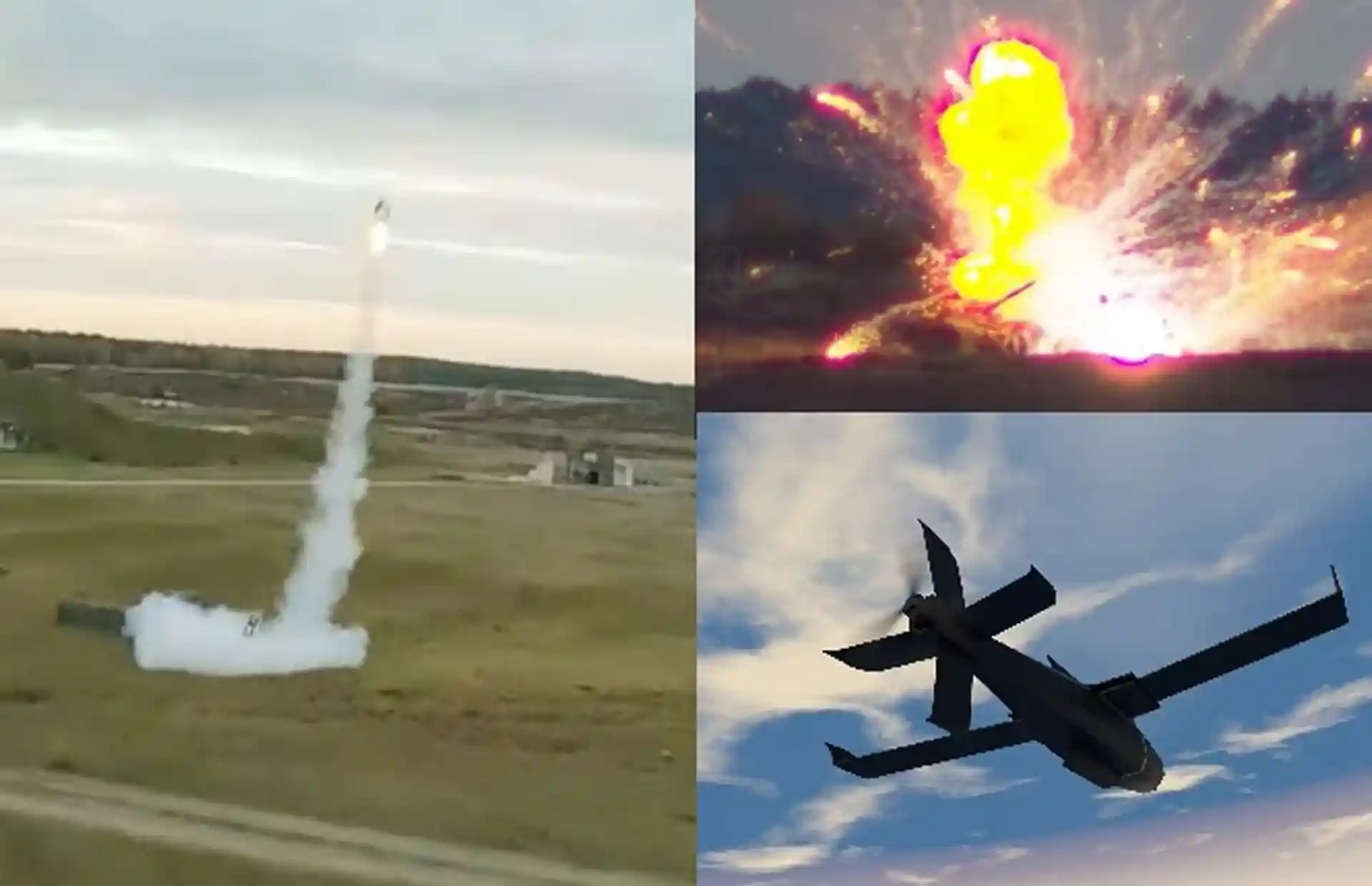
Germany has conducted live-fire trials of the Rheinmetall FV-014 loitering munition, unveiling a precision strike system designed to deliver 100-kilometer reach and more than 600 millimeters of rolled homogeneous armor (RHA) penetration. The demonstration, held on February 19, 2026, at the National Test Centre for Unmanned Aerial Systems in Cochstedt, signals a decisive step in Europe’s push to field sovereign, scalable loitering strike capabilities aligned with NATO operational doctrine.
Revealed through official footage released by Rheinmetall, the FV-014 is positioned as a brigade- and battalion-level asset capable of engaging armored vehicles, artillery systems, command posts, and fortified targets. The system reflects operational lessons drawn from Ukraine, where loitering munitions have transformed battlefield dynamics by delivering precision effects at relatively low cost and high responsiveness.
Weighing approximately 20 kilograms at launch, the fixed-wing drone carries a roughly 5-kilogram high-explosive dual-purpose warhead. Rheinmetall states that the munition can defeat over 600 mm of RHA, placing it within credible anti-armor parameters against the side and rear aspects of modern main battle tanks while maintaining lethal blast-fragmentation effects against lighter targets and hardened positions.
Operational Profile: 100 km Reach with 70-Minute Endurance
The FV-014 occupies a critical capability tier between traditional tube artillery and high-cost tactical missile systems. With a maximum strike range of 100 kilometers and a flight endurance of up to 70 minutes, it enables tactical units to conduct reconnaissance, target validation, and precision engagement within a single sortie.
The system’s data link reportedly extends to around 60 kilometers, allowing operators to maintain control throughout much of the engagement envelope. Rheinmetall emphasizes a human-in-the-loop architecture, ensuring that operators can positively identify targets, authorize strikes, or abort missions as battlefield conditions evolve. In environments characterized by rapid repositioning, decoys, and camouflage, this continuous oversight is operationally decisive.
Rather than functioning as a simple one-way drone, the FV-014 is designed to loiter over a designated area, assess targets dynamically, and execute controlled terminal maneuvers. This capability enhances both effectiveness and discrimination, reducing the likelihood of wasted munitions or unintended collateral effects.
Warhead Design: Dual-Purpose Penetration and Blast Effects
At the core of the system is its dual-purpose high-explosive warhead, engineered to combine shaped-charge penetration with blast-fragmentation lethality. The declared penetration of more than 600 mm RHA suggests effectiveness against armored platforms when engaging vulnerable angles, while the explosive and fragmentation output ensures versatility against artillery batteries, radar installations, logistics nodes, and fortified defensive points.
This hybrid warhead approach reflects a shift in European doctrine toward flexible, multi-role precision munitions. Instead of fielding separate systems for anti-armor and general strike roles, the FV-014 consolidates both functions into a single deployable platform. For brigade commanders, that translates into fewer logistical variables and greater tactical autonomy.
Airframe and Propulsion: Signature Reduction and Terminal Agility
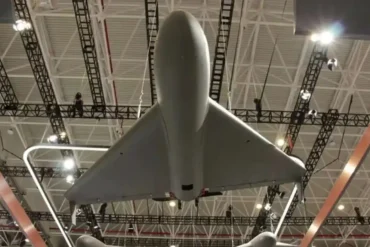
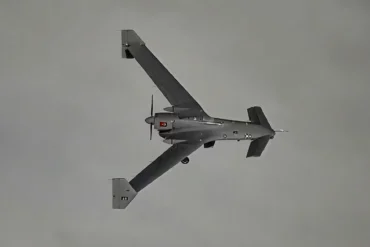
The FV-014 features a fixed-wing configuration with electric propulsion, utilizing a pusher propeller layout that reduces acoustic and thermal signatures during approach. In the final seconds before impact—when defensive systems attempt detection and interception—lower acoustic output can complicate reaction timelines.
Rheinmetall highlights faceted airframe structures intended to minimize radar signature and improve survivability in contested airspace. Aerodynamic control surfaces are engineered to balance long-range efficiency with high-speed terminal maneuvering, an engineering challenge that has constrained many smaller unmanned systems.
Reconciling endurance with aggressive final-attack dynamics is central to loitering munition design. Excessively optimized endurance platforms may lack maneuverability in the terminal phase, while highly agile designs can sacrifice range. The FV-014’s architecture aims to mitigate this tradeoff by combining aerodynamic efficiency with responsive control algorithms.
Launch Flexibility and Multi-Domain Integration
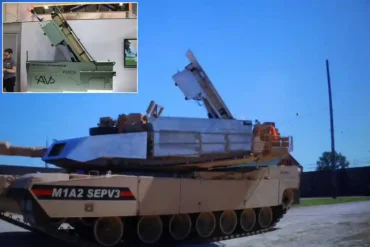
The system is booster-launched from a sealed transport-and-launch container, enabling rapid deployment without extensive setup infrastructure. Rheinmetall indicates compatibility with vehicle-mounted and maritime platforms, aligning the munition with NATO’s dispersed operations concept.
Containerized deployment allows units to store and transport munitions discreetly, maintaining readiness while minimizing exposure. For ground forces, this supports distributed battlegroup operations. For naval or littoral units, the FV-014 offers a flexible strike option against coastal targets, fast attack craft, or radar installations without committing high-cost anti-ship missiles.
The architecture also supports multi-launcher configurations, enabling coordinated strikes. Rheinmetall has referenced potential swarm employment concepts, where multiple munitions operate in coordinated patterns to saturate short-range air defenses or overwhelm point-defense systems.
Resilience in GNSS-Denied and Electronic Warfare Environments
A defining requirement for modern loitering munitions is survivability within electronically contested battlespaces. The Ukraine conflict has underscored the vulnerability of unmanned systems to jamming, spoofing, and communications disruption. Rheinmetall states that the FV-014 is engineered to operate in GNSS-denied or GNSS-interfered conditions, integrating navigation redundancy and robust data-link protections.
In spectrum-congested environments, the ability to maintain control and navigation continuity becomes a decisive differentiator. Systems unable to adapt to jamming lose effectiveness rapidly. By prioritizing electromagnetic resilience, the FV-014 reflects a doctrinal shift away from reliance on uncontested satellite navigation.
This design philosophy suggests an understanding that future conflicts will feature dense electronic warfare layers. Precision strike assets must therefore function amid degraded signals and active countermeasures, not merely in permissive airspace.
Industrial Scalability and European Strategic Autonomy
Beyond tactical performance, the FV-014 embodies an industrial strategy focused on scalable production and modular architecture. Rheinmetall notes the integration of commercially proven components, standardized subsystems, and digitally networked production processes. Additive manufacturing and automation are intended to shorten delivery timelines and enable high-volume output.
This approach addresses a core lesson of modern high-intensity warfare: limited boutique inventories cannot sustain prolonged operations. The capacity to produce loitering munitions at scale—rapidly and domestically—has become a strategic requirement for European defense planners.
The emphasis on sovereign production aligns with broader European efforts to reduce dependency on external suppliers for critical strike systems. By consolidating design, manufacturing, and supply chains within Europe, Rheinmetall positions the FV-014 as both a military and industrial asset.
Cost-Effectiveness and Battlefield Economics
Loitering munitions have redefined battlefield economics. In Ukraine, comparatively low-cost drones have successfully neutralized high-value assets such as artillery systems and armored vehicles. This asymmetry forces adversaries to invest heavily in layered counter-UAS defenses, altering procurement priorities across NATO and beyond.
Although Rheinmetall has not disclosed unit pricing, the emphasis on modularity and commercial components signals an intent to maintain cost efficiency. A system combining 100 km reach, significant armor penetration, and reusable industrial processes presents an attractive balance between capability and expenditure.
For mid-sized and smaller militaries, such systems provide organic deep-strike capacity without the financial burden associated with cruise missiles or large tactical ballistic systems. The FV-014 effectively bridges the gap between artillery and strategic missile forces, extending tactical lethality without escalating overall force structure.
Strategic Implications for NATO Operations
The live-fire trials at Cochstedt represent more than a product milestone. They illustrate Europe’s accelerating adaptation to the realities of modern warfare: dispersed formations, rapid decision cycles, contested electromagnetic domains, and the necessity for precision at scale.
By combining endurance, anti-armor capability, electronic resilience, and scalable production, the Rheinmetall FV-014 loitering munition enters a competitive and rapidly evolving segment of the defense market. Its integration into brigade and battalion-level formations could significantly expand organic strike envelopes across NATO ground forces.
As European militaries reassess procurement strategies in light of ongoing conflicts and emerging threats, systems like the FV-014 are poised to play a central role in shaping the next generation of networked, precision-centric operations.