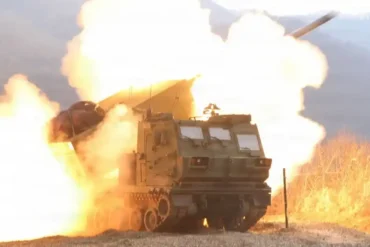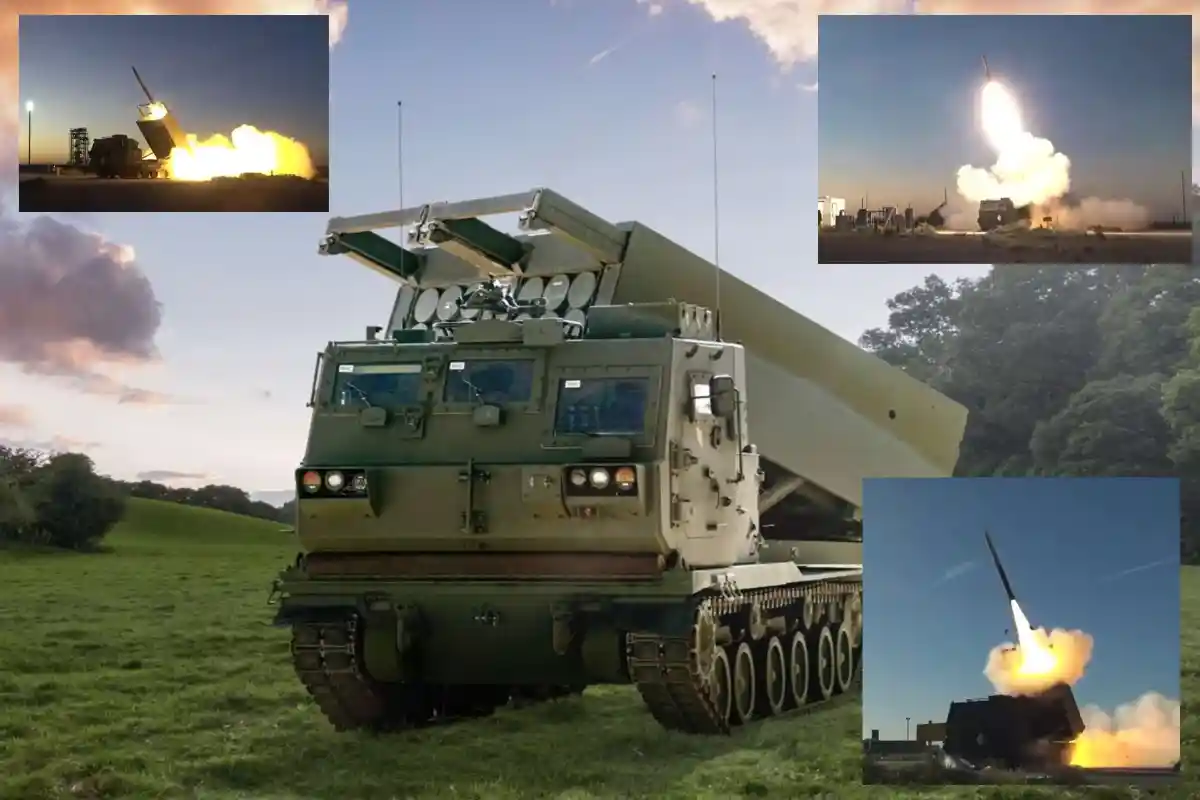
The United Kingdom has crossed a decisive threshold in the modernisation of its long-range land fires, initiating live-fire testing of the first two M270A2 Multiple Launch Rocket Systems (MLRS) ahead of their delivery to frontline units. Conducted in the United States, the trials signal the practical arrival of a capability designed to extend British reach, sharpen precision, and harden survivability in an era defined by contested battlespaces and rapid counter-battery threats. The event is not ceremonial; it is an operational proof point that places British rocket artillery on a shared technological footing with key NATO partners.
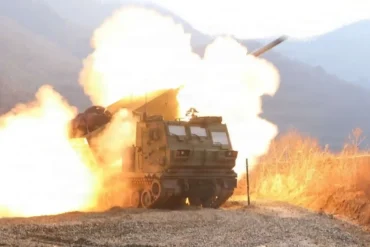
Announced by the Ministry of Defence through Defence Equipment & Support on 5 February 2026, the tests took place at White Sands Missile Range, a location synonymous with complex missile and rocket evaluations. Footage released alongside the announcement showed successful live firing, underscoring confidence in the platform’s upgraded propulsion, fire control, and launcher subsystems. With delivery to the Field Army scheduled for this summer, the British Army is transitioning from upgrade plans to deployable combat power.
Behind the announcement lies a multi-year effort to recapitalise the UK’s MLRS fleet under the Land Deep Fires programme. This initiative reflects a clear strategic judgement: future land operations will hinge on the ability to strike accurately at long range, rapidly displace, and integrate fires across domains. The M270A2 is the launcher chosen to carry that burden.
A Deliberate Shift From Legacy Systems to a NATO-Aligned Standard
The British Army’s existing launchers are M270B1s, a national adaptation of the earlier M270A1. The B1 configuration emerged from hard-earned experience in Iraq and Afghanistan, where enhanced armour was added to protect crews against improvised explosive devices and indirect fire. While robust, these vehicles were anchored to an earlier generation of electronics, automotive components, and fire control architecture.
In 2021, the UK committed to upgrading 44 launchers to the M270A2 standard under a five-year programme intended to keep the system credible through 2050. Work began in March 2022, focusing not on cosmetic updates but on deep structural and digital renewal. The arrival of the first two A2 vehicles for live testing marks the transition point at which the B1 lineage begins to give way to a common, allied configuration.
Alignment matters. By adopting the same standard as the US Army and other partners, the UK ensures interoperability in training, logistics, and munitions employment. In high-intensity conflict, that commonality reduces friction when forces deploy together, share stocks, or execute coordinated fire missions.
What Makes the M270A2 a Generational Upgrade
The M270A2 is often described as a life-extension, but that framing undersells the scope of change. At the heart of the upgrade is a new 600-horsepower engine paired with a rebuilt transmission, restoring mobility margins eroded by decades of incremental weight growth. These automotive improvements are not luxuries; they are essential for a launcher expected to “shoot and scoot” under persistent surveillance from drones and counter-battery radars.
The older cab has been replaced by a modern armoured cabin with improved blast protection, better crew ergonomics, and enhanced visibility. New launcher modules improve reliability and maintainability, reducing downtime in sustained operations. Together, these changes return the vehicle to a mobility and survivability standard suitable for modern manoeuvre warfare.
The most transformative element, however, is digital. The Common Fire Control System (CFCS) introduces a standardised, software-driven architecture shared across the MLRS family. CFCS enables faster target processing, improved integration with sensors and command networks, and seamless employment of current and future munitions.
Expanding the Arsenal: From GMLRS to Precision Strike Missile
With CFCS installed, the M270A2 becomes a gateway to an expanding suite of precision munitions. The launcher is fully compatible with Guided MLRS (GMLRS), long valued for its accuracy and combat-proven performance. More significantly, it supports Extended-Range GMLRS (GMLRS-ER), pushing effective engagement distances to roughly 150 kilometres.
Looking ahead, the A2 configuration is designed to employ the Precision Strike Missile (PrSM), which will extend reach to several hundred kilometres. This shift fundamentally alters how land forces contribute to joint campaigns. Targets once reserved for fast jets or cruise missiles—air defence nodes, logistics hubs, command centres—can increasingly be serviced by ground-based fires, complicating adversary planning and stretching defensive resources.
For British planners, this is not about replacing air power but about adding depth and resilience. Land-based missiles are harder to suppress, cheaper per shot, and continuously available once deployed.
Lessons From Recent Conflicts, Written Into Steel and Software
The operational relevance of the M270 family has been repeatedly reinforced, most recently through systems supplied to Ukraine. There, long-range rocket artillery has demonstrated its ability to disrupt command structures, destroy ammunition depots, and sever key lines of communication well behind the front line. These effects are achieved not through massed fire alone, but through precision, timing, and rapid displacement.
The British Army has absorbed these lessons. Survivability now depends as much on speed of engagement and relocation as on armour thickness. The M270A2’s faster fire control cycles and improved mobility directly address this reality. Its ability to integrate into sensor-to-shooter chains, receiving targeting data from UAVs, counter-battery radars, or allied ISR platforms, reflects a doctrinal shift toward networked fires.
The UK’s decision to donate M270 launchers and rockets to Ukraine also created a practical imperative to rebuild domestic capacity. The A2 programme fills that gap while ensuring the rebuilt force is more capable than what preceded it.
How M270A2 Changes British Artillery Operations
For the Royal Artillery, the transition to M270A2 is not simply a hardware update; it reshapes how deep fires are planned and executed. An A2 battery can receive a target, compute a firing solution, launch a salvo of 12 rockets, and displace in markedly less time than earlier variants. That speed compresses the enemy’s decision loop and reduces exposure to counter-fire.
Extended range allows British units to influence the fight across a divisional or even corps frontage. Launchers can operate from greater depth, protected by friendly air defences and terrain, while still striking high-value targets. When required, improved protection and situational awareness systems allow them to move closer to manoeuvre forces, providing responsive fires in fast-moving operations.
This flexibility supports a range of missions, from deterrence patrols on NATO’s eastern flank to high-intensity combat against peer adversaries. It also strengthens the credibility of British contributions to multinational formations.
A Pillar of NATO’s Long-Range Fires Architecture
The M270A2 sits at the intersection of national modernisation and alliance strategy. NATO has placed renewed emphasis on long-range precision fires as a counter to massed forces, anti-access strategies, and hardened command networks. The UK’s Land Deep Fires programme aligns closely with this priority, reinforcing a broader political commitment to a NATO-first defence posture.
By fielding the same launcher standard as the United States and several European allies, Britain embeds itself in a shared ecosystem of training, sustainment, and munitions development. Stockpiles can be pooled, spare parts shared, and fire plans coordinated with fewer technical barriers. In a crisis, British M270A2 batteries can integrate seamlessly with US M270A2 and HIMARS units, delivering coordinated effects across land, air, and maritime domains.
This interoperability is not abstract. It is the practical foundation of credible deterrence, signalling to potential adversaries that allied forces can fight as a coherent whole.
From Test Range to Field Army: What Comes Next
The live-fire trials at White Sands represent the final proving ground before the first launchers enter British service. For Defence Equipment & Support, the milestone validates years of collaboration with industry partners and the US Army. For soldiers, it confirms that the vehicles arriving this summer are not prototypes, but combat-ready systems tested under demanding conditions.
As more M270A1 and B1 launchers are stripped down, rebuilt, and returned as A2s, the British Army’s rocket artillery will steadily transform. The process is methodical, but the direction is clear: fewer limitations, longer reach, and tighter integration with joint and allied forces.
In strategic terms, the M270A2 is a bridge between lessons learned and future conflict. It carries forward the proven lethality of MLRS while opening the door to a new generation of missiles and networked warfare concepts. With live-fire testing now complete for the first vehicles, the UK has moved beyond intent and into execution, reinforcing its role as a serious contributor to NATO’s long-range strike capability and a more credible deterrent in an increasingly unstable security environment.