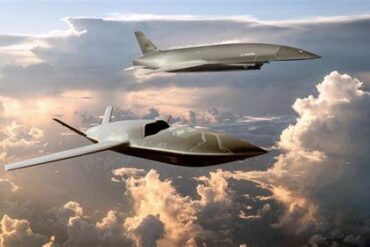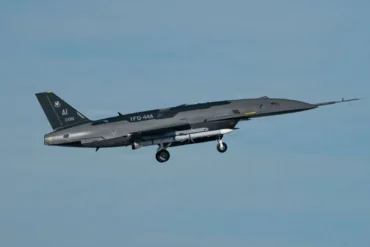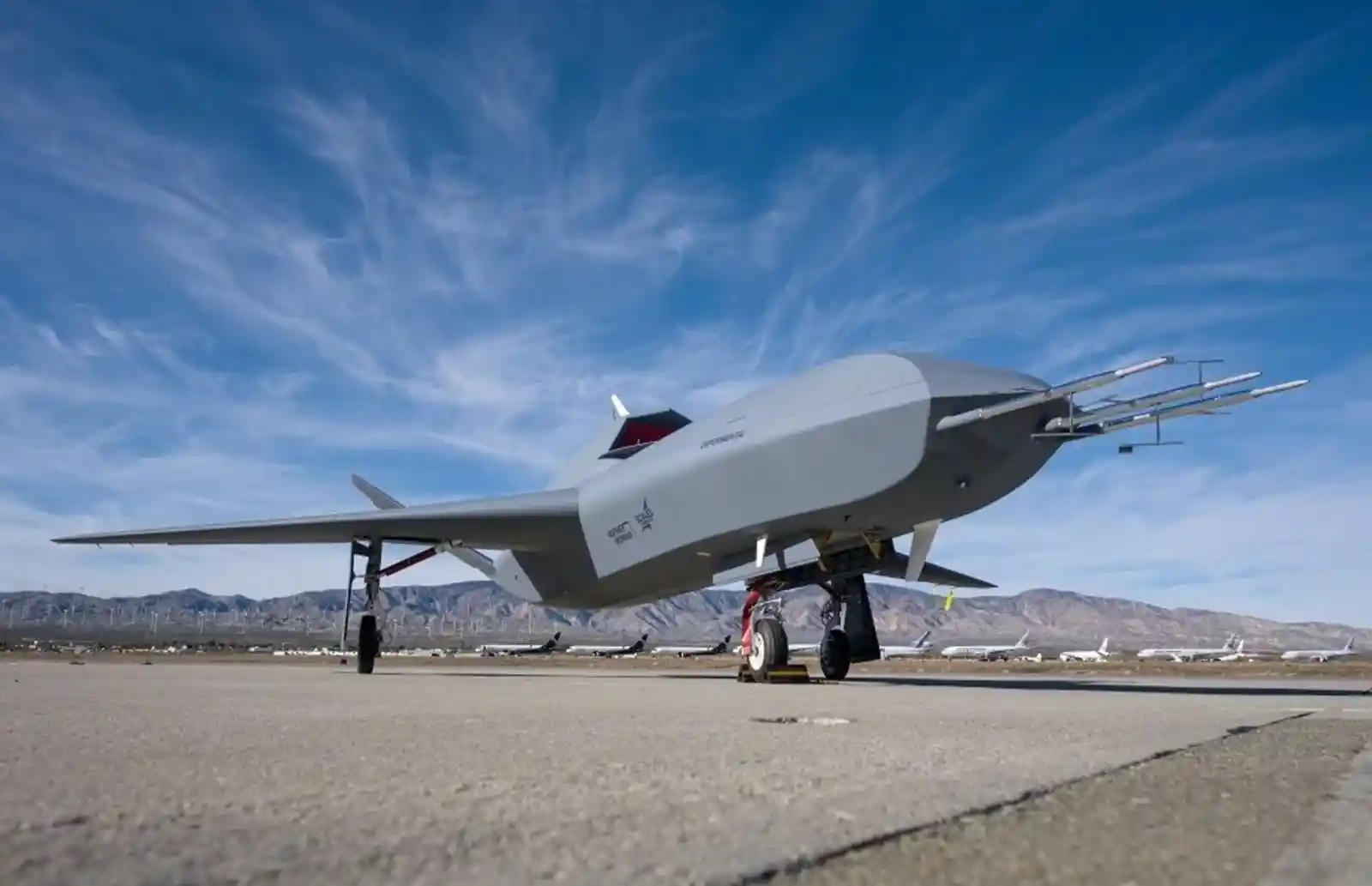
The U.S. Air Force has moved a step closer to operationalizing autonomous wingmen with the start of flight testing for the YFQ-48A Talon Blue, Northrop Grumman’s stealth-leaning Collaborative Combat Aircraft designed to expand fighter capacity in highly contested airspace. The aircraft enters the test phase at a moment when the service is reshaping how airpower is generated, shifting from small numbers of exquisite manned platforms toward affordable mass—a doctrine that prizes numbers, resilience, and rapid replacement over perfection. Talon Blue is not pitched as a lone silver bullet. It is meant to be one node in a distributed combat web, carrying sensors, effects, and risk closer to enemy defenses while remaining tethered to a human-controlled kill chain.
The assignment of the YFQ-48A Mission Design Series designation is a signal that the program has crossed a psychological threshold from internal demonstrator to a platform the Air Force intends to keep in the competitive field as the Collaborative Combat Aircraft portfolio expands beyond its first increment. That designation matters in procurement politics. It tells industry and Congress that the service wants options alive as requirements evolve, rather than locking itself into a single early design that could age poorly against fast-moving threats. In parallel, Increment 1 CCAs are already advancing toward weapons-carry tests with inert AIM-120 beyond-visual-range missiles, building the operational scaffolding into which later designs like Talon Blue could slot.
The design philosophy behind Talon Blue is pragmatic in a way that reflects hard-earned lessons from decades of exquisite programs that proved slow to scale. Northrop Grumman has emphasized survivability through shaping rather than chasing headline performance metrics, while pushing manufacturability as a first-order requirement. The result is a configuration that leans into low-observable principles without claiming the kind of extreme stealth reserved for crewed fifth-generation fighters. The aircraft is intended to survive long enough to matter, and to be produced quickly enough to be replaced when it does not. In a war of attrition against dense integrated air defense systems, that trade space becomes strategically decisive.
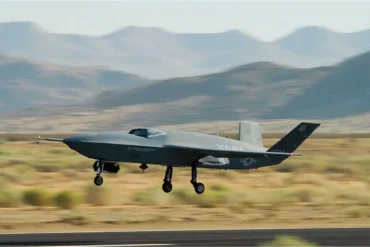
Talon Blue’s airframe reveals those priorities in metal and composite. A long, slender fuselage blends into a lambda wing planform, paired with a canted V-tail and a dorsal trapezoidal inlet feeding a single turbofan. The forward fuselage carries a chine line that helps manage radar returns from frontal aspects, and sawtooth-edged access panels hint at deliberate radar cross-section management across seams and openings. The exhaust is semi-recessed between the tails, a compromise that simplifies propulsion integration while enabling thermal and signature management through internal ducting choices. None of these features exist in isolation. Together they sketch a vehicle shaped for survivability at acceptable cost rather than maximal stealth at any price.
The prototype’s external details suggest a test program designed to move quickly. Air data probes protrude from the nose, domed antennas appear along the upper forward fuselage, and additional aerials cluster near the intake, all pointing to an instrumentation-heavy configuration meant to harvest flight data early and often. The main landing gear retracts inward beneath the wings, widely spaced for ground stability, and Northrop has acknowledged that the gear itself is sourced from an existing aircraft design to compress development risk and cost. A large sawtooth-edged panel on the underside has drawn attention as a potential internal bay door. While the company has not confirmed a weapons bay architecture, it has been explicit about modular payload volume to support multiple mission sets.
Manufacturing metrics, rather than raw performance numbers, are where Northrop has chosen to be unusually transparent. The company says Talon Blue is roughly 1,000 pounds lighter than its earlier Increment 1 proposal, uses about 50 percent fewer parts, and can be built around 30 percent faster thanks to extensive composite structures that collapse part counts and simplify assembly. Development was split between Northrop Grumman and Scaled Composites, its rapid-prototyping subsidiary, with the air vehicle moving from concept to weight-on-wheels in roughly 15 months. First flight followed on a compressed timeline aimed squarely at 2026. In a program defined by the need to replace losses at wartime tempo, these industrial realities may matter more than a few knots of speed or a marginal gain in ceiling.
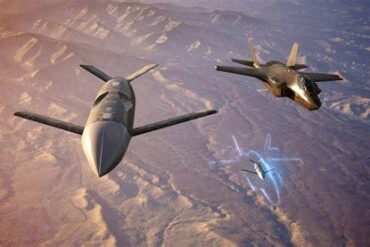
The aircraft’s role inside the Collaborative Combat Aircraft construct is to act as a flexible teammate to crewed fighters such as the F-35A and the Air Force’s future Next Generation Air Dominance platform. The service envisions CCAs extending magazine depth, pushing sensors forward, and absorbing risk that would otherwise be borne by pilots. In practical terms, that means Talon Blue can be tasked as an ISR node, an electronic attack platform that complicates enemy radar pictures, a communications relay bridging gaps in contested electromagnetic environments, or a decoy that provokes enemy emitters into revealing themselves. Each of those roles feeds into a broader operational effect: degrading enemy situational awareness and opening corridors through air defenses for joint forces.
Autonomy is the quiet engine that makes this vision workable, and Northrop is positioning Talon Blue as one airframe inside a wider autonomy ecosystem rather than as a one-off robotic aircraft. The company’s Project Talon portfolio treats the vehicle and the autonomy stack as separable layers that can evolve at different speeds. Talon IQ, a dedicated flying laboratory, is used to mature mission autonomy and human-machine teaming concepts rapidly, while the Prism autonomy package provides the command-and-control and decision-support layer already proven on earlier demonstrators. This separation matters. Airframes evolve on hardware timelines measured in years. Software, if given the right test ecosystem, can evolve on timelines measured in months. The Air Force’s insistence that CCAs remain under human command does not negate autonomy. It raises the bar for trustworthy autonomy that can act decisively within guardrails set by human operators.
The strategic context around Talon Blue is as important as the aircraft itself. The Air Force has structured the CCA program around continuous competition and multiple on-ramps, deliberately avoiding a single winner-take-all decision early in the life of a disruptive technology. Increment 1 will inform tactics, datalinks, weapons integration, and human-machine teaming concepts. Increment 2 and beyond are expected to absorb those lessons while pushing cost down and scale up. Northrop has been candid that Project Talon was not purpose-built as an Increment 2 entry. Yet the YFQ-48A designation and the push into flight testing keep Talon Blue relevant as a candidate for later increments, especially if it can demonstrate production realism alongside credible autonomy.
Cost pressure is the gravitational force shaping every design decision in the CCA universe. Senior Air Force leaders have repeatedly signaled discomfort with early price points that threaten to turn “affordable mass” into boutique mass. Talon Blue’s reduced part count, modular manufacturing approach, and compressed build timelines are a direct response to that pressure. The underlying bet is that survivability can be achieved through numbers, tactics, and software-defined behaviors as much as through exquisite materials and edge-case performance. That bet aligns with the lived reality of modern conflict, where adversaries field dense sensor networks and long-range missiles that punish predictability and reward resilience through distribution.
Flight testing will now turn theory into data. The early phases will focus on basic airworthiness, handling qualities, and the reliability of the autonomy stack under real-world datalink constraints. As the envelope expands, the program will be judged on repeatable autonomous behaviors, payload integration, and the ability to plug into manned-unmanned teaming constructs without creating cognitive overload for pilots. The Air Force’s emerging concept of operations places a premium on trust between human operators and autonomous teammates. That trust is earned through boring excellence: stable links, predictable behaviors, and systems that fail gracefully rather than catastrophically.
If Talon Blue clears those hurdles, its real test will be industrial. Can multiple air vehicles be produced quickly without a fragile supply chain? Can damaged aircraft be repaired or replaced at a tempo that makes sense in a high-intensity fight? Can autonomy updates be rolled out without grounding fleets for months at a time? These questions sound mundane compared to stealth shaping or artificial intelligence buzzwords, yet they are where programs live or die when theory meets logistics. The Air Force is trying to build a force that can take hits and keep fighting. Talon Blue’s flight testing is the beginning of an answer to whether autonomous wingmen can be built not just to fly, but to endure as part of a resilient combat system.