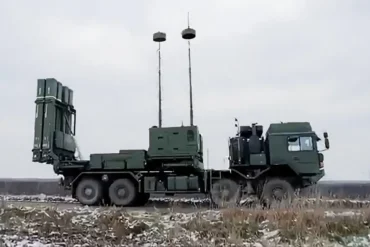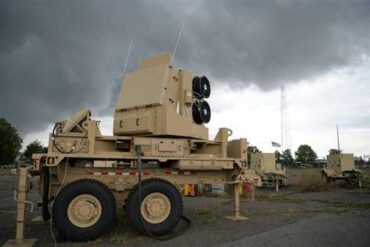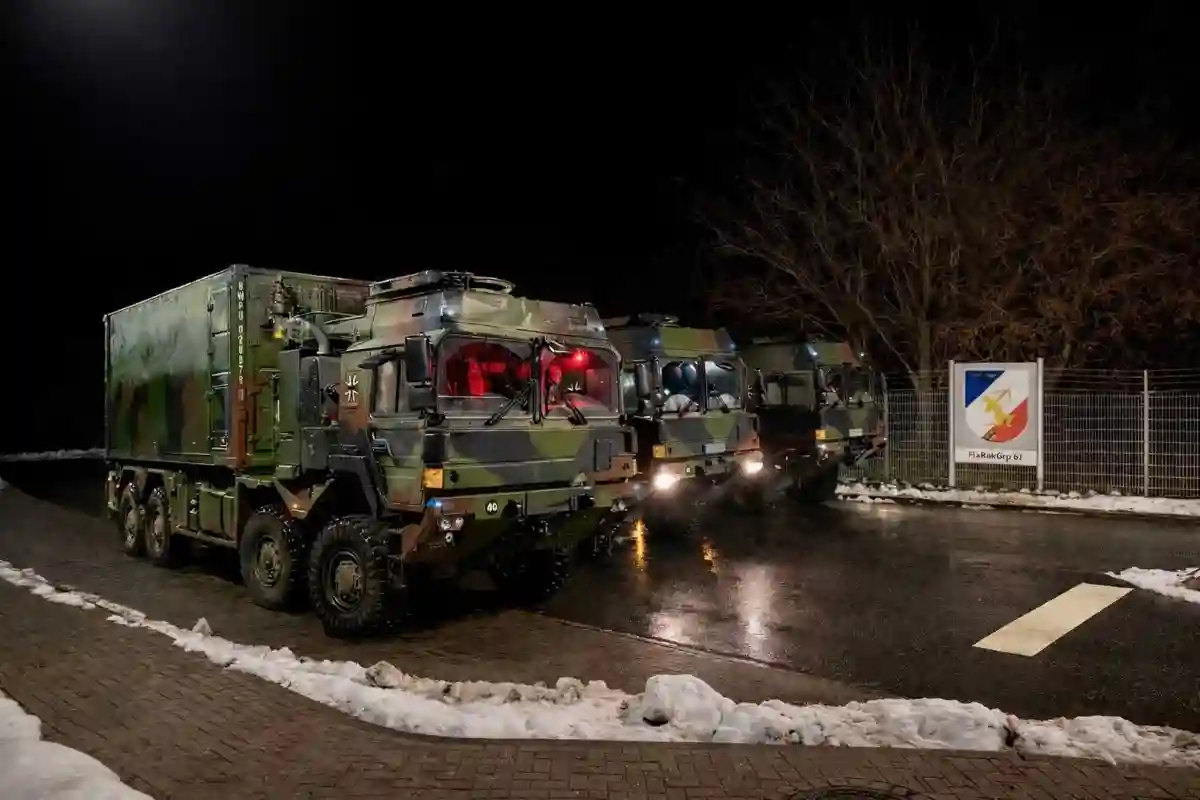
Germany’s air defense revival just crossed a visible threshold. The German Air Force has formally received its first IRIS-T SLM medium-range air defense missile system in full national configuration, marking the operational arrival of a system designed to stitch together the country’s evolving, layered aerial shield. Delivered to Air Defence Missile Group 61 in Todendorf, the fire unit represents not merely a hardware transfer but the beginning of doctrinal, organizational, and technological integration into Germany’s modernized ground-based air defense framework.
The handover, announced on February 13, 2026, signals the transition from procurement planning to fielded capability. The delivered configuration includes a Hensoldt TRML-4D radar, an IBMS-FC command post, and three launcher vehicles carrying a combined 24 ready-to-fire missiles. Together, these components form a self-contained combat element capable of autonomous detection, tracking, engagement, and networked coordination within national and NATO air defense grids.
This induction lands at a time when European airspace defense has re-entered strategic focus. Germany’s modernization drive, accelerated by shifting threat perceptions and alliance commitments, places systems like IRIS-T SLM in the crucial middle tier—bridging the gap between short-range mobile protection and high-altitude strategic interceptors.
National Configuration Signals Operational Integration
The “national configuration” designation is more than bureaucratic phrasing. It reflects a system tailored to Germany’s command structures, communications standards, and operational doctrine. The standard German IRIS-T SLM fire unit integrates radar surveillance, battle management, and missile launch capability into a network-ready combat node.
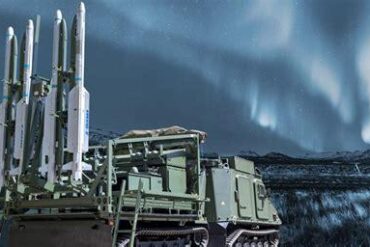
Each launcher mounts eight vertically launched missiles, enabling 360-degree engagement without mechanical reorientation. Vertical launch also shortens reaction time, a critical variable when intercept windows are measured in seconds. Supported by reload and maintenance vehicles, the fire unit can sustain repeated engagements under high-tempo threat conditions.
With an engagement range of up to 40 kilometers and an altitude ceiling reaching 20 kilometers, IRIS-T SLM occupies the medium-range layer of Germany’s defensive stack. This tier is engineered to counter cruise missiles, aircraft, helicopters, drones, and certain ballistic threats—targets that often evade either very-short-range guns or high-altitude strategic interceptors.
Air Defence Missile Group 61: From SHORAD to Medium-Range Power
Stationed in Todendorf and numbering roughly 500 personnel, Flugabwehrraketengruppe 61 has historically specialized in short-range protection of maneuver forces. Its inventory included the Wiesel 2 Ozelot light air defense system—an agile SHORAD (Short Range Air Defense) platform optimized against low-flying aircraft and helicopters.
Until October 2023, the unit also fielded the MANTIS close-in protection system, designed for point defense against rockets and artillery. The arrival of IRIS-T SLM expands the unit’s operational horizon upward and outward, transforming it from a purely tactical shield into a formation capable of area defense.
Commanded since October 2024 by Oberstleutnant Björn Klarl, the group is undergoing phased conversion. Five IRIS-T SLM fire units are scheduled to enter service, with full operational transformation targeted for mid-2027. The first commissioning milestone was reached in September 2024, laying the groundwork for doctrinal adaptation and personnel training pipelines.
Procurement Framework and Strategic Funding
Germany’s acquisition pathway for IRIS-T SLM reflects both urgency and scale. On June 14, 2023, the Bundestag Budget Committee approved approximately €950 million for six fire units and 216 missiles, with options for two additional units. Funding was drawn from the Bundeswehr’s special modernization fund—a financial instrument created to accelerate defense readiness.
Serial deliveries are scheduled from late 2025 through 2027. The first fire unit was accepted in August 2024 and formally commissioned on September 4 that year, preceding the 2026 operational handover.
A broader €3.85 billion defense package approved in November 2025 allocated roughly €1 billion to expand IRIS-T SLM missile stocks, launcher elements, and sensor integration. Strategic planning discussions now point toward a significantly enlarged medium-range inventory, potentially scaling to several dozen systems alongside up to 100 IRIS-T SLS short-range units.
This expansion feeds directly into the European Sky Shield Initiative (ESSI), where IRIS-T SLM operates in concert with systems such as Patriot and Arrow 3, forming a multi-layered continental defense mesh.
Combat Validation in Ukraine
No modern air defense system escapes the proving ground of real conflict. For IRIS-T SLM, that crucible has been Ukraine.
The first system was transferred on October 11, 2022, followed by additional deliveries in April 2023, October 2023, May 2024, and December 2024. Ukraine also received IRIS-T SLS short-range variants, creating a layered defensive pairing.
Operational reports from Ukrainian authorities cite interception rates approaching 90 percent. Documented engagements include simultaneous cruise missile interceptions within seconds and successful strikes against short-range ballistic threats. By September 2024, German officials referenced hundreds of intercepted cruise missiles, drones, and rockets attributed to IRIS-T systems in Ukrainian service.
Combat performance has acted as an accelerant for industrial scaling. Germany committed roughly €1.5 billion to expand missile production capacity, culminating in the افتتاح of a new manufacturing facility in Saarland in January 2026.
Development Lineage and Multinational Engineering
The IRIS-T SLM story begins in 2007 under the leadership of Diehl Defence, developed in cooperation with Norway, Sweden, Greece, and Italy. The program aimed to create a ground-launched counterpart to the IRIS-T air-to-air missile while complementing the MEADS air defense initiative.
Testing unfolded methodically. Unguided flight trials took place in October 2009 at South Africa’s Overberg Test Range. Prototype firing campaigns began in 2012, culminating in a successful drone interception in December of that year. Developer trials concluded in 2015, followed by Bundeswehr testing in 2017.
Operational readiness status was achieved in 2022. A dedicated training center established in Todendorf in 2023 now prepares both German and international operators, underscoring the system’s export trajectory.
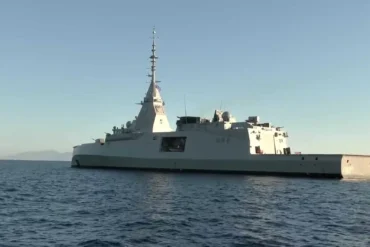
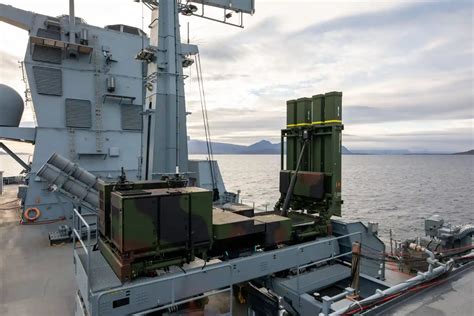
IRIS-T SLM competes globally with platforms such as Sky Sabre and MICA VL. Naval integration experiments have also occurred, including a demonstrator tested aboard the frigate Baden-Württemberg in 2025, exploring compatibility with Mk 41 vertical launch systems and the Aegis combat environment.
Modular Architecture and Rapid Deployability
One of IRIS-T SLM’s quiet advantages lies in its modular design philosophy. All major components are mounted on standardized 20-foot ISO container frames, enabling transport by truck, rail, sea, or air. Compatibility with C-130 and A400M aircraft grants expeditionary mobility—a trait increasingly valuable in NATO’s forward defense posture.
The Tactical Operations Center functions as the system’s neural core, managing engagements while linking to higher command echelons through radio or fiber-optic networks. Launchers can disperse up to 20 kilometers from the command post, complicating enemy targeting and enhancing survivability.
Deployment speed is equally notable. A launcher becomes combat-ready roughly ten minutes after emplacement, while a full reload cycle takes about 15 minutes—numbers that matter when saturation attacks attempt to exhaust missile inventories.
The open-architecture design allows integration with alternative sensors including CEAFAR, Saab Giraffe 4A, Thales Ground Master 200, and TwInvis passive radar, though Germany’s baseline configuration centers on TRML-4D.
TRML-4D Radar: Sensor Backbone
The Hensoldt TRML-4D radar provides the system’s eyes and early warning reflexes. Operating in the G-band with an Active Electronically Scanned Array (AESA) built on gallium nitride amplifiers, the radar delivers full 360-degree azimuth coverage.
Its instrumented detection range reaches 250 kilometers, with altitude tracking up to 30 kilometers. It can detect targets with radar cross sections as small as 0.01 square meters—objects roughly the size of a large bird from a radar reflectivity standpoint.
Tracking capacity extends to 1,500 simultaneous targets in three-dimensional surveillance mode. Detection benchmarks include approximately 120 kilometers for fighter-sized aircraft and 60 kilometers for supersonic missiles. Integrated Identification Friend-or-Foe (IFF) systems reduce fratricide risk in congested airspace.
Missile Engineering and Intercept Mechanics
The interceptor itself is an evolutionary descendant of the IRIS-T air-to-air missile, redesigned for ground launch. It features an enlarged 152 mm diameter solid-fuel rocket motor produced by Nammo, paired with thrust vector control for extreme maneuverability.
Guidance unfolds in phases. After vertical launch, the missile navigates via GPS-aided inertial guidance, receiving midcourse updates through a two-way data link. Terminal homing relies on imaging infrared seekers, allowing precise endgame targeting even against low-signature threats.
Weighing between 110 and 130 kilograms, the missile reaches speeds near Mach 3. Its 11.4-kilogram fragmentation warhead, triggered by impact or active radar proximity fuzing, is engineered to neutralize fast, maneuvering aerial threats within the system’s 40-kilometer engagement envelope.
Strategic Meaning for Germany’s Air Defense Future
The induction of the first national-configured IRIS-T SLM unit is less a finish line than a starting pulse. Germany is rebuilding a layered air defense architecture that had thinned after the Cold War, rebalancing toward homeland protection, expeditionary coverage, and alliance burden-sharing.
Medium-range systems like IRIS-T SLM form the connective tissue of that architecture. They intercept what slips past fighters, complement what strategic interceptors cannot economically engage, and shield ground forces from aerial coercion.
In technological ecosystems, the interesting story is never a single machine—it is the network. Sensors, shooters, command nodes, and industrial supply chains intertwine into a defensive organism. Germany’s first IRIS-T SLM fire unit is one cell in that organism, now alive, learning, and expanding its reflexes in an increasingly contested sky.