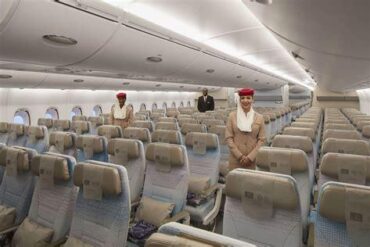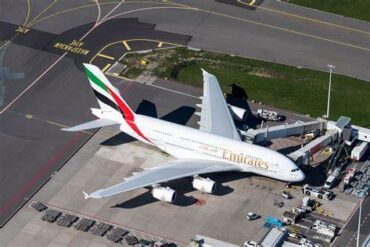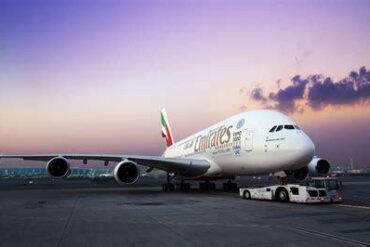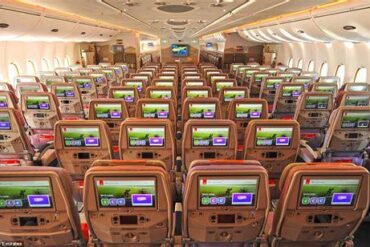
Emirates is preparing to debut a redesigned version of the Airbus A380—an aircraft already famous for its colossal size. Next month, the airline will introduce a newly configured 569-seat superjumbo, marking the beginning of a fleet transformation that trades raw seat density for a more premium-heavy cabin strategy. While the previous configuration packed an astonishing 615 passengers onboard, the upcoming layout reflects a different philosophy: fewer seats overall but far more emphasis on higher-yield travel classes.
The transition signals an important moment for the world’s largest passenger aircraft. The Airbus A380 has always been associated with scale and spectacle, but airlines increasingly balance capacity with revenue optimization. Emirates, the aircraft’s largest operator, is essentially redesigning how the superjumbo earns money—replacing sheer passenger numbers with a broader mix of premium experiences.
For aviation observers, the debut of this aircraft also marks the end of an unusual experiment. The two-class, 615-seat A380, once the highest-capacity passenger aircraft configuration in the world, is gradually being retired as each of the 15 aircraft undergoes retrofitting.
Inside Emirates’ New 569-Seat Airbus A380 Configuration
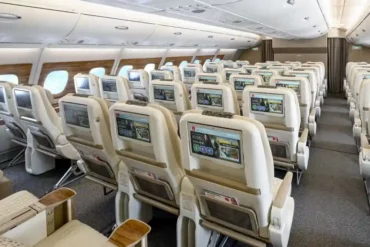
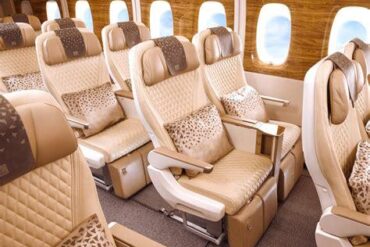
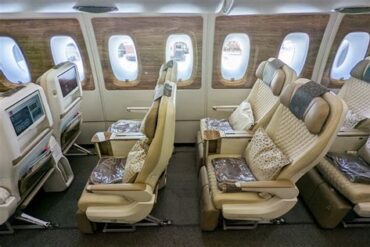
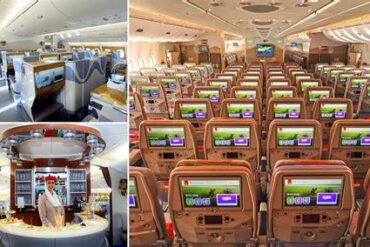
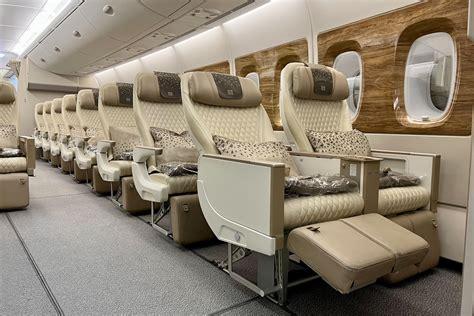
The redesigned cabin dramatically reshapes how passengers are distributed across the double-decker aircraft. Instead of focusing almost entirely on economy seating, the new layout significantly increases premium capacity and introduces a long-awaited middle tier: premium economy.
The updated configuration includes:
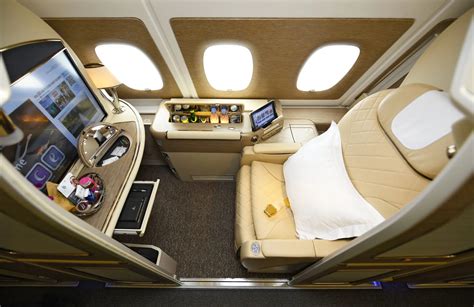
- 76 business class seats, representing an increase of 18 seats compared with the previous layout
- 56 premium economy seats, a completely new addition to this aircraft type
- 437 economy seats, reflecting a reduction of 120 seats
The numbers tell a clear story. Economy once dominated the 615-seat aircraft, but the new design elevates premium travel dramatically. Business class alone will now account for roughly 13% of all seats, while the total share of non-economy seating jumps from 9% to 23%.
This shift mirrors broader trends across the aviation industry. Airlines have discovered that adding premium seating—especially business and premium economy—often produces higher overall revenue than simply packing more economy passengers into the cabin. For Emirates, the A380 remains a flagship aircraft, but its economic model is evolving.
Tracking The First Aircraft To Receive The Retrofit
Evidence suggests that two specific aircraft may lead the transformation: A6-EOP and A6-EUX. These widebody giants have recently been spotted in locations consistent with maintenance or retrofit work.
Flight-tracking data indicates that A6-EOP, approximately 10.8 years old, arrived in Guangzhou in mid-February and has remained there since. Meanwhile, the nine-year-old A6-EUX has been parked in Dubai since late February.
Although Emirates has not publicly confirmed the retrofit status of these frames, their current inactivity strongly hints at preparation for the new layout. Once completed, both aircraft are expected to enter service around mid-April, launching the new configuration into commercial operation.
By November, the airline plans to convert all 15 of its former 615-seat A380s to the 569-seat three-class configuration. After that transition is complete, this layout will become the highest-capacity A380 configuration still flying globally.
Dubai–Amman To Host The First 569-Seat A380 Flight
According to Emirates’ current scheduling data, the inaugural passenger flight using the redesigned aircraft will operate between Dubai and Amman. The route will temporarily become the proving ground for the airline’s newest superjumbo layout.
The first scheduled departure is planned for April 14, with the aircraft operating on the following daily services:
- EK903: Dubai (14:15) → Amman (16:30)
- EK904: Amman (18:15) → Dubai (22:25)
Interestingly, Amman has not previously hosted the ultra-dense 615-seat configuration. The route currently receives Emirates A380 aircraft equipped with four classes, including first class. The introduction of the 569-seat aircraft therefore means that first class will disappear from these flights, at least temporarily.
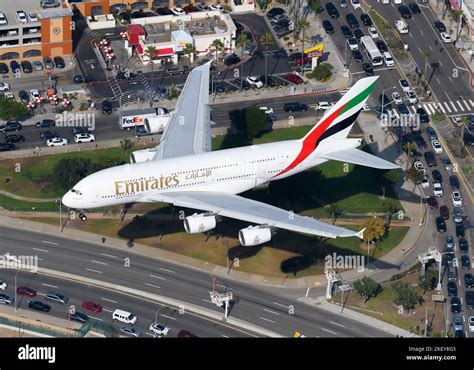
Despite its relatively short duration, the Dubai–Amman sector will become the third-shortest A380 flight from Emirates’ hub, making it a fascinating test case for the airline’s revised cabin strategy.
Prague Confirmed As The Next Destination
Beyond Amman, Prague is the only destination officially scheduled to receive the new A380 configuration so far. Beginning June 1, the Czech capital will transition from the older 615-seat aircraft to the newly configured 569-seat model.
For travelers in Central Europe, the change brings a major perk: Emirates’ premium economy cabin will appear on the Prague route for the first time. The airline has gradually expanded this product across its network, and the A380 retrofit will accelerate that rollout.
Prague joins a small but growing list of destinations receiving Emirates’ upgraded cabin offering. Similar introductions recently occurred elsewhere in the network, including London Gatwick following the arrival of the Airbus A350-900.
More Routes May Follow Across The Global Network
While Emirates has confirmed only two destinations so far, aviation analysts suspect many more routes could adopt the 569-seat A380 throughout 2026.
Schedule analysis suggests potential future deployments to cities such as Bali, Bangkok, Birmingham, Düsseldorf, Jeddah, Kuala Lumpur, London Gatwick, Manchester, and Mauritius. These locations already see the airline’s highest-capacity A380 operations today, making them logical candidates for the newly retrofitted aircraft.
The evidence comes from internal scheduling codes—specifically “388K,” believed to identify the new configuration within Emirates’ operational systems. Still, until the airline publishes the routes in official passenger timetables, these deployments remain speculative.
What is certain is that Emirates is reshaping how the world’s largest passenger aircraft fits into modern airline economics. The 569-seat Airbus A380 keeps the spectacular scale of the superjumbo alive while steering the aircraft toward a more premium-focused future—one where luxury, not just size, defines the experience of flying the skies.