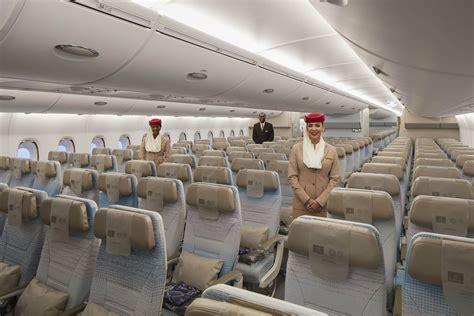
Emirates is reshaping the identity of its Airbus A380 fleet with a dramatic cabin overhaul that signals where the future of long-haul travel is heading. The Dubai-based carrier has officially introduced a newly retrofitted 569-seat Airbus A380 configuration, replacing the airline’s ultra-dense 615-seat layout with a more premium-focused product centered around expanded business class and the addition of premium economy.
The aircraft, registered as A6-EUX, has already returned to commercial service after spending months in Dubai undergoing a major interior transformation. Its debut flight operated between Dubai International Airport and Birmingham, marking the beginning of a broader rollout that will eventually spread across nine international routes.
Rather than maximizing passenger volume at all costs, Emirates is now prioritizing revenue efficiency, premium demand, and cabin consistency. The move reflects a major shift in strategy for one of the world’s most recognizable long-haul airlines.
The redesigned A380 represents far more than a cosmetic refresh. It is part of Emirates’ massive $5 billion fleet modernization program covering both Airbus A380s and Boeing 777 aircraft.
Emirates Retires Its Densest Airbus A380 Configuration
For years, Emirates operated one of the most extreme high-capacity passenger aircraft configurations in commercial aviation. Its two-class Airbus A380s featured a staggering 615 seats, including 58 business class seats and 557 economy seats.
Those aircraft were designed for routes where demand was exceptionally strong and seat density mattered more than luxury diversification. They became especially valuable on heavily trafficked leisure and visiting-friends-and-relatives markets where filling hundreds of economy seats daily was achievable.
But aviation economics have evolved rapidly.
The old configuration lacked premium economy entirely, creating a noticeable gap between economy and business class. As global travelers increasingly seek enhanced comfort without paying business class fares, premium economy has become one of the fastest-growing and most profitable cabin products in aviation.
Emirates’ new 569-seat A380 directly addresses that issue.
The updated cabin layout now includes:
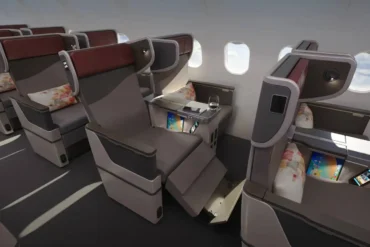
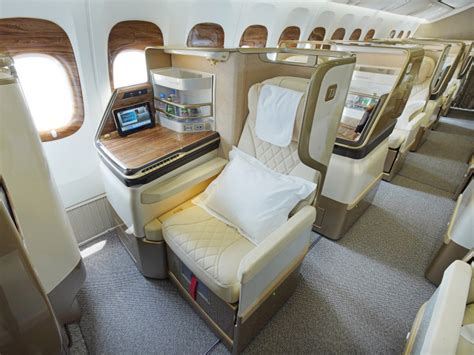
- 76 business class seats
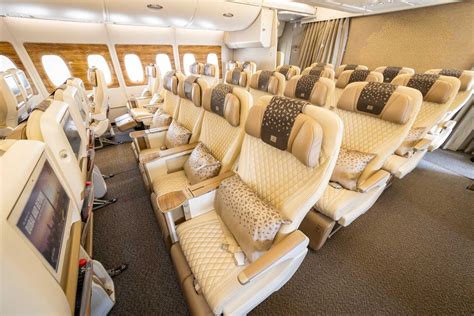
- 56 premium economy seats
- 437 economy seats
While total capacity falls by 46 seats, the premium offering expands dramatically. Premium cabins now account for nearly a quarter of total onboard seating, more than doubling the previous premium share.
Business class itself also receives a substantial boost, increasing from 58 to 76 seats. That expansion underscores how valuable high-yield travelers have become for airlines operating ultra-large aircraft.
Inside Emirates’ New Premium Economy Strategy
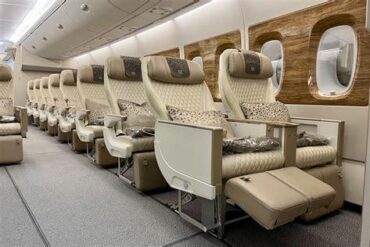
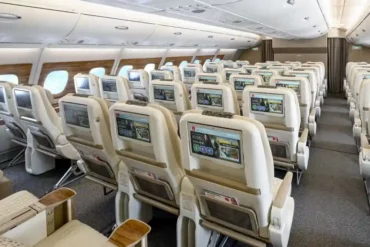
The centerpiece of the retrofit is unquestionably the premium economy cabin.
Emirates entered the premium economy market later than several international competitors, but the airline is now aggressively accelerating deployment across its global network. The new A380 configuration places premium economy seats on the upper deck alongside business class, helping create a more cohesive premium passenger environment.
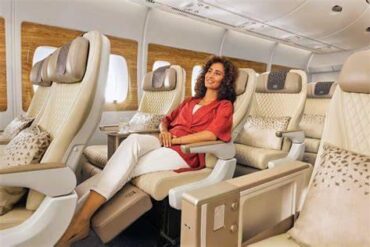
The cabin offers:
- 40-inch seat pitch
- 19.5-inch seat width
- 8-inch recline
- 2-4-2 seating layout
That represents a substantial upgrade over standard economy seating, especially on long-haul routes lasting six to twelve hours.
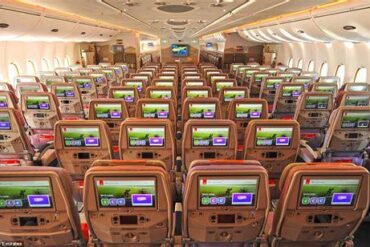
Meanwhile, economy class remains in a 3-4-3 configuration on the main deck with a 32-inch pitch and 17.9-inch seat width. Although Emirates removed 120 economy seats during the retrofit, the airline is betting that stronger premium demand will more than compensate financially.
This is increasingly becoming the defining strategy among global airlines. Rather than chasing maximum passenger numbers alone, carriers are focusing on extracting higher revenue per seat.
Premium economy sits perfectly in that sweet spot.
Passengers receive a significantly better experience than economy class while paying far less than business class fares. Airlines benefit because premium economy margins are often exceptionally attractive compared to the amount of cabin space required.
The 9 Routes Scheduled For Emirates’ Reconfigured A380
The first reconfigured aircraft is already flying between Dubai and Birmingham, but Emirates has rapidly expanded deployment plans.
According to updated schedules, the 569-seat Airbus A380 will operate on nine international routes over the coming months.
The destinations include:
- Bangkok
- Birmingham
- Copenhagen
- Denpasar (Bali)
- Düsseldorf
- London Gatwick
- Manchester
- Mauritius
- Prague
These routes reveal a clear pattern in Emirates’ planning.
Most are heavily leisure-oriented markets or destinations with strong VFR traffic. They are precisely the kinds of routes where premium economy demand is growing fastest. Travelers heading to vacation destinations often want additional comfort for long journeys but may not justify business class pricing.
Bangkok joins the network in late June, while Copenhagen and Prague begin receiving the aircraft in July. Mauritius enters the schedule in August, followed by Bali in September. London Gatwick joins from December.
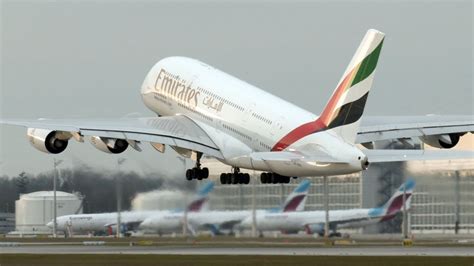
The route selection also demonstrates Emirates’ confidence in the Airbus A380 itself. Despite years of speculation about the future of very large aircraft, Emirates continues doubling down on the superjumbo as a cornerstone of its global strategy.
No airline in the world has committed more heavily to the A380 than Emirates.
Why Emirates Is Investing Billions Into Older Aircraft
Many airlines retired Airbus A380s during the pandemic era, believing smaller twin-engine jets would permanently dominate long-haul operations. Emirates took the opposite approach.
The carrier stored aircraft temporarily but consistently maintained that the A380 would remain central to its future.
That decision now appears increasingly justified.
International demand has rebounded strongly, particularly on major leisure corridors. Airports with slot constraints continue favoring larger aircraft capable of carrying more passengers per movement. At the same time, premium leisure travel has exploded globally.
Instead of abandoning its superjumbos, Emirates chose modernization.
Its retrofit program covers 219 aircraft in total, including 110 Airbus A380s and 109 Boeing 777s. The scale of the project is extraordinary and effectively gives large portions of the fleet a second commercial life.
For Emirates, replacing older interiors with modern premium-heavy cabins is considerably cheaper than acquiring entirely new fleets at today’s aircraft prices and delivery timelines.
The airline also gains another advantage: product consistency.
Historically, Emirates passengers often encountered dramatically different cabin experiences depending on the aircraft assigned to a route. Some A380s featured first class suites and premium economy, while others offered only business and economy cabins.
That inconsistency complicated marketing and customer expectations.
The new retrofits significantly reduce those variations.
The Economics Behind Fewer Seats And Higher Profits
At first glance, removing 46 seats from an aircraft might seem counterintuitive for profitability. In reality, the opposite may prove true.
Modern airline economics increasingly reward yield optimization rather than simple seat volume.
A premium economy seat can generate substantially higher revenue than an economy seat while occupying relatively limited additional cabin space. On many routes, airlines achieve disproportionately strong margins from premium economy because operational costs remain close to economy while fares rise considerably.
Emirates is essentially recalibrating the revenue profile of its densest A380 fleet.
The old 615-seat layout was optimized for sheer capacity. The new 569-seat aircraft are optimized for balanced profitability.
Business travelers, affluent leisure passengers, and long-haul tourists are increasingly willing to pay more for comfort upgrades, especially on overnight flights or journeys exceeding eight hours.
That trend has transformed premium economy from a niche product into a strategic necessity.
Several global airlines now consider premium economy one of the most important cabins onboard their fleets. Emirates’ rapid expansion confirms the airline sees the same long-term opportunity.
Emirates’ Premium Economy Network Is Expanding Rapidly
The airline has stated that premium economy service is expected to reach 99 destinations by the end of 2026.
That target illustrates just how aggressively Emirates intends to standardize the product throughout its network.
All 15 former 615-seat Airbus A380s are expected to complete retrofits by November, eliminating the airline’s densest configuration entirely. Once completed, passengers booking Emirates A380 flights will encounter a far more predictable onboard experience regardless of destination.
For travelers, the transformation delivers several immediate benefits:
- Greater availability of premium economy seats
- Expanded business class capacity
- More modern cabin interiors
- Improved consistency across routes
For Emirates, the benefits are even broader.
The airline strengthens its competitive position against rival Gulf carriers and major European airlines while extracting stronger revenue performance from existing aircraft assets.
In many ways, the redesigned 569-seat Airbus A380 symbolizes the next phase of global aviation. Airlines are no longer solely competing on network size or aircraft scale. Increasingly, they are competing on cabin segmentation, onboard comfort, and the ability to monetize premium demand efficiently.
Emirates’ newest A380 configuration shows that even the world’s largest passenger aircraft can evolve alongside changing traveler expectations.