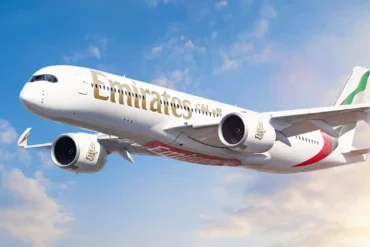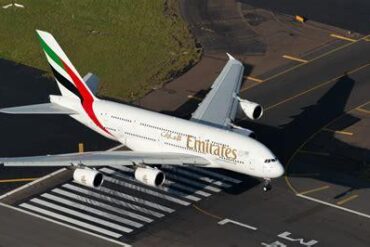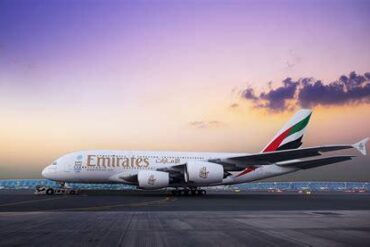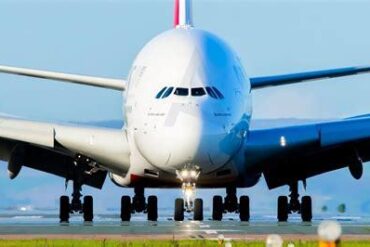
The Airbus A380 has long been synonymous with scale, prestige, and the ability to move enormous numbers of passengers across the globe. For years, Emirates built much of its long-haul strategy around the world’s largest passenger aircraft, leveraging its immense capacity to dominate some of the busiest international routes. Yet the arrival of Emirates’ newly reconfigured Airbus A380s marks a significant shift in philosophy. What appears on the surface to be a simple cabin upgrade is actually a carefully calculated trade-off involving passenger volume, profitability, fleet longevity, engineering complexity, and changing traveler expectations.
The debut of the first retrofitted high-density Airbus A380 on the Dubai-to-Birmingham route in May 2026 represents far more than a new seating arrangement. It reflects how airlines are adapting to a dramatically different aviation environment where premium demand is rising, aircraft deliveries are delayed, and maximizing revenue per flight has become more important than maximizing passenger numbers.
After years of operating some of the highest-capacity A380s in the world, Emirates is effectively rewriting the role of the superjumbo in its network.
Why Emirates Is Reducing Airbus A380 Capacity
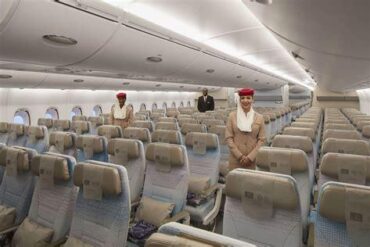
For decades, airline economics often revolved around one simple objective: carry as many passengers as possible while keeping costs under control. Emirates mastered this approach with its dense two-class Airbus A380 configuration, which accommodated an impressive 615 passengers.
The aircraft served as a highly efficient people-mover. With 557 economy seats packed into a single airframe, Emirates could spread operating costs across a vast number of travelers. Routes linking Dubai with major leisure destinations and regional British airports benefited significantly from this formula.
However, airline profitability has increasingly shifted away from pure volume.
Modern travelers are demonstrating a greater willingness to pay for enhanced comfort, particularly on long-haul journeys. Premium leisure travelers, affluent tourists, and corporate passengers who cannot justify business-class fares are creating unprecedented demand for intermediate cabin products.
Instead of focusing solely on filling every available seat, airlines are increasingly asking a different question: how much revenue can each square meter of cabin space generate?
That question sits at the heart of Emirates’ A380 transformation.
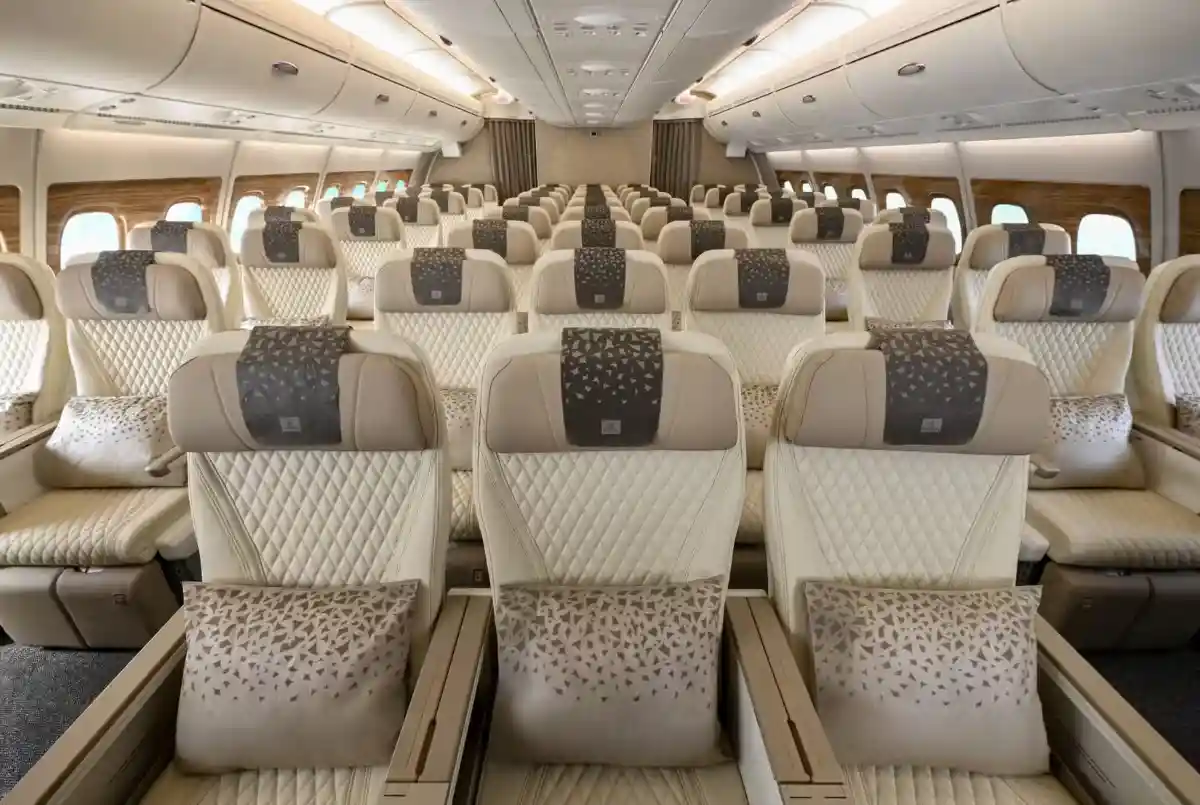
The reconfigured aircraft reduces total seating capacity from 615 passengers to 569. On paper, removing 46 seats might appear counterintuitive during an era of strong travel demand. In reality, those removed seats create space for significantly more profitable products.
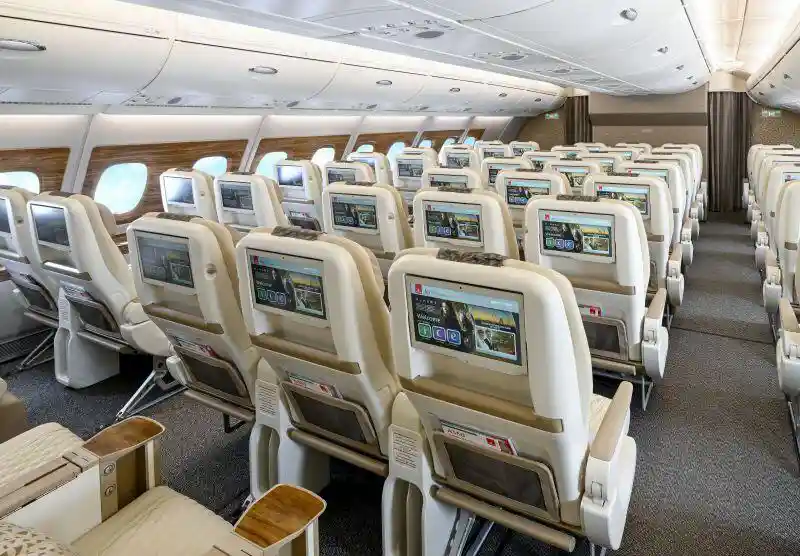
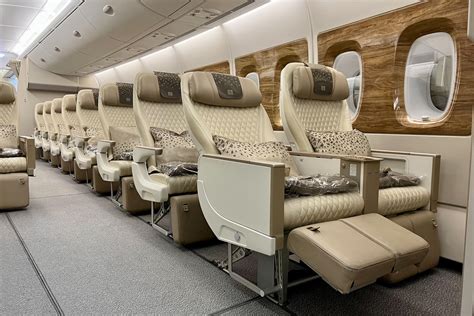
The new layout introduces 56 premium economy seats while simultaneously expanding business-class capacity. These additions allow Emirates to capture higher-paying travelers who may never have considered booking economy but still find traditional premium cabins too expensive.
This strategic shift highlights a growing reality in global aviation: fewer passengers can sometimes produce more revenue.
The Rise of Premium Economy as Aviation’s Most Valuable Cabin
Perhaps the most important element of the retrofit is not the reduction in capacity itself but the introduction of premium economy on formerly high-density aircraft.
Premium economy has evolved into one of the airline industry’s fastest-growing revenue segments. Positioned between economy and business class, it appeals to travelers seeking extra comfort without paying several times the price of a standard ticket.
The cabin attracts a remarkably diverse customer base. Leisure travelers celebrating special occasions often view premium economy as an affordable luxury. Business travelers restricted by corporate travel policies frequently find it to be the highest class their employers permit. Meanwhile, frequent flyers looking for additional comfort on overnight flights increasingly consider it the ideal balance between cost and experience.
For Emirates, premium economy offers something equally valuable: predictability.
Unlike first class, which can experience fluctuating demand depending on seasonality, route characteristics, and economic conditions, premium economy consistently attracts passengers across a broad range of markets.
This consistency is especially attractive on routes where every available seat must generate maximum financial return.
The Hidden Economics Behind Cabin Space
One of the most fascinating aspects of the Airbus A380 retrofit lies in how Emirates is reassessing cabin real estate.
Every section of an aircraft represents a revenue-generating asset. Airline planners constantly evaluate whether a given area should be used for high-density seating or low-density luxury accommodations.
The contrast becomes particularly striking when comparing premium economy and first class.
A cabin footprint capable of accommodating just 14 first-class suites can instead house approximately 56 premium economy passengers. While first-class tickets command exceptional fares, they also rely on a relatively small pool of customers.
Premium economy, by comparison, delivers substantially higher passenger density while maintaining significantly higher ticket prices than standard economy.
This creates a more stable and predictable revenue stream.
Rather than depending on occasional ultra-premium travelers, Emirates can consistently fill a larger number of premium economy seats with passengers willing to pay moderate fare premiums.
The result is a business model designed around sustainable profitability rather than prestige alone.
The Engineering Challenge Hidden Beneath the Cabin
Replacing seats is often perceived as a straightforward task. The reality inside a modern Airbus A380 is far more complex.
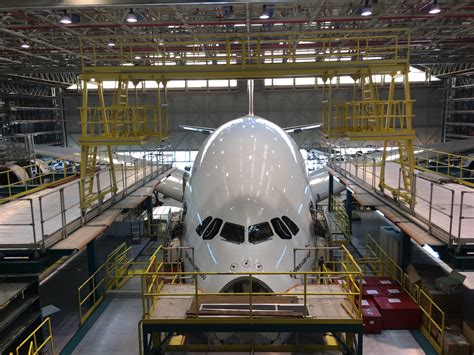
Transforming a high-density superjumbo into a multi-class premium aircraft requires extensive structural modifications. Entire sections of the aircraft must be dismantled and rebuilt to support new cabin arrangements.
The retrofit of airframe A6-EUX demonstrates the scale of the challenge.
Emirates Engineering removed 120 economy seats from the upper deck before beginning the reconstruction process. Technicians then relocated galleys, adjusted overhead storage systems, rebuilt partitions, modified electrical networks, and rerouted plumbing infrastructure.
These modifications are necessary because the original aircraft were never designed to support the specific requirements of premium economy and expanded business-class installations.
Advanced seat electronics, upgraded entertainment systems, enhanced power supply networks, and redesigned service areas all require extensive reengineering.
The first conversion demanded approximately 35,000 man-hours of labor performed by a specialized team of 50 engineers.
More than 2,500 different replacement components were required to complete the project.
This level of intervention transforms the retrofit from a cosmetic refresh into something approaching a complete interior reconstruction.
How Supply Chain Delays Revived the Airbus A380
The resurgence of the Airbus A380 is one of the aviation industry’s most unexpected developments.
Only a few years ago, many analysts viewed the aircraft as a symbol of an outdated era. Production ended, several airlines retired their fleets, and predictions of the superjumbo’s decline appeared inevitable.
Yet the global aviation landscape changed dramatically.
Manufacturers across the aerospace industry continue to face production bottlenecks and supply chain disruptions. Deliveries of next-generation aircraft have been delayed repeatedly, forcing airlines to rely on existing fleets for longer than originally planned.
For Emirates, delays involving the Boeing 777X have become a major strategic consideration.
Instead of waiting for replacement aircraft, the airline has chosen to maximize the value of the assets already under its control.
The retrofit program effectively extends the economic relevance of the Airbus A380 while ensuring that passengers continue receiving modern onboard products.
By upgrading existing aircraft instead of depending solely on future deliveries, Emirates gains greater operational flexibility and reduces vulnerability to external manufacturing delays.
The strategy demonstrates that the future of an aircraft is not determined solely by production status. It is also determined by how effectively operators adapt the platform to changing market conditions.
The Democratization of the Airbus A380 Upper Deck
One of the most visible consequences of the retrofit involves the aircraft’s iconic upper deck.
Historically, the upper deck functioned as an exclusive zone reserved almost entirely for premium passengers. Business-class and first-class travelers enjoyed a quieter environment physically separated from the crowded economy cabins below.
The new configuration fundamentally alters this dynamic.
Premium economy passengers now gain access to the upper deck experience previously enjoyed primarily by premium-cabin travelers.
This shift may seem minor from an operational perspective, but it carries significant psychological implications.
The upper deck has always been one of the Airbus A380’s most distinctive features. Its curved sidewalls, quieter atmosphere, and more intimate cabin environment create a noticeably different travel experience.
By opening this space to a broader segment of travelers, Emirates is effectively expanding the perceived value of premium economy.
Passengers paying modest fare premiums receive not only larger seats and improved service but also access to one of commercial aviation’s most unique environments.
This creates a compelling product differentiation strategy that competitors may find difficult to replicate.
Why Slot-Constrained Airports Make the Strategy More Attractive
The retrofit becomes even more logical when viewed through the lens of airport infrastructure.
Many of Emirates’ most important destinations operate under strict slot constraints. Airports such as London Heathrow and Birmingham limit the number of available takeoff and landing opportunities.
When an airline cannot add additional flights, increasing revenue from each existing flight becomes critical.
In these circumstances, replacing low-yield economy seats with higher-yield premium products can significantly improve profitability without requiring additional airport access.
The Airbus A380 remains uniquely valuable in this environment because it allows Emirates to maintain enormous capacity while simultaneously increasing revenue per passenger.
Rather than deploying smaller aircraft more frequently, the airline can continue leveraging the A380’s unmatched scale while refining the revenue potential of every flight.
The Operational Risks of a Mixed Airbus A380 Fleet
Despite the advantages, the transition is not without challenges.
Managing multiple cabin configurations across the same aircraft type introduces operational complexity. Passengers booking premium economy expect consistency, yet not every Airbus A380 currently features the new layout.
Scheduling teams must carefully assign aircraft to routes while minimizing disruptions caused by maintenance requirements, fleet substitutions, and operational irregularities.
Any last-minute aircraft swap could potentially affect seat availability and passenger expectations.
As additional aircraft undergo conversion, these challenges should gradually diminish. Emirates plans to retrofit 15 high-density A380s by the end of 2026, steadily increasing fleet standardization.
Until then, network planners must balance customer expectations with operational realities.
The Long-Term Future of Emirates’ Airbus A380 Strategy
The retrofit program reveals a broader truth about modern airline economics.
The Airbus A380 is no longer being optimized solely for maximum passenger volume. Instead, it is being transformed into a platform capable of generating higher yields through carefully balanced cabin segmentation.
Emirates is effectively betting that premium demand will remain strong enough to justify sacrificing some capacity in exchange for greater revenue potential.
Early indicators suggest the strategy aligns closely with evolving passenger preferences. Travelers increasingly prioritize comfort, personal space, and enhanced onboard experiences. Airlines that successfully capture these preferences stand to generate stronger margins even when carrying fewer passengers.
The newly configured Airbus A380 therefore represents more than a cabin refresh. It symbolizes the evolution of the superjumbo from a capacity-focused giant into a sophisticated revenue-maximization tool.
As manufacturing delays continue, premium demand remains robust, and slot restrictions persist across major global hubs, Emirates’ decision may ultimately become one of the most influential fleet optimization strategies of the decade.
Far from signaling the twilight of the Airbus A380, these extensive retrofits suggest that the world’s largest passenger aircraft still has a crucial role to play in the future of long-haul aviation. The aircraft may carry fewer people than before, but every seat now works harder, generates greater value, and reflects a changing reality in the economics of global air travel.