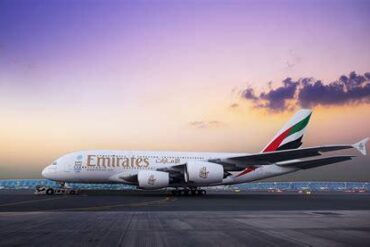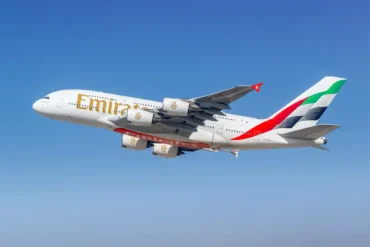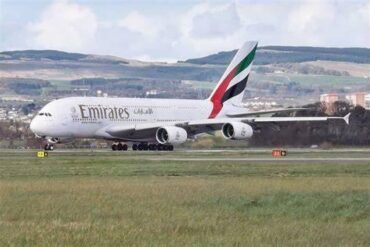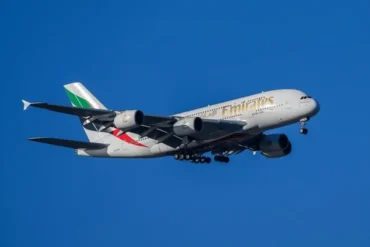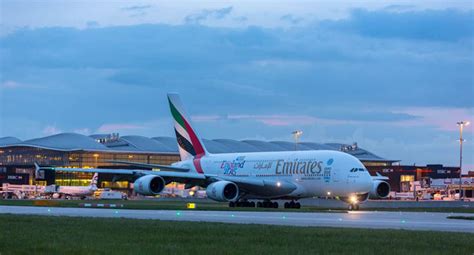
Emirates has restored six daily services between Dubai International Airport (DXB) and London Heathrow Airport (LHR) for July, but the airline has introduced an unexpected operational adjustment by temporarily replacing selected Airbus A380 flights with the Boeing 777-300ER. While the carrier has resumed its pre-reduction frequency after operating only five daily flights in June, passengers traveling during parts of July will notice that not every departure is operated by the iconic double-decker aircraft.
The temporary aircraft substitution follows recent operational challenges across the Middle East, including disruptions linked to the ongoing conflict involving Iran. Although Emirates has not permanently altered its Heathrow strategy, the short-term deployment of the Boeing 777 demonstrates how rapidly airlines continue adapting schedules to changing operational conditions while maintaining capacity on one of the world’s busiest long-haul routes.
The Dubai–Heathrow corridor remains one of Emirates’ flagship international markets. The airline continues to dominate the route with multiple daily departures, carrying both point-to-point travelers and thousands of connecting passengers heading between Europe, Asia-Pacific, Africa, and the Middle East through its Dubai hub.
Emirates Returns to Six Daily Heathrow Flights
After reducing operations throughout much of June, Emirates restored its six daily flights between Dubai and Heathrow on July 1. The six-flight schedule was last consistently available during May before temporary operational adjustments reduced overall frequencies.
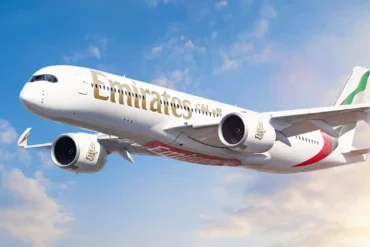
Although the restoration represents a return to normal service levels, the aircraft roster is no longer exclusively centered around the Airbus A380. During selected dates, one rotation will instead be operated by the Boeing 777-300ER, creating one of the few periods in recent years when Heathrow sees a mixed Emirates fleet rather than an all-A380 operation.
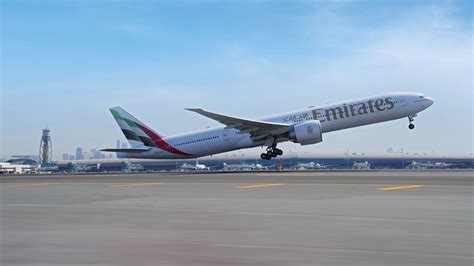
The Boeing 777-300ER is scheduled to operate from July 1 through July 14 and again between July 27 and July 31. Earlier schedules indicated the substitution would end in mid-July, but updated operational planning extended the deployment through the final days of the month, highlighting how airline scheduling continues to evolve even after publication.
Why Emirates Is Deploying the Boeing 777-300ER
Despite Heathrow being synonymous with Emirates’ Airbus A380 operation, the Boeing 777 substitution represents only a minor adjustment within an exceptionally large schedule.
Two versions of the Boeing 777-300ER may appear during the affected flights:
- 360-seat three-class configuration with First Class
- 328-seat four-class configuration
Meanwhile, most Heathrow services continue using various Airbus A380 layouts, including aircraft configured with:
- 484 seats
- 487 seats
- 517 seats
- 519 seats
Because Heathrow is among the world’s most slot-constrained airports, Emirates generally maximizes passenger capacity by assigning its largest aircraft. Even so, the Boeing 777 remains capable of maintaining premium cabin offerings while providing operational flexibility during periods of fleet adjustments.
Full Emirates Heathrow Passenger Schedule for July
Emirates continues operating six daily departures in each direction throughout July.
| Arrival at Heathrow | Departure from Heathrow | Aircraft |
|---|---|---|
| 7:05 AM | 9:05 AM | 487-seat Airbus A380 |
| 12:25 PM | 2:20 PM | 484-seat Airbus A380 |
| 2:25 PM | 4:50 PM | 517-seat Airbus A380 |
| 4:10 PM | 7:50 PM | 519-seat Airbus A380 or Boeing 777-300ER (selected July dates) |
| 6:40 PM | 8:40 PM | 484-seat Airbus A380 |
| 8:15 PM | 10:15 PM | 484-seat Airbus A380 |
The only service receiving the temporary Boeing 777 substitution is the rotation arriving Heathrow at 4:10 PM and departing Heathrow at 7:50 PM during the specified periods.
The EK31 Rotation Is the One Seeing Aircraft Changes
The aircraft substitution affects EK31, which departs Dubai at 11:25 AM before arriving in London at 4:10 PM local time.
Unlike Emirates’ overnight and early morning departures, this late-morning service offers comparatively fewer onward connection opportunities from inbound regional flights. As a result, it primarily serves travelers whose journeys either begin in Dubai or require flexible accommodation following earlier delays or schedule changes.
Operationally, this makes EK31 one of the easier services for Emirates to assign a smaller aircraft without significantly disrupting its broader global connection network.
Heathrow Continues to Be One of Emirates’ Most Important Markets
Despite the temporary aircraft adjustment, Heathrow remains among Emirates’ highest-profile destinations worldwide.
During the twelve months ending April 2026, approximately 1.5 million passengers traveled directly between Dubai and London Heathrow. The route continues generating exceptionally strong local demand thanks to business travel, tourism, premium leisure traffic, and the extensive commercial relationship between the United Kingdom and the United Arab Emirates.
Equally important is Heathrow’s role within Emirates’ global hub-and-spoke network. Every day, thousands of passengers transfer through Dubai, allowing the airline to efficiently connect Europe with destinations throughout Asia, Africa, Australia, and the Indian Ocean.
Dubai Continues to Power Emirates’ Global Connecting Network
Nearly 950,000 passengers connected through Dubai between Heathrow and another Emirates destination during the same twelve-month period. On an average day, roughly 2,500 travelers used Dubai solely as a transfer hub before continuing onward.
India remains Emirates’ largest connecting market from Heathrow, followed by Australia, Pakistan, Thailand, New Zealand, the Maldives, South Africa, Indonesia, Mauritius, and the Philippines.
At the airport level, the strongest onward destinations include Melbourne, Sydney, Brisbane, Malé, Islamabad, Mauritius, Bangkok, Colombo, Auckland, and Lahore. These routes demonstrate why Emirates continues scheduling multiple daily Heathrow departures despite occasional aircraft substitutions, as each flight supports both local demand and one of the world’s largest international connecting networks.
Temporary Changes, Not a Long-Term Shift
While the Boeing 777-300ER makes a rare appearance on selected Heathrow services during July, the adjustment should be viewed as a short-term operational measure rather than a strategic fleet change. The Airbus A380 remains the backbone of Emirates’ Heathrow operation, reflecting the airline’s long-standing commitment to maximizing capacity at one of the world’s busiest and most slot-restricted international airports.
Passengers traveling during the affected dates should simply expect a different aircraft on one daily rotation, while the remaining services continue showcasing the airline’s flagship Airbus A380 fleet across the busy Dubai–London corridor.