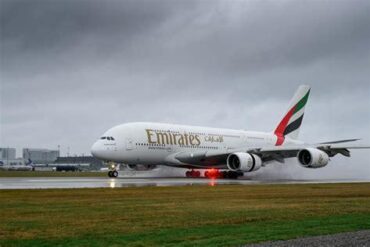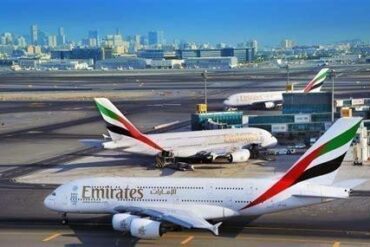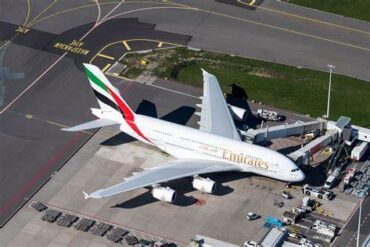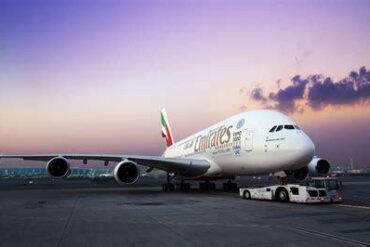
Emirates is preparing to close a remarkable chapter in commercial aviation: the retirement of the world’s highest-capacity operational passenger aircraft, its 615-seat Airbus A380. By November, the Gulf carrier’s 15 ultra-dense, two-class superjumbos will be transformed into three-class aircraft featuring 569 seats, marking a decisive shift from maximum volume to premium yield.
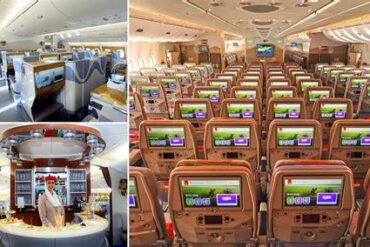
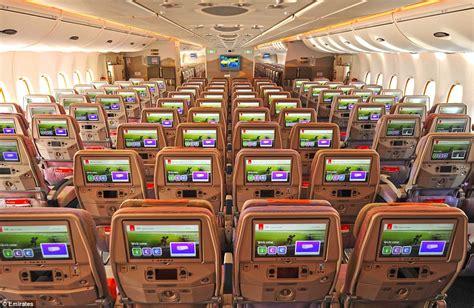
For years, the 615-seat configuration stood as a symbol of Emirates’ scale-driven ambition. With 58 business class seats and an astonishing 557 economy seats, the layout pushed the A380’s capacity envelope further than any other airline in scheduled service. Compared to Emirates’ other A380 variants—typically carrying between 468 and 487 passengers across three or four classes—this was a high-density machine built to move leisure traffic at formidable scale.
Yet aviation economics evolve. Cabin mix now matters as much as seat count. Emirates’ decision to retrofit these aircraft underscores a strategic pivot: fewer seats overall, but more seats that command higher fares.
A Strategic Farewell To The 615-Seat A380
The transformation is not cosmetic. It is structural and revenue-driven. The current 615-seat aircraft allocate just 9% of total capacity to business class, reflecting their low-premium orientation. Under the new configuration, business class will expand from 58 to 76 seats, representing a 31% increase. The proportion of business seats rises to 13% of total capacity, aligning these aircraft with the rest of Emirates’ A380 fleet.
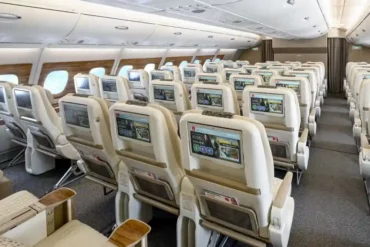
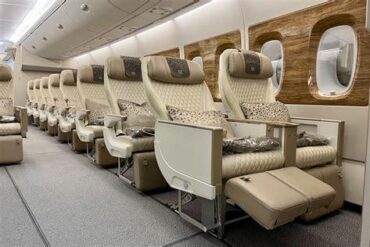
More significantly, the retrofit introduces 56 premium economy seats in a 2-4-2 layout, featuring a generous 40-inch seat pitch, upgraded dining, Royal Doulton china tableware, and stainless-steel cutlery. When combined, business and premium economy will account for 23% of total seats, up from just 9% today.
To accommodate this shift, the economy cabin will shrink by 120 seats, falling from 557 to 437. The total seat count drops from 615 to 569—a reduction of 46 seats—but the revenue potential per flight rises materially.
This move mirrors a broader industry recalibration. British Airways, for example, is also reducing A380 density, cutting capacity from 469 to 421 seats as it rebalances toward premium demand.
Premium Economy: From Late Arrival To Fleet Standard
Emirates was notably cautious in adopting premium economy, resisting the trend while many competitors embraced the “in-between” cabin. That hesitation has now given way to acceleration. The airline’s new Airbus A350s feature premium economy as standard, and the A380 retrofit program signals full institutional commitment.
Premium economy occupies a valuable middle ground: priced significantly above standard economy yet below business class, it attracts leisure travelers seeking comfort and corporate travelers bound by stricter travel policies. For Emirates, whose network spans high-volume leisure destinations and connecting long-haul markets, the cabin adds pricing flexibility without sacrificing seat density entirely.
The 569-seat A380 will still be a high-capacity aircraft. It simply becomes more diversified in how those seats are monetized.
Deployment Timeline And Early Routes
The first two retrofitted aircraft are scheduled to enter service by mid-April, with all 15 completed by November. Retrofitting widebody aircraft is complex—structural modifications, cabin rewiring, certification checks—yet the timeline reflects a coordinated push to accelerate the rollout.
According to current schedule data, the inaugural route for the 569-seat A380 will be Dubai–Amman, operating as EK903 and EK904 beginning April 14. The outbound flight departs Dubai at 2:15 pm, arriving in Jordan at 4:30 pm local time. The return leg leaves at 6:15 pm, landing in Dubai at 10:25 pm, feeding onward connections across Asia-Pacific.
Dubai–Amman is Emirates’ third-shortest regular A380 route after Jeddah and Mumbai. Its selection is noteworthy because Amman no longer routinely sees the 615-seat configuration, instead receiving other multi-class A380 variants. The introduction of the 569-seat layout provides operational flexibility while debuting premium economy on the sector.
Prague: The First Medium-Haul Showcase
While Amman marks the technical debut, Prague will become the first longer route to consistently feature the reconfigured aircraft. At 2,412 nautical miles (4,467 km), Dubai–Prague represents a medium-haul European market served by Emirates since 2010.
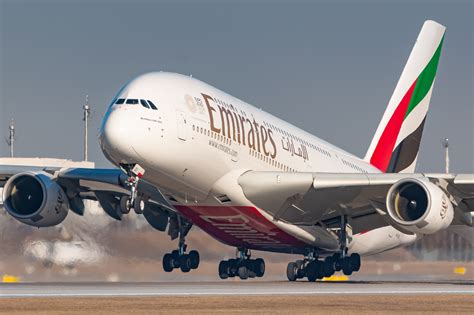
The A380 first appeared regularly on the route in May 2016, and the 615-seat version has operated daily since December 2024. Its final scheduled departure in that configuration is set for May 31. From June 1 onward, the 569-seat A380 will take over, introducing premium economy to the Czech capital for the first time.
Prague’s profile—strong leisure demand, consistent tourism flows, and steady connecting traffic—makes it an ideal proving ground for the new cabin mix. The shift illustrates Emirates’ recalibrated objective: preserve volume while extracting higher yields.
The Economics Behind The Seat Reduction
On paper, reducing seat count might appear counterintuitive for an airline famous for scale. In practice, aircraft profitability hinges on yield per available seat kilometer (RASK) as much as raw capacity. A smaller cabin with higher average ticket revenue can outperform a packed aircraft filled with low-fare passengers.
The 615-seat A380 was a marvel of density, but density alone no longer defines competitiveness. Post-pandemic travel patterns reveal sustained premium demand, particularly on long-haul routes. Airlines increasingly optimize for cabin mix rather than maximum headcount.
By standardizing its A380 layouts closer to a three-class template, Emirates also simplifies fleet planning, crew training, catering logistics, and maintenance workflows. Commonality reduces operational complexity across its superjumbo fleet.
The End Of An Era For The Densest Passenger Aircraft
The 615-seat Airbus A380 represented the zenith of high-capacity commercial aviation—a machine engineered to move enormous passenger volumes between global hubs. Its retirement does not signal the end of the A380 itself, but it does mark the conclusion of the densest configuration still flying in scheduled service.
The aircraft will remain a central pillar of Emirates’ long-haul strategy. It will simply carry fewer passengers, in more varied cabins, at higher margins.
Aviation evolves through cycles of ambition and adjustment. The 615-seat giant embodied the era of unrestrained growth and hub dominance. The forthcoming 569-seat variant reflects a more calibrated strategy—one that balances capacity with profitability, scale with segmentation, and spectacle with sustainability.