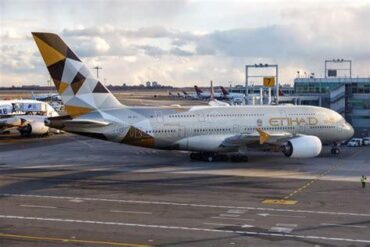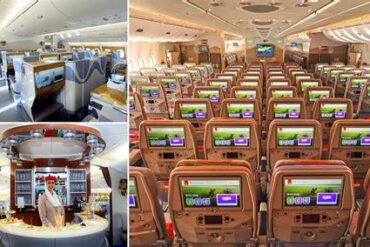
Emirates is sharpening its premium proposition on one of the world’s most competitive long-haul corridors. Beginning April 1, 2026, the Dubai-based carrier will introduce its retrofitted four-class Airbus A380 on select flights between Dubai International Airport (DXB) and New York John F. Kennedy International Airport (JFK), marking a significant expansion of its highly regarded Premium Economy cabin into the U.S. market. The deployment starts with four weekly services on the EK201/202 rotation—Mondays, Wednesdays, Fridays, and Saturdays—before scaling up to daily operations from June 1, just ahead of peak summer demand.
This move is not symbolic. It signals Emirates’ strategic confidence in the New York market, long a cornerstone of transatlantic and global premium traffic. JFK has always been a battleground for high-yield passengers—corporate travelers, international financiers, luxury leisure flyers—and the addition of Premium Economy strengthens Emirates’ position between its Business and Economy cabins, capturing travelers seeking elevated comfort without the full Business Class fare.
For years, Emirates and several Gulf competitors resisted adding a fourth cabin. The airline built its brand on a sharp three-class hierarchy—lavish First Class suites, high-spec Business Class, and generous long-haul Economy. Yet shifting passenger expectations and rising demand for a mid-tier premium product reshaped that calculus. The result is a meticulously designed Premium Economy cabin that blends aesthetics, space, and service differentiation in a way that feels intentional rather than retrofitted as an afterthought.
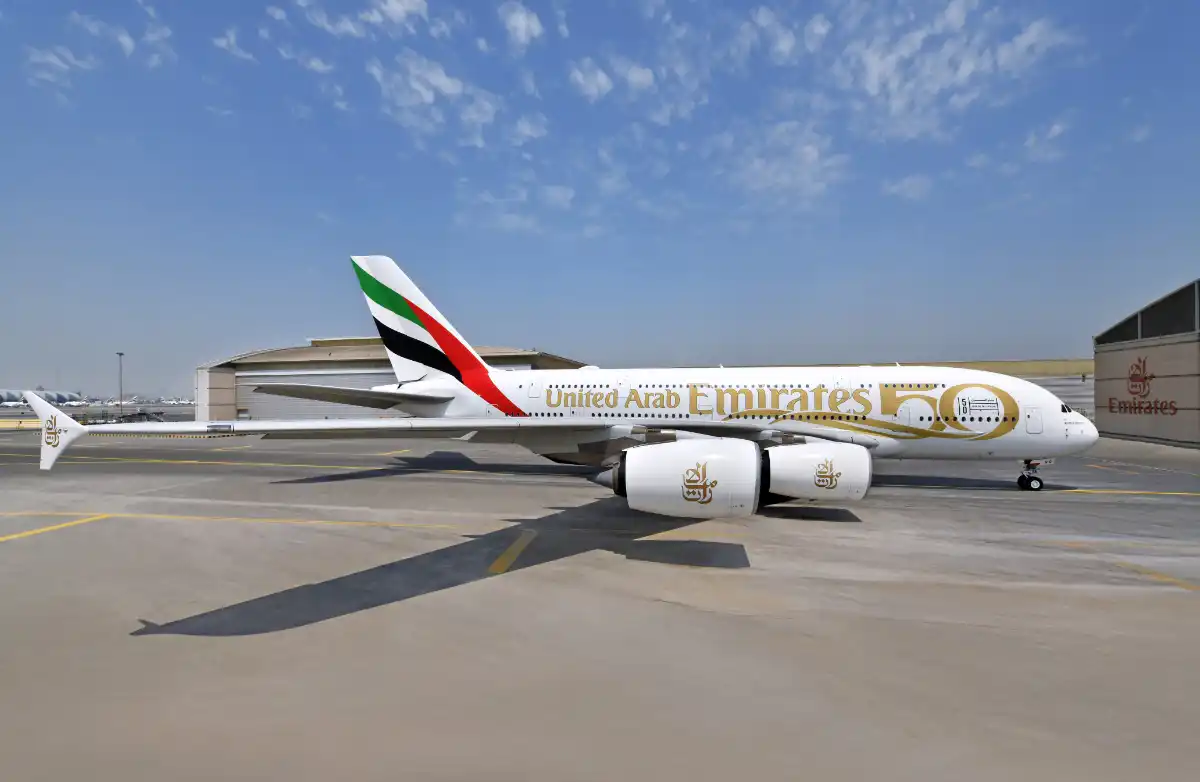
Emirates Premium Economy Arrives at JFK: A Strategic Expansion
The retrofitted A380 serving JFK is configured with four distinct cabins: First, Business, Premium Economy, and Economy. This configuration reflects Emirates’ ongoing multi-billion-dollar cabin refurbishment program, which continues to modernize its flagship double-decker fleet.
The airline has confirmed that, as part of the same retrofit initiative, it will complete the upgrade of its first high-density two-class A380 by mid-April, reconfiguring it into a three-class layout. That broader fleet transformation underscores a long-term investment strategy rather than a short-term marketing gesture.
By expanding Premium Economy on the JFK route, Emirates is targeting travelers who increasingly prioritize comfort, personal space, and upgraded dining without stepping into lie-flat territory. In the competitive New York–Dubai corridor—where nonstop ultra-long-haul flights demand endurance—the value proposition is particularly compelling.
Inside the Retrofitted Airbus A380: Cabin Layout and Seating Experience
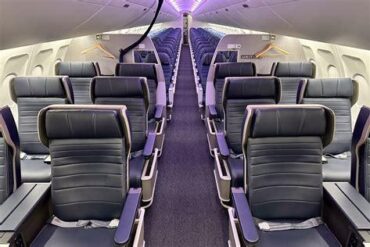
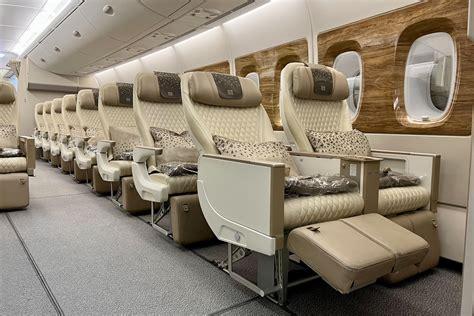
Onboard the Emirates A380, the Premium Economy cabin features 56 seats arranged in an eight-abreast 2-4-2 configuration on the lower deck. Positioned at the front of the main deck, the cabin benefits from a quieter, more exclusive atmosphere, separated from the denser 3-4-3 Economy cabin behind it.
The seat dimensions tell a clear story. Premium Economy passengers receive:
- 40 inches of seat pitch
- 19.5 inches of seat width
- 8 inches of recline
By comparison, the Economy cabin offers 32–34 inches of pitch, 18 inches of width, and five inches of recline—respectable by global standards, but distinctly less spacious.
The difference becomes tangible on a 14-hour sector. Those additional inches translate into improved circulation, more relaxed sleeping posture, and greater workspace flexibility. The seats are finished in a refined cream leather, accented with wood-grain trim, projecting a subtle design language that aligns more closely with Business Class than Economy.
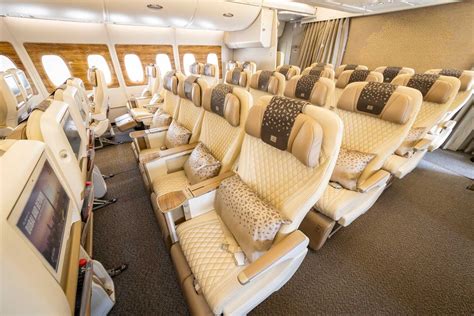
One standout feature is the raised cushioned leg rest, which extends significantly when the seat reclines. Unlike simple footrests found in some competing products, this design supports the lower legs more comprehensively, reducing fatigue on ultra-long-haul sectors. It is a functional detail that frequent travelers will immediately appreciate.
Each seat is equipped with a 13.3-inch HD entertainment screen, providing access to Emirates’ ICE inflight entertainment system—one of the industry’s most expansive content libraries. The hardware feels proportionate to the cabin’s positioning, offering a clear upgrade over Economy’s screen size and overall interface presentation.
Elevated Dining and Service: More Than Just Extra Space
Emirates has deliberately framed its Premium Economy as an “elevated dining experience,” and the distinction extends beyond marketing language. Meals are presented on chinaware rather than disposable trays, accompanied by premium beverages and curated menus that reflect longer-haul catering standards.
The service flow also benefits from the smaller cabin size. With only 56 seats, the ratio between crew and passengers allows for more attentive interactions and a calmer service cadence. On a route like Dubai–New York, where time-zone shifts and fatigue are unavoidable, these softer elements—service pacing, lighting ambiance, cabin separation—contribute meaningfully to perceived comfort.
Premium Economy occupies an increasingly important psychological space in aviation. It bridges aspiration and practicality. For corporate travelers whose budgets no longer support Business Class across every long-haul segment, and for leisure passengers celebrating milestone trips, it offers tangible differentiation without the cost of a fully flat bed.
A380 Retrofit Program Signals Long-Term Commitment
The JFK deployment is part of a broader expansion. Emirates is steadily introducing Premium Economy across its network, including select Boeing 777s, Airbus A350s, and additional A380 routes. In Europe, Zürich will see four-class A380 service, while Milan and Dublin are set to receive 777s equipped with the upgraded cabin. Destinations such as Mauritius, Basra, Ho Chi Minh City, Entebbe, and Hong Kong are also joining the rollout.
By year’s end, Emirates plans to offer Premium Economy on flights to 99 destinations, a scale that transforms the product from novelty to network standard.
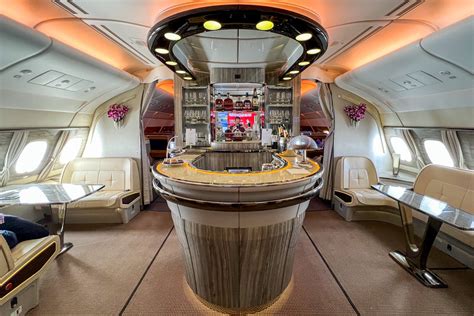
The retrofit program itself is complex. Reconfiguring an A380 is not a cosmetic exercise; it involves structural adjustments, seat installation, wiring modifications, galley redesigns, and certification processes. That Emirates continues investing in its A380 fleet—despite global retirements of the type elsewhere—reinforces the aircraft’s importance to its long-haul strategy. The double-decker remains uniquely suited to high-capacity premium markets like New York, where slot constraints and demand density justify its scale.
Reinforcing Emirates’ Competitive Edge in the U.S. Market
The New York deployment strengthens Emirates’ positioning in North America, where competition from U.S. legacy carriers and European connectors remains intense. By enhancing its mid-tier product, the airline expands its appeal across multiple price sensitivities while preserving its flagship First and Business Class differentiation.
JFK passengers will now have access to a four-class hierarchy that reflects evolving global travel preferences. The introduction of Premium Economy is not merely about adding seats; it represents a recalibration of value, space, and passenger expectation on one of the airline’s most visible routes.
In the long-haul arena, inches matter. So does perception. Emirates’ decision to bring its retrofitted four-class A380 to New York ensures that both are working firmly in its favor.