The Indian Ocean became the center of an unexpected naval crisis in early March 2026, after a U.S. submarine torpedoed the Iranian frigate IRIS Dena, triggering a chain of events that ultimately placed another Iranian naval vessel, the fleet replenishment ship IRIS Bushehr, under the control of Sri Lankan authorities. What began as a routine naval deployment by Iran evolved into a complex maritime emergency involving rescue operations, geopolitical sensitivities, and the delicate balance of neutrality for Sri Lanka.
The episode unfolded near Sri Lanka’s southern maritime approaches, a region that lies along some of the most strategically important sea lanes in the world. Following the sudden sinking of the Iranian warship, the nearby support vessel IRIS Bushehr reported mechanical trouble and requested emergency assistance from Sri Lanka. In response, Sri Lankan naval authorities launched a humanitarian operation that eventually led to the evacuation of more than two hundred Iranian sailors and the placement of the vessel under state supervision.
For Colombo, the situation was uniquely sensitive. The country found itself handling the aftermath of a major naval incident involving Iran and the United States, two states locked in escalating tensions across several theaters. While Sri Lanka has traditionally maintained a policy of neutrality, its obligation under maritime law to respond to distress calls forced the government to intervene directly.
U.S. Submarine Attack That Triggered the Crisis
The chain of events began during the early hours of March 4, 2026, when distress signals were detected roughly 19 nautical miles off the port of Galle. Sri Lankan naval monitoring systems picked up emergency transmissions from a vessel under attack in the Indian Ocean. Within minutes, maritime response units were mobilized, including patrol ships and reconnaissance aircraft from both the Sri Lankan Navy and Air Force.
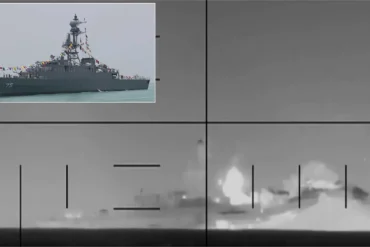
The targeted vessel was later confirmed to be the Iranian Navy frigate IRIS Dena, a Moudge-class warship operating as part of an Iranian naval group traveling through the region. According to multiple reports, the frigate was struck by a torpedo fired from a United States submarine, widely believed to be the Los Angeles-class attack submarine USS Charlotte (SSN-766).
The torpedo strike proved catastrophic. The Iranian warship sank in the Indian Ocean with approximately 180 personnel on board, transforming the situation into a large-scale search-and-rescue operation. Sri Lankan rescue teams recovered 32 survivors from the water, while divers and patrol vessels located dozens of bodies during the initial recovery phase. Several reports indicated that the death toll eventually climbed to around 87 sailors, with additional crew members unaccounted for during the early stages of the search.
Oil slicks and drifting life rafts were spotted across a wide area of ocean, highlighting the violence of the attack and the speed at which the frigate had gone down.
Iranian Fleet Deployment Before the Incident
The Iranian naval group had not been operating secretly. In fact, the deployment had originally been connected to multinational naval activities in the region, including participation in maritime events linked to India’s International Fleet Review 2026 and the MILAN naval exercise.
Iran had formally requested permission from Sri Lanka on February 26 for three naval vessels to conduct a cooperative port visit between March 9 and March 13. The proposed visit included the frigate IRIS Dena, the replenishment ship IRIS Bushehr, and a third Iranian naval vessel whose identity was not publicly confirmed at the time.
While the request was still under review, the Iranian ships remained positioned outside Sri Lanka’s exclusive economic zone (EEZ) but within operational proximity of the island. The situation initially appeared routine for a long-range naval deployment. Iranian warships frequently conduct extended voyages through the Arabian Sea, Gulf of Aden, and Indian Ocean to demonstrate blue-water operational capability.
However, the unexpected submarine strike radically altered the circumstances, placing Sri Lanka at the center of an unfolding maritime emergency.
Mechanical Failure Forces IRIS Bushehr to Seek Help
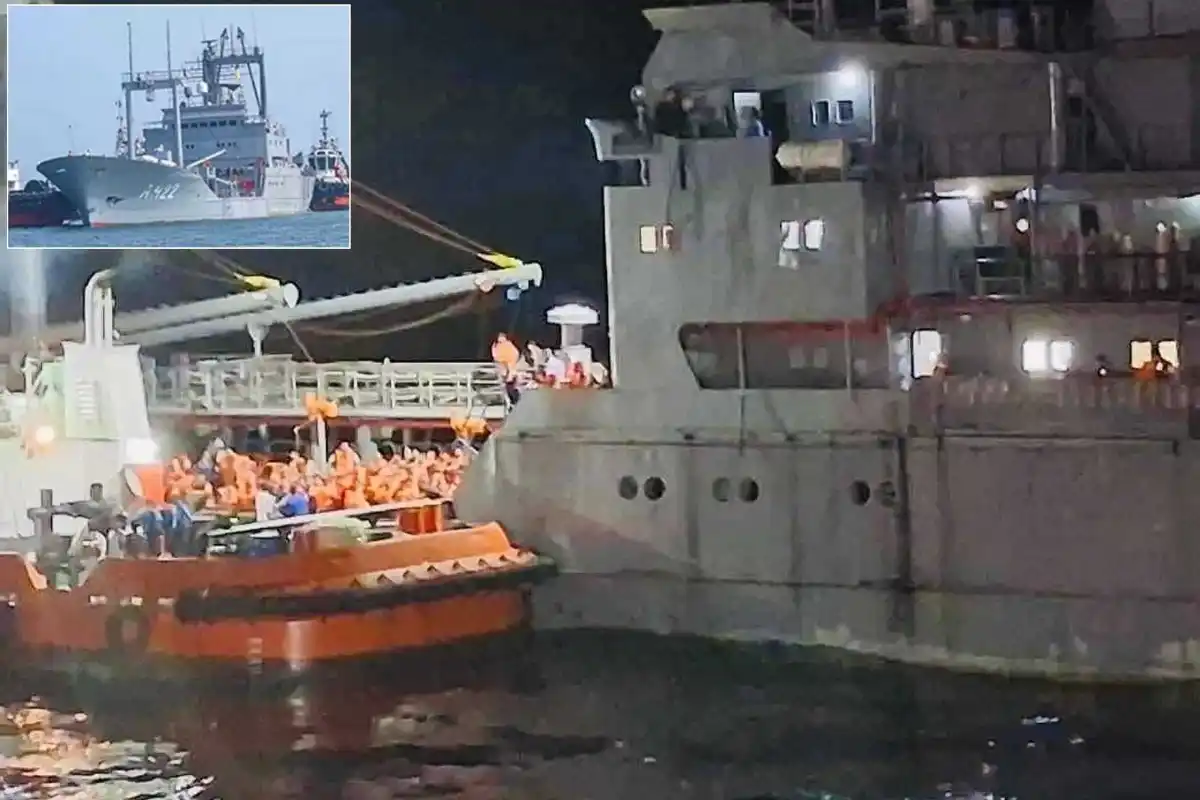
Just hours after the torpedo attack on IRIS Dena, the Iranian auxiliary vessel IRIS Bushehr (422) reported a serious engine malfunction while operating near Sri Lankan waters. The ship’s captain contacted Sri Lankan authorities requesting permission to enter port for assistance.
Sri Lanka faced a complex decision. The vessel belonged to a navy involved in a recent combat incident in nearby waters, yet maritime law obliges coastal states to assist vessels in distress when possible. After consultations with Iranian diplomatic representatives and naval officials aboard the ship, Sri Lanka granted emergency permission for assistance operations.
The government soon decided to evacuate the majority of the crew and assume temporary supervision of the ship. This move ensured safety for the personnel while allowing Sri Lanka to maintain operational control of the situation within its maritime jurisdiction.
Large-Scale Crew Evacuation Operation
Sri Lankan naval vessels moved quickly to transfer the crew from the Iranian support ship. In total, 208 personnel were evacuated from IRIS Bushehr during the operation.
The group represented a diverse cross-section of the ship’s company, including:
- 53 officers
- 84 cadet officers
- 48 senior sailors
- 23 enlisted sailors
After evacuation, the personnel were transported to Colombo, where they underwent medical examinations and immigration processing. Sri Lankan authorities later moved them to facilities at Welisara Naval Base, located north of the capital.
This decision served two purposes: ensuring the safety of the Iranian sailors and preventing a large foreign military crew from remaining aboard a vessel undergoing technical difficulties in Sri Lankan waters.
Escort to Trincomalee Under Sri Lankan Supervision
With most of the crew ashore, Sri Lanka decided not to allow the vessel to remain in Colombo Port, the country’s busiest commercial harbor. Officials were concerned that hosting a foreign naval ship connected to a recent conflict could disrupt commercial shipping or raise insurance and security concerns for international maritime traffic.
Instead, the government ordered the ship to be escorted to Trincomalee, a deep-water harbor on Sri Lanka’s northeastern coast that has long served as one of the region’s most important naval anchorages.
A reduced crew remained aboard the vessel alongside Sri Lankan naval personnel, ensuring that the ship could safely transit while under government supervision. The escort operation effectively placed the vessel under Sri Lankan control until the diplomatic and operational situation surrounding the incident could be clarified.
The Strategic Role of IRIS Bushehr
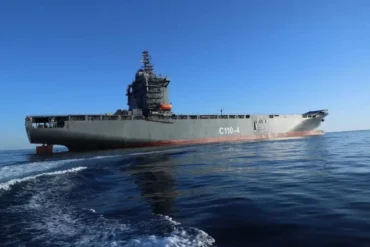
The IRIS Bushehr is not a combat ship but a critical logistical platform designed to sustain Iranian naval deployments far from home ports. The vessel belongs to the Bandar Abbas-class fleet replenishment ships, a small class built to provide fuel, supplies, and ammunition to Iranian naval groups operating at sea.
Constructed in West Germany at the C. Lühring shipyard in Brake, the ship was launched on March 23, 1974, before entering Iranian naval service later that year. Despite its age, the vessel has remained operational for decades, supporting long-range training missions and overseas deployments.
Technically, the ship measures 108 meters in length with a beam of 16.6 meters and a maximum draft of roughly 4.5 meters. At full load it displaces approximately 4,748 tons, carrying more than 3,300 tons of cargo capacity that can include fuel, provisions, and military supplies.
Propulsion is provided by two MAN 6L 52-55 diesel engines, generating roughly 12,060 horsepower and driving twin shafts. This system allows the ship to reach 20 knots while maintaining an operational range of about 3,500 nautical miles at cruising speed.
Although primarily logistical in nature, Bushehr is equipped with limited defensive armament. The ship carries three GAM-B01 20 mm cannons and two 12.7 mm heavy machine guns, providing basic protection against small surface threats or low-flying aircraft.
The vessel also features a helicopter landing deck and telescopic hangar, enabling it to support reconnaissance missions and personnel transfers during extended naval deployments.
A Delicate Neutrality for Sri Lanka
For Sri Lanka, the incident highlighted the difficult balance faced by smaller states positioned along strategic maritime corridors. The island sits near some of the busiest shipping routes on Earth, linking the Middle East, Asia, and Europe.
When the submarine attack occurred nearby, Sri Lanka was suddenly confronted with both a humanitarian emergency and a geopolitical dilemma. Responding to distress signals was required under international maritime conventions, yet any action involving Iranian or American military assets risked political complications.
By evacuating the crew, securing the vessel, and relocating it away from commercial shipping areas, Sri Lankan authorities attempted to maintain strict neutrality while fulfilling their legal and humanitarian obligations.
At the same time, search operations for survivors from the sunken IRIS Dena continued in nearby waters, with assistance from regional partners including India, which dispatched maritime patrol aircraft and naval vessels to aid the effort.
Rising Tensions in the Indian Ocean
The sinking of an Iranian warship by a U.S. submarine marks one of the rarest forms of modern naval combat: a direct submarine strike against a surface combatant during a period of heightened geopolitical tension rather than declared war.
Such incidents are uncommon in the modern era because submarines operate primarily as deterrence platforms. When they do engage surface ships, the consequences are often swift and decisive—as demonstrated by the destruction of IRIS Dena.
The resulting chain reaction—rescue missions, stranded vessels, and diplomatic coordination—has placed Sri Lanka in an unexpected position at the crossroads of major power rivalry in the Indian Ocean theater.
For now, the Iranian replenishment ship IRIS Bushehr remains under Sri Lankan supervision while investigations, rescue operations, and diplomatic discussions continue. The situation illustrates how quickly maritime security incidents can ripple across the region, transforming routine naval deployments into international crises almost overnight.