The United States has delivered a devastating maritime blow in the Middle East, announcing the destruction of 17 Iranian warships, including what officials describe as Tehran’s most operational submarine. The strikes, part of the sweeping campaign known as Operation Epic Fury, mark one of the most intense naval degradations Iran has faced in decades. According to U.S. Central Command (CENTCOM), the objective is blunt and unapologetic: eliminate every platform capable of threatening American forces or international shipping.
Four days into the operation, the scale of firepower is staggering. More than 50,000 U.S. troops, over 200 combat aircraft, carrier strike groups, and continuous 24/7 sorties have converged on Iranian military infrastructure. Nearly 2,000 targets have been struck with over 2,000 munitions, creating what commanders call the largest regional military buildup in a generation. The opening 24 hours reportedly exceeded the intensity of the 2003 “shock and awe” campaign in Iraq, a comparison that underscores the magnitude of the assault.
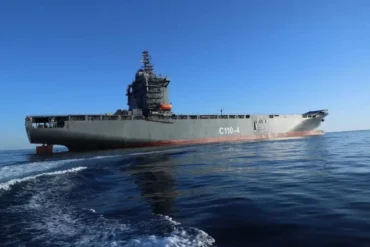
At sea, the damage appears systemic rather than symbolic. Naval bases at Bandar Abbas and Konarak have sustained heavy strikes, while high-value assets such as the converted drone and helicopter carrier IRIS Shahid Bagheri were sunk early in the campaign. The forward basing ship IRIS Makran was left ablaze in port, its massive silhouette engulfed in smoke visible from commercial satellite imagery.
The Fateh-Class Submarine: Iran’s Indigenous Ambition “Holed”
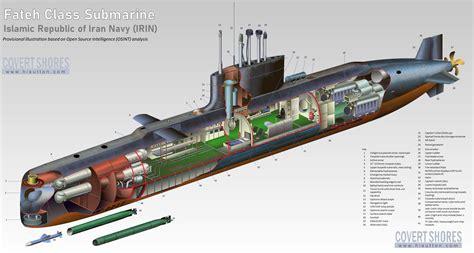
Among the most consequential losses is believed to be a Fateh-class submarine, widely interpreted as the “most operational” boat referenced by CENTCOM commander Adm. Brad Cooper. If confirmed, the destruction of this platform would represent a strategic setback far beyond simple hull loss.
The Fateh-class, displacing approximately 593 tons, was designed as a bridge between Iran’s aging Russian-built Kilo-class submarines and its numerous but smaller Ghadir-class coastal submarines. Equipped with four to six 533-mm torpedo tubes, the Fateh could deploy Valfajr torpedoes and potentially underwater-launched anti-ship cruise missiles. Optimized for littoral warfare, the submarine was built for ambush tactics in confined waters such as the Strait of Hormuz.
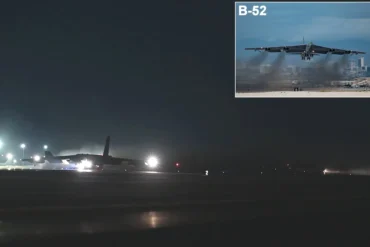
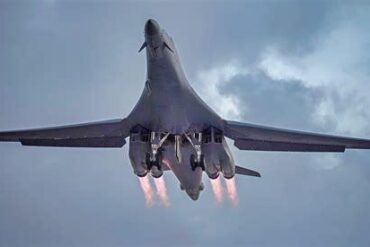
Reports suggest the submarine suffered a catastrophic hull breach, likely caused by precision-guided munitions delivered by B-2 Spirit stealth bombers or B-1B Lancer aircraft operating in uncontested airspace. A compromised pressure hull renders a diesel-electric submarine effectively inoperable, transforming a prized deterrent asset into a sunken liability.
For Tehran, the symbolism cuts deep. The Fateh program was marketed domestically as proof of naval self-reliance, a statement that Iran could produce advanced underwater warfare systems despite sanctions and technological constraints. Its loss signals not only material destruction but reputational erosion.
Iran’s Asymmetric Naval Strategy Under Siege
Iran’s naval doctrine has long relied on asymmetric warfare—a strategy that offsets conventional inferiority with unpredictability. Fast attack craft, naval mines, swarm tactics, coastal missile batteries, and small submarines form a web designed to harass and restrict superior fleets.
The Ghadir-class submarines, numbering in the dozens, embody this philosophy. Compact and agile, they are tailored for shallow-water ambushes and mine-laying operations. Yet they lack endurance and payload capacity compared to the Fateh or Kilo classes. The destruction of a larger, more capable submarine therefore narrows Iran’s operational flexibility.
More broadly, CENTCOM claims that no Iranian vessel is currently underway in the Arabian Gulf, Strait of Hormuz, or Gulf of Oman. If accurate, this indicates a temporary but sweeping paralysis of Iranian naval maneuverability. Given that nearly one-fifth of global seaborne oil transits through Hormuz, maritime dominance in these waters carries economic implications that ripple far beyond the region.
Air Superiority and the Neutralization of Defenses
The naval destruction unfolded alongside systematic suppression of Iran’s air defense networks, radar installations, ballistic missile launchers, and drone arsenals. CENTCOM reports hundreds of missiles, launchers, and unmanned systems destroyed. Achieving uncontested access to Iranian airspace was essential to enabling repeated deep-strike missions against hardened targets.
Iranian claims of striking the USS Abraham Lincoln with ballistic missiles were categorically rejected by U.S. officials, who asserted that no missile approached the carrier. Instead, CENTCOM countered that the only confirmed carrier sunk was Iran’s own Shahid Bagheri. The information battle has mirrored the kinetic one, with both sides seeking to shape domestic and international perception.
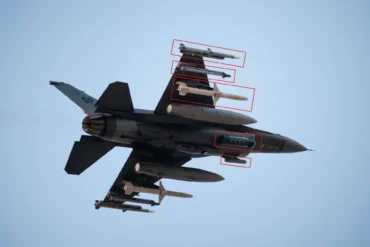
From a strategic perspective, the degradation of Iran’s navy and air defenses suggests a deliberate campaign design: first blind the adversary, then strip away its ability to contest sea lanes. The combination of stealth bombers, carrier aviation, and precision-guided munitions indicates a doctrine centered on overwhelming tempo and sustained pressure.
Strategic Consequences for the Gulf Balance of Power
The sinking of 17 Iranian warships is not merely a battlefield statistic. It reshapes the maritime calculus of the Gulf. Iran’s capacity to interdict shipping, threaten tankers, or stage naval demonstrations has historically served as leverage in geopolitical disputes. With its fleet severely diminished, that leverage contracts.
Yet naval power is never static. Iran retains shore-based missile systems, fast attack craft, and remaining submarines that could still impose risk. Maritime security in the region will likely depend on continued patrols and escort operations by U.S. and allied forces to deter opportunistic retaliation.
Operation Epic Fury illustrates a brutal truth of modern warfare: technological superiority, when paired with sustained operational tempo, can dismantle layered defenses with astonishing speed. Submarines designed for stealth can be exposed. Ports assumed secure can become burning targets. Entire fleets can be rendered inert in days rather than months.
Whether the destruction of Iran’s naval assets produces lasting deterrence or merely a pause before adaptation remains to be seen. History shows that maritime strategy evolves under pressure. For now, however, the operational picture is stark: the U.S. sinks 17 Iranian warships, cripples a flagship submarine program, and asserts temporary dominance over one of the world’s most strategically vital waterways.