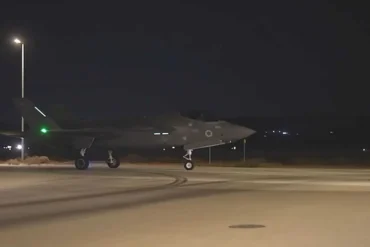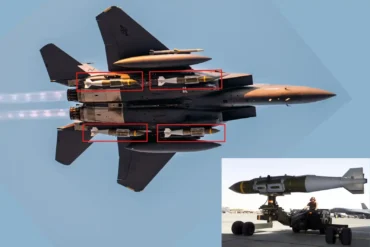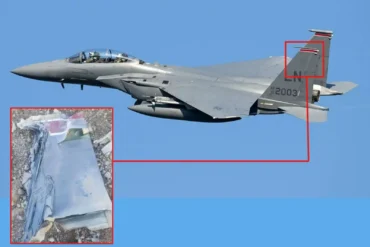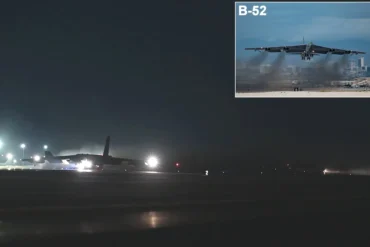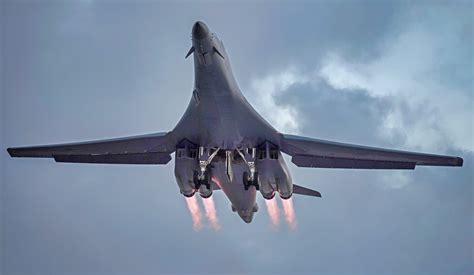
The strategic chessboard of the Middle East shifted dramatically on March 2, 2026, when the United States launched Operation Epic Fury, a long-range precision strike targeting Iranian ballistic missile infrastructure. According to U.S. Central Command (CENTCOM), multiple B-1B Lancer strategic bombers conducted deep-penetration attacks on missile facilities and command-and-control nodes tied to Iran’s missile forces. The mission represented one of the most extensive conventional air campaigns conducted by the United States against Iranian strategic assets in recent years, marking a significant escalation in the ongoing confrontation over Tehran’s missile capabilities.
The operation unfolded under a carefully orchestrated framework of global power projection. Long-range bombers traveled thousands of kilometers to strike key targets inside Iranian territory, demonstrating the ability of the United States Air Force to launch precision attacks against hardened strategic infrastructure far from American shores. Defense officials described the mission as a critical step in weakening Iran’s ballistic missile network, which has long been a cornerstone of the country’s regional deterrence strategy.
In a statement following the operation, U.S. Central Command confirmed that the strike package focused specifically on facilities connected to Iran’s missile launch and command architecture. These installations reportedly supported both operational missile deployments and the coordination systems responsible for controlling ballistic missile units across several military districts.
Operation Epic Fury: A Long-Range Strike Across Continents
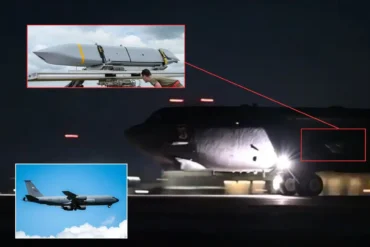
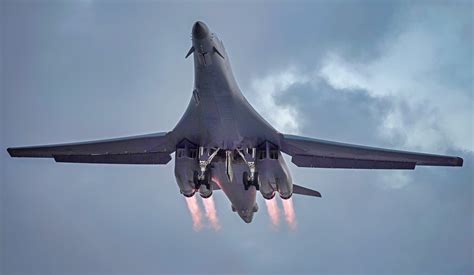
Operation Epic Fury showcased the extraordinary logistical reach of the United States Air Force. According to open-source flight tracking data, the participating B-1B Lancer bombers likely departed from Ellsworth Air Force Base in South Dakota, although the Pentagon has not formally confirmed the launch point. From there, the aircraft executed an intercontinental strike profile that required multiple aerial refueling operations across both the Atlantic Ocean and the Mediterranean Sea.
Such extended bomber missions demand an intricate aerial support network involving tanker aircraft, command centers, and surveillance assets operating across several theaters simultaneously. This logistical choreography enables strategic bombers to maintain operational unpredictability, a key element in modern airpower doctrine. By launching from the continental United States rather than forward bases, the Air Force preserved strategic ambiguity while demonstrating its ability to project force globally.
Military analysts note that this form of strike operation is designed to complicate adversary defensive planning. When bombers can depart from distant bases thousands of kilometers away, it becomes far more difficult for opposing air defense systems to predict attack vectors or establish effective interception strategies.
Strategic Context: Escalation of the U.S.–Iran Military Confrontation
The strikes occurred within a broader campaign aimed at degrading Iran’s missile infrastructure, a network that has expanded significantly over the past two decades. Iranian ballistic missiles form a central pillar of the country’s defense strategy, providing a means to threaten regional bases, naval forces, and allied territories across the Middle East.
Air Force General Dan Caine, chairman of the Joint Chiefs of Staff, explained during a Pentagon briefing that the cumulative impact of recent bomber missions has begun to alter the operational balance in parts of Iranian airspace. Earlier strikes carried out by B-2 Spirit stealth bombers targeted deeply buried facilities believed to support missile research, storage, and launch capabilities.
According to Caine, the combination of stealth bomber penetration strikes followed by heavy conventional bombardment from B-1B aircraft has generated localized air superiority in selected sectors of the battlespace. This evolving control of the air environment allows follow-on missions to be conducted with greater safety and operational flexibility.
The B-1B Lancer: Backbone of America’s Conventional Strike Power
At the center of the operation stands one of the most formidable aircraft in the U.S. arsenal: the B-1B Lancer. Developed as a supersonic heavy bomber capable of delivering massive conventional payloads across intercontinental distances, the aircraft has evolved into a cornerstone of American global strike capabilities.
Powered by four General Electric F101-GE-102 turbofan engines, each producing over 30,000 pounds of thrust, the B-1B can exceed speeds of 900 miles per hour and approach Mach 1.2 under optimal conditions. These engines provide the raw power necessary to carry enormous weapon loads across vast distances while maintaining high subsonic or supersonic performance when required.
Unlike stealth bombers designed primarily for undetected penetration, the B-1B emphasizes speed, payload capacity, and endurance. Its design allows the aircraft to travel thousands of kilometers, strike multiple targets in a single mission, and remain on station for extended periods when supported by aerial refueling.
This capability makes the bomber particularly effective in operations targeting distributed infrastructure, such as missile launch sites, command nodes, and weapons storage complexes.
Variable-Sweep Wings and High-Speed Penetration Design
One of the most distinctive features of the B-1B Lancer is its variable-geometry wing design, often referred to as “swing wings.” These wings can change their sweep angle depending on the aircraft’s speed and flight phase.
When the wings are extended forward, the aircraft gains improved lift and stability, which is particularly useful during takeoff, landing, and aerial refueling operations. When swept backward, the wings reduce drag and enable the aircraft to maintain high-speed flight, improving efficiency during long-range cruise or rapid penetration missions.
This configuration provides a rare combination of aerodynamic flexibility and maneuverability for a strategic bomber. It allows the aircraft to operate effectively at both low-altitude terrain-following profiles and higher altitude strike routes, depending on mission requirements.
Massive Weapons Payload and Precision Strike Capability
Payload capacity is where the B-1B truly dominates the battlefield. The aircraft can carry up to 75,000 pounds of weapons distributed across three internal bomb bays, making it the bomber with the largest conventional payload in the U.S. Air Force inventory.
This arsenal includes a wide range of precision-guided weapons designed to strike high-value targets with extraordinary accuracy. Among the most commonly deployed munitions are:
- GBU-31 Joint Direct Attack Munition (JDAM)
- GBU-38 JDAM precision bombs
- AGM-158 Joint Air-to-Surface Standoff Missiles (JASSM)
- AGM-158B JASSM-ER extended-range cruise missiles
The JASSM family of cruise missiles plays a particularly important role in modern strike doctrine. Designed with low-observable features, these missiles can travel hundreds of kilometers before reaching their targets. The extended-range JASSM-ER variant can strike targets more than 900 kilometers away, allowing bombers to launch attacks while remaining outside the engagement envelope of many air defense systems.
This capability dramatically increases survivability for bomber crews while enabling strikes against hardened or heavily defended facilities.
Advanced Sensors, Data Links, and Networked Warfare
Modern upgrades have transformed the B-1B from a traditional bomber into a highly networked combat platform. The aircraft is equipped with synthetic aperture radar, a powerful sensor capable of producing high-resolution ground imagery while tracking moving targets. This radar enables the crew to detect and engage targets even under poor weather conditions or at night.
Navigation and targeting are supported by a GPS-aided Inertial Navigation System, which allows extremely precise positioning without reliance on external navigation aids. This autonomy is critical during deep-strike missions where electronic warfare or infrastructure destruction may disrupt traditional navigation signals.
One of the most important enhancements in recent years is the integration of Link-16 data connectivity through the Fully Integrated Data Link (FIDL) system. This network allows bomber crews to receive real-time targeting updates from the Combined Air Operations Center and other command networks.
The result is a platform capable of dynamic targeting, meaning it can redirect weapons toward newly identified threats during the mission rather than relying solely on pre-planned targets.
Electronic Warfare and Survivability Systems
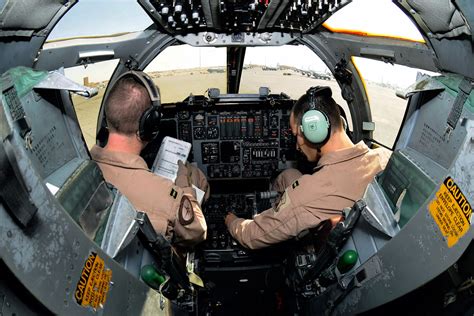
Operating in contested airspace requires robust defensive systems, and the B-1B is equipped with an extensive suite designed to counter modern air defenses. The aircraft carries the ALQ-161 electronic countermeasures system, which detects hostile radar signals and automatically deploys jamming techniques to disrupt enemy tracking.
Additional defensive equipment includes:
- Radar warning receivers
- Chaff and flare dispensers
- ALE-50 towed decoy systems
The ALE-50 decoy trails behind the aircraft and emits signals designed to attract radar-guided missiles away from the bomber itself. Combined with a relatively reduced radar cross-section compared to older bombers, these systems provide an important layer of survivability during high-risk missions.
The U.S. Bomber Triad in Modern Warfare
Operation Epic Fury also highlights the strategic value of the United States’ three-bomber fleet, which includes the B-2 Spirit, B-1B Lancer, and B-52H Stratofortress. Each aircraft contributes a unique role within the broader strike architecture.
The B-2 Spirit specializes in penetrating heavily defended airspace using stealth technology, allowing it to destroy hardened or deeply buried targets. The B-1B Lancer follows with massive conventional firepower capable of striking multiple dispersed facilities in a single mission. Meanwhile, the B-52H Stratofortress provides persistent long-range strike capacity with an arsenal of cruise missiles and precision bombs.
By deploying all three bomber classes in the same operational theater, the United States demonstrates a layered strike strategy that blends stealth penetration, high-volume bombardment, and sustained long-range firepower.
Strategic Implications for the Middle East
The strikes carried out during Operation Epic Fury send a clear signal regarding the reach and scale of American military power. Conducting deep-strike missions from intercontinental distances demonstrates that the United States can maintain pressure on strategic targets even without relying exclusively on regional bases.
For Iran, the attacks represent a direct challenge to one of its most important military capabilities. Ballistic missiles serve not only as battlefield weapons but also as instruments of strategic deterrence. Disrupting missile infrastructure therefore has implications that extend beyond the immediate tactical battlefield.
At the same time, the operation underscores the evolving nature of modern warfare, where long-range precision strike, networked intelligence systems, and global logistics combine to enable military operations across continents. Operation Epic Fury illustrates how strategic bombers remain central to that equation—machines capable of crossing oceans, carrying immense payloads, and delivering decisive force within a matter of hours.
In an era defined by rapid technological change and shifting geopolitical tensions, these aircraft continue to embody the enduring principle of airpower: the ability to project strength anywhere on Earth, at any time.