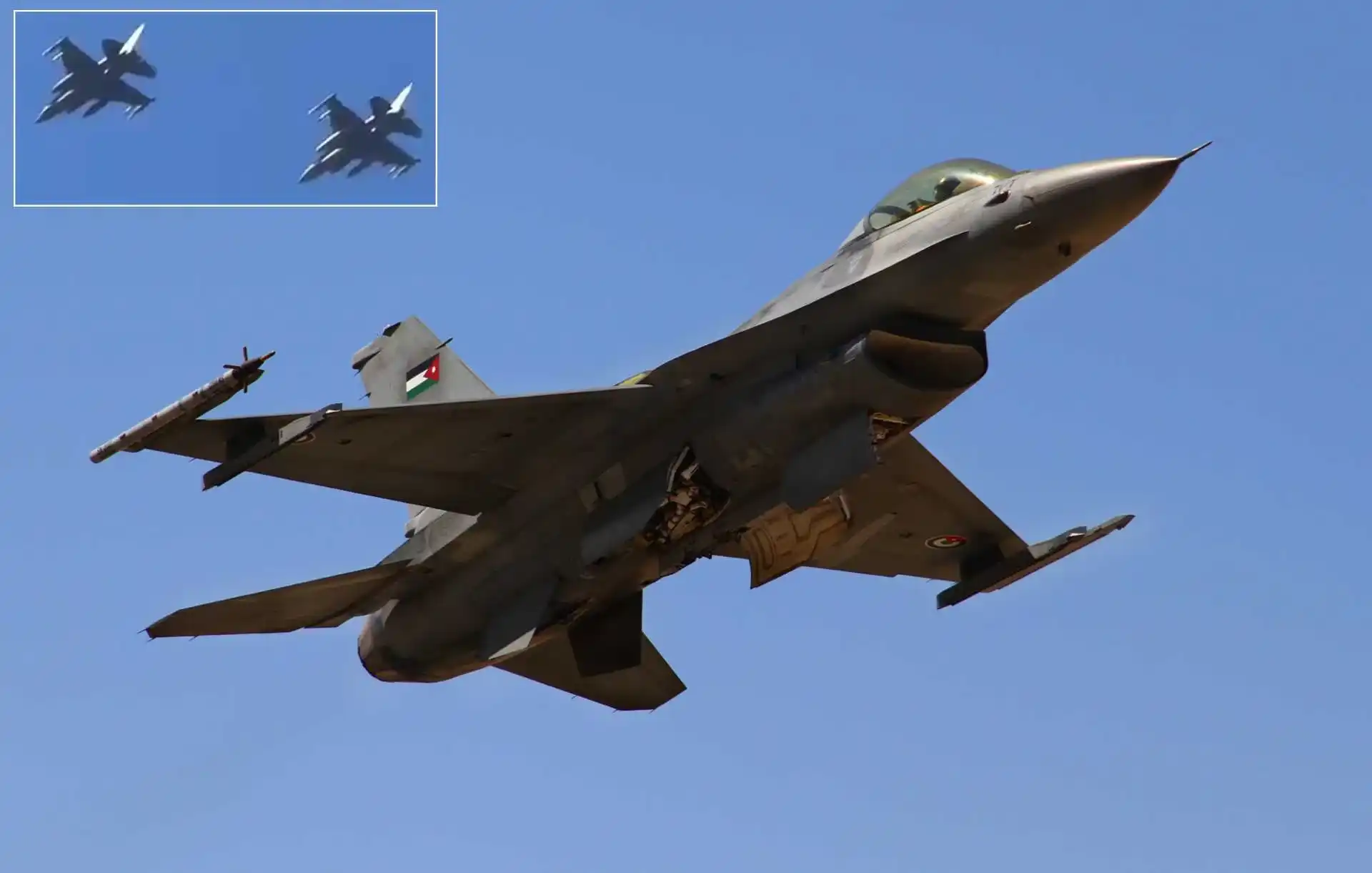
Jordan has moved decisively to secure its skies, scrambling Royal Jordanian Air Force F-16 fighter jets to intercept Iranian drones crossing toward and within its national airspace. The interceptions, conducted on March 2, 2026, unfolded against the backdrop of Operation Epic Fury, a wider regional escalation marked by extensive drone and missile launches traversing Iraqi and Syrian airspace. For Amman, the message was unambiguous: Jordanian airspace is not a transit corridor for armed systems.
The decision to launch fighter intercepts reflects the evolving geometry of Middle Eastern air warfare, where unmanned aerial systems and ballistic trajectories now routinely span multiple sovereign borders. Hundreds of Iranian one-way attack drones and missiles have been reported on flight paths cutting across the region, creating persistent overflight risks for neighboring states. Jordan’s northern and eastern radar coverage places it squarely along several of these trajectories, particularly those intersecting critical civil aviation corridors linking Amman to Gulf destinations.
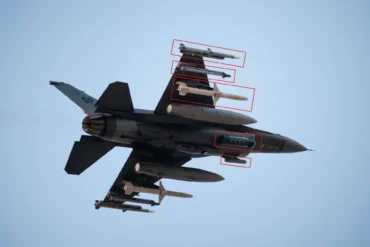
By scrambling aircraft armed with AIM-120C AMRAAM and AIM-9M Sidewinder air-to-air missiles, Jordan demonstrated both readiness and intent. Interceptions were executed to shield population centers and protect commercial air traffic from potential airborne threats. In a region where minutes can separate surveillance from strike impact, the rapid activation of combat air patrols signals a calibrated but firm defensive posture.
Jordan’s Airspace as a Strategic Buffer Zone
Geography has always shaped Jordan’s security doctrine. Sandwiched between conflict-prone theaters, the kingdom occupies a pivotal airspace corridor bridging the Levant and the Gulf. When drones and missiles launched from western Iran arc across Iraq and Syria, their trajectories frequently pass within radar reach of Jordanian sensors. Even if not deliberately targeted at Jordan, these systems create unacceptable ambiguity.
Airspace sovereignty is not merely symbolic. Modern civilian aviation relies on predictable routing and assured separation from military threats. When weaponized drones share air corridors with commercial aircraft, the risk calculus shifts dramatically. A single navigational miscalculation, interception misfire, or debris fall could endanger civilian lives and destabilize regional confidence in air traffic safety.
Jordan’s leadership has therefore drawn a bright operational line: no armed platform may transit its airspace unchallenged. The scramble of F-16s under Operation Epic Fury was not a symbolic gesture but a kinetic enforcement of that principle.
The F-16A/B Backbone of Jordan’s Air Defense
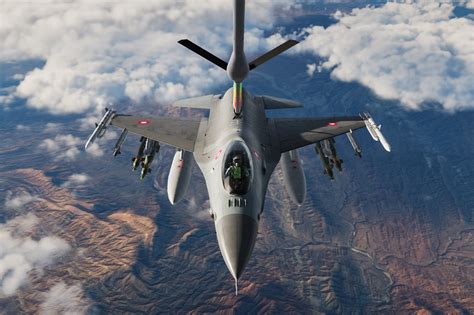
At the center of this response stands a fleet of 64 F-16A/B fighter jets, acquired and modernized through successive Peace Falcon programs. These aircraft form the backbone of Jordan’s quick reaction alert missions and national air defense architecture.
The first major acquisition, Peace Falcon I, signed in July 1996, authorized the lease of 16 Block 15 Air Defense Fighter (ADF) jets. Twelve were single-seat F-16A variants and four were dual-seat F-16B models. Structural enhancements and engine upgrades to the Pratt & Whitney F100-220E standard extended airframe life from 4,000 to 8,000 hours, ensuring longevity well beyond initial projections.
Subsequent programs—Peace Falcon II through VI—incrementally expanded and modernized the fleet. Aircraft from Belgium and the Netherlands were incorporated, many upgraded to Block 20 Mid-Life Update (MLU) standard, transforming aging fourth-generation fighters into digitally integrated, multi-role platforms. By the early 2010s, Jordan possessed a highly cohesive fleet capable of air superiority, interception, and precision strike roles.
Block 20 MLU: Extending Relevance in the Drone Era
The Block 20 MLU configuration fundamentally redefined what earlier F-16A/B airframes could accomplish. Cockpits were redesigned with color multifunction displays and modular mission computers, dramatically improving pilot situational awareness. Enhanced data buses and identification friend-or-foe systems enabled seamless integration into networked air defense environments.
Radar capabilities evolved as well. Upgraded AN/APG-66 variants provided improved detection range and multi-target tracking, essential for engaging small or medium-sized unmanned systems. Compatibility with beyond-visual-range missiles such as the AIM-120 AMRAAM gave Jordanian pilots the ability to intercept hostile drones before they approached defended airspace.
Structural refurbishments and wiring updates ensured compatibility with modern targeting pods and electronic warfare suites. The result was a cost-effective modernization path that preserved proven airframes while elevating operational capability to near F-16C/D standards.
In an era defined by drone swarms and distributed attacks, that adaptability is not a luxury—it is survival.
AMRAAM and Sidewinder: Tools for Counter-Drone Engagement
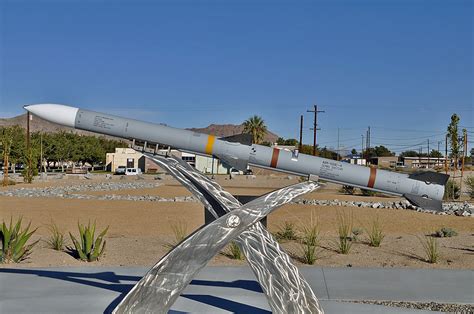
Modern counter-drone operations demand speed, precision, and flexibility. Fighter-launched air-to-air missiles provide all three. The AIM-120C AMRAAM, equipped with active radar guidance, allows pilots to engage targets beyond visual range. Its fire-and-forget capability means a pilot can launch, break away, and re-engage additional threats without maintaining continuous radar lock.
Against coordinated drone launches, that multi-target flexibility becomes decisive. A swarm of unmanned systems is designed to saturate defenses. A fighter armed with AMRAAMs can thin that swarm before it penetrates deeper into defended airspace.
The AIM-9M Sidewinder, though shorter in range, remains lethal in visual engagements. Infrared guidance makes it effective against drones with detectable heat signatures, particularly when radar cross-sections are small. High agility and rapid lock-on allow quick reaction intercepts in dynamic airspace environments.
Using fighters to counter drones also provides altitude and speed advantages. An F-16 can climb, accelerate, and position itself far more rapidly than most ground-based systems can reposition. This flexibility ensures that hostile drones are neutralized well before they threaten infrastructure or civilian corridors.
Operation Epic Fury and Regional Escalation
Operation Epic Fury has altered the operational tempo across the Middle East. The widespread launch of Iranian one-way attack drones and ballistic missiles has blurred the boundaries between direct participants and geographically adjacent states. Even countries not directly targeted find themselves navigating the hazards of transiting weapons systems.
For Jordan, neutrality does not equate to passivity. The kingdom’s strategic calculus balances regional diplomacy with uncompromising defense of sovereignty. By intercepting drones crossing its airspace, Jordan avoids entanglement while asserting control.
This approach also reinforces deterrence. Clear, consistent enforcement signals to all actors that Jordanian airspace is actively monitored and defended. Ambiguity invites miscalculation; clarity discourages it.
Air Defense in the Age of Unmanned Systems
The drone era has complicated traditional air defense doctrine. Unlike conventional aircraft, unmanned systems can be inexpensive, numerous, and expendable. They exploit altitude gaps, radar blind spots, and saturation tactics. Yet they are not invincible.
Fighter aircraft remain uniquely suited to intercept such threats, especially when equipped with advanced sensors and beyond-visual-range weapons. Jordan’s F-16 fleet, though rooted in late-20th-century design, illustrates how thoughtful modernization can preserve relevance against 21st-century challenges.
Air defense today is a layered enterprise: ground-based systems, radar networks, electronic warfare, and combat air patrols working in concert. The scramble over Jordanian skies underscores that sovereignty in the missile-and-drone age is enforced not only by policy statements but by aircraft climbing into contested airspace, missiles armed, ready to intercept.
Jordan’s response during Operation Epic Fury demonstrates that even amid regional turbulence, disciplined air power remains a stabilizing force. In a theater crowded with trajectories and uncertainties, the sight of F-16s streaking upward is more than spectacle. It is a declaration that control of the sky still matters—and that Jordan intends to keep it.