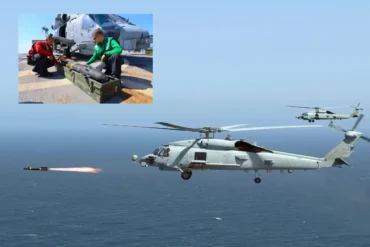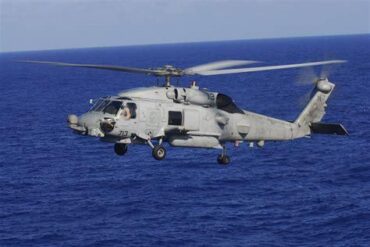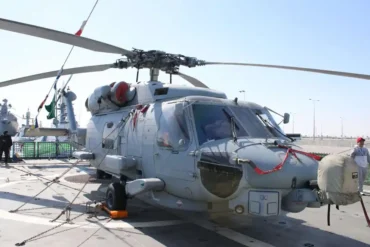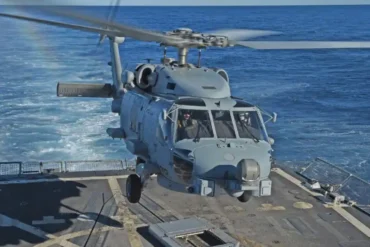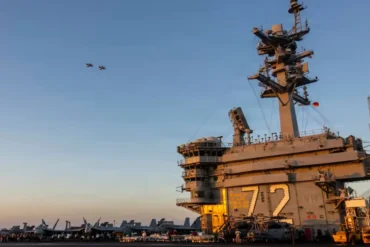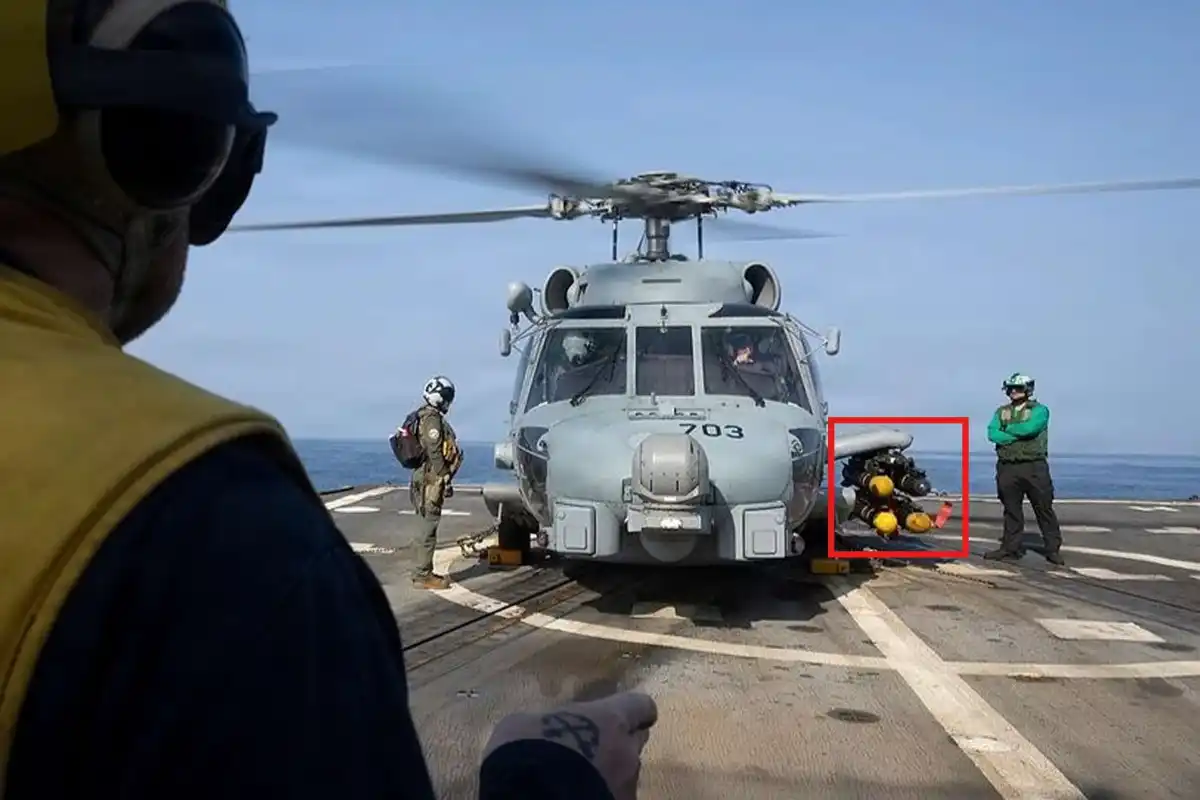
Modern naval warfare increasingly depends on flexibility, precision, and the ability to counter unconventional threats in crowded maritime environments. Newly released U.S. Navy imagery from March 7, 2026, provides a vivid illustration of that evolving strategy: an MH-60R Seahawk helicopter armed with AGM-114 Hellfire missiles operating from the flight deck of the Arleigh Burke-class guided-missile destroyer USS Delbert D. Black (DDG-119). The aircraft was photographed conducting flight operations within the U.S. Central Command (CENTCOM) area of responsibility as part of Operation Epic Fury, an ongoing military campaign targeting Iranian military infrastructure and associated threats.
The deployment highlights the growing importance of ship-borne aviation as a precision strike extension of surface warships. While destroyers possess formidable missile arsenals capable of striking targets hundreds of miles away, smaller and more agile threats—such as fast attack craft, armed patrol boats, and irregular maritime forces—require a faster and more flexible response. The MH-60R Seahawk, equipped with precision weapons and advanced sensors, fills that operational niche by projecting the ship’s combat reach well beyond the radar horizon.
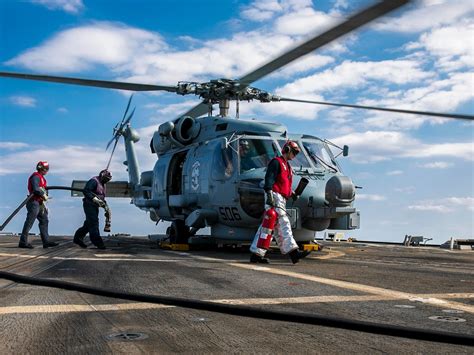
Operating from the deck of USS Delbert D. Black, the helicopter was assigned to Helicopter Maritime Strike Squadron (HSM) 46, one of the U.S. Navy’s frontline aviation units specializing in anti-surface and anti-submarine warfare missions. The released imagery captures a flight-deck evolution in progress, with a U.S. Sailor directing the helicopter as it prepares for or completes launch operations—an everyday but critical moment in the tightly choreographed environment of naval aviation.
Hellfire Missiles Transform the Seahawk into a Precision Maritime Strike Platform
One of the most striking details visible in the imagery is the four AGM-114 Hellfire missiles mounted along the helicopter’s left-side weapons pylon. This configuration signals that the aircraft has been prepared for a dedicated anti-surface warfare mission, significantly enhancing its offensive capabilities.
Originally designed as an anti-tank missile for attack helicopters, the Hellfire has proven highly adaptable across multiple combat environments. In maritime operations, the missile provides highly accurate, short-range strike capability against small vessels and lightly armored targets. For naval forces operating in confined waters such as the Persian Gulf and surrounding maritime corridors, the system offers an effective tool to counter rapidly maneuvering threats.
Armed with Hellfires, the MH-60R becomes far more than a surveillance platform. It transforms into a rapid-response airborne hunter, capable of tracking suspicious vessels, maintaining visual identification, and delivering precision firepower within moments if hostile intent is confirmed. This capability allows commanders to respond proportionally to threats without relying on larger and more destructive ship-launched weapons.
The Role of USS Delbert D. Black in Forward Naval Operations
USS Delbert D. Black is part of the Arleigh Burke class, one of the most advanced and versatile surface combatant classes in the world. Designed around the powerful Aegis Combat System, these destroyers integrate radar, missile defense, and advanced command-and-control capabilities into a single highly networked warfighting platform.
However, even a ship equipped with Tomahawk cruise missiles, Standard surface-to-air interceptors, and sophisticated radar systems benefits enormously from embarked aviation assets. The presence of the MH-60R dramatically extends the ship’s operational reach in several ways:
- Expanding reconnaissance and surveillance coverage beyond the radar horizon
- Providing rapid identification of unknown maritime contacts
- Delivering precision strikes against small surface threats
- Supporting maritime interdiction and force protection operations
This integration effectively turns the destroyer into a multi-layered combat system, combining long-range missile firepower with agile airborne reconnaissance and strike capabilities.
Operation Epic Fury and the Strategic Context in the CENTCOM Region
The deployment of the Hellfire-armed Seahawk occurs within the broader framework of Operation Epic Fury, a U.S. military campaign launched in late February 2026. The operation focuses on neutralizing elements of Iran’s military infrastructure considered capable of threatening U.S. forces, regional allies, and international shipping lanes.
Targets reportedly include:
- Missile launch facilities
- Drone deployment sites
- Integrated air defense systems
- Command-and-control networks
Naval forces play a central role in this campaign. Destroyers operating in regional waters have already conducted long-range precision strikes using cruise missiles, while carrier aviation and land-based aircraft contribute additional layers of offensive capability.
Yet the maritime environment in this region presents unique challenges. The Persian Gulf, Strait of Hormuz, and surrounding waters are heavily trafficked and geographically constrained, creating ideal conditions for asymmetric naval tactics.
Iranian naval doctrine has long emphasized the use of fast attack craft, missile boats, and swarm tactics, where multiple small vessels rapidly converge on larger ships to overwhelm their defenses. While destroyers possess powerful weapons capable of neutralizing such threats, deploying a cruise missile against a small boat would be both inefficient and potentially escalatory.
This is precisely where the MH-60R Seahawk armed with Hellfire missiles proves invaluable.
Airborne Counter-Swarm Capability in Modern Naval Warfare
In a potential swarm scenario, speed and situational awareness are critical. Helicopters like the MH-60R provide both. Launching from the destroyer’s flight deck, the Seahawk can quickly investigate suspicious contacts many miles away from the ship.
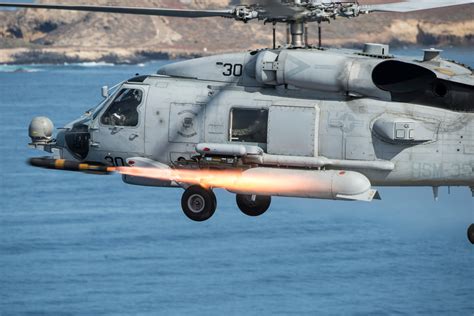
Equipped with advanced maritime radar, electro-optical targeting systems, and secure data links, the aircraft can identify and classify vessels long before they approach weapons range. Once a threat is confirmed, the helicopter’s precision-guided Hellfire missiles allow it to neutralize hostile craft with minimal collateral damage.
This layered defensive architecture provides several advantages:
- Early detection of suspicious maritime activity
- Flexible engagement options tailored to the threat level
- Reduced reliance on heavy ship-launched weapons
- Enhanced protection for high-value naval assets
In essence, the helicopter becomes the forward shield of the destroyer, intercepting potential threats long before they can endanger the ship itself.
The MH-60R Seahawk: Backbone of U.S. Navy Maritime Helicopter Operations
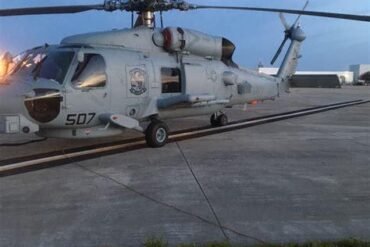
The MH-60R Seahawk, often called the “Romeo,” represents the U.S. Navy’s primary ship-borne multi-mission helicopter. Developed from the proven Sikorsky H-60 family, the aircraft combines cutting-edge sensors with a versatile weapons suite designed for both surface and subsurface warfare.
Its mission set includes:
- Anti-submarine warfare (ASW)
- Anti-surface warfare (ASuW)
- Maritime surveillance and reconnaissance
- Search and rescue operations
- Targeting support for naval weapons systems
To accomplish these tasks, the helicopter carries an array of advanced technologies. These include sonobuoy launch systems for submarine detection, dipping sonar, multimode maritime radar, and electro-optical/infrared targeting systems. The aircraft also integrates seamlessly with naval data networks, allowing it to transmit real-time targeting information back to its host ship or other units in the task force.
Weapons options further expand the helicopter’s versatility. In addition to Hellfire missiles, the Seahawk can carry Mk 54 lightweight torpedoes, machine guns, and other precision munitions, enabling it to confront a wide spectrum of threats across the maritime battlespace.
Distributed Lethality and the Future of Naval Combat
The deployment of an armed Seahawk from USS Delbert D. Black reflects a broader shift in U.S. naval doctrine known as distributed lethality. Rather than concentrating firepower exclusively in large platforms, this strategy spreads offensive capability across multiple interconnected assets—including aircraft, unmanned systems, and surface vessels.
In this model, the MH-60R acts as both a sensor node and a strike platform. It gathers intelligence, shares targeting data across the fleet, and engages threats independently when required. This approach complicates enemy planning by ensuring that combat power can originate from multiple directions simultaneously.
For operations in contested maritime zones like the Middle East, this flexibility is essential. A destroyer supported by armed aviation can rapidly transition between surveillance, deterrence, and direct engagement—often within the same mission cycle.
As Operation Epic Fury continues to unfold, the imagery of the Hellfire-armed Seahawk over the deck of USS Delbert D. Black provides a clear visual reminder of how modern naval warfare is evolving. Rotary-wing aviation remains a critical multiplier, extending the reach, awareness, and striking power of the U.S. Navy’s surface fleet in some of the world’s most complex and volatile maritime environments.