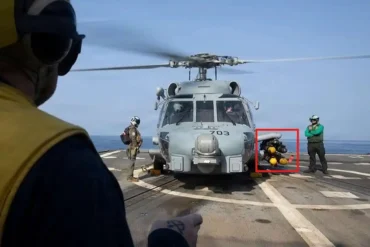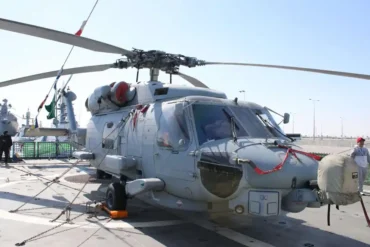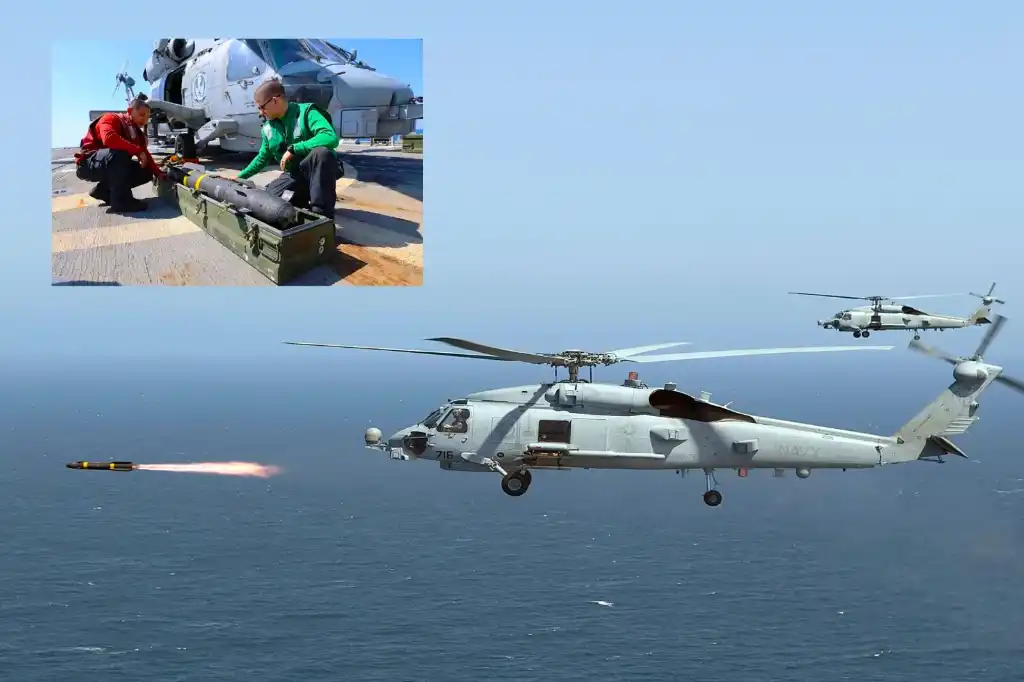
The newly surfaced image of an MH-60R Seahawk loaded with an AGM-114 Hellfire missile aboard USS Roosevelt marks one of the clearest public signals yet that American destroyers operating near the Gulf of Aden are keeping their aviation assets fully armed and ready to strike. Captured on November 22 and released days later through official channels, the photograph reveals the daily, quietly intense rhythm of U.S. naval operations in a region where commercial vessels have endured nearly two years of missile strikes, drone attacks, and harassment from Yemen’s Houthi movement.
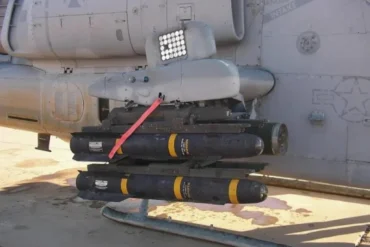
The frame itself is deceptively simple: sailors from Helicopter Maritime Strike Squadron 79 locking a Hellfire into place beneath the Seahawk’s stub wing, the desert-colored sea behind them rolling without concern. Beneath the stillness lies the context of a shipping corridor facing sustained threats and the reality that a destroyer’s helicopter is no longer just a sensor platform—it is an armed guardian for a maritime artery that links continents.
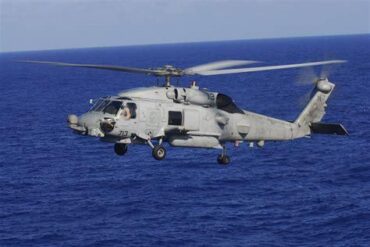
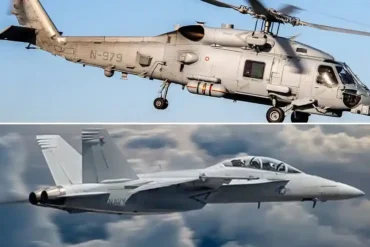
The MH-60R Seahawk has long served as the U.S. Navy’s principal multi-mission helicopter, renowned for its blend of surveillance power, anti-submarine capabilities, and surface warfare punch. Operating from Arleigh Burke-class destroyers such as USS Roosevelt, the aircraft can carry a diverse arsenal: Mk 54 lightweight torpedoes, sonobuoys, 20 mm or 30 mm cannons, and machine guns. Against the backdrop of the Gulf of Aden’s fast-moving threats—ranging from explosive-laden unmanned surface vessels to small attack craft—its ability to mount up to eight Hellfire missiles transforms the helicopter into a fast-reacting strike platform.
The recent U.S. Navy photo does more than capture equipment maintenance. It conveys operational intent. The Seahawk’s weapons configuration reflects a shift from routine presence missions to a posture aligned with real-world engagement, shaped by the spate of attacks that have damaged commercial vessels, endangered crews, and rerouted global shipping.
Why the Hellfire Missile Matters in Modern Naval Warfare
The AGM-114 Hellfire, originally designed in the Cold War era to destroy armored vehicles, has taken on a new maritime identity. Adapted for naval use beginning in the 1990s and refined after years of operations near chokepoints like the Bab el-Mandeb, the missile now functions as an ideal counter to the nimble small craft favored by non-state actors.
The Navy showcased this utility most dramatically in December 2023, when MH-60R helicopters defending a U.S. destroyer group in the Red Sea neutralized armed Houthi small boats attempting to seize a merchant vessel. That engagement underscored how vital helicopter-based precision firepower has become in littoral combat zones—where identifying a threat is hard, reaction time is short, and collateral risk is high.
The Pentagon’s ongoing transition toward the AGM-179 Joint Air-to-Ground Missile (JAGM)—a more advanced, multi-mode seeker weapon compatible with the same launch rails—signals a future where naval helicopter strike missions gain even greater flexibility and resilience.
Extending the Destroyer’s Reach Beyond the Horizon
Arming the MH-60R offers advantages that even a sophisticated destroyer’s organic weapons cannot easily replicate. The helicopter becomes the commander’s eyes, ears, and precision scalpel far beyond the visible horizon. Its radar, electro-optical sensors, and datalinks allow it to identify suspicious small craft weaving among dozens of benign vessels—targets that would challenge shipboard radar cluttered by commercial traffic.
Once a threat is validated, the helicopter can strike with deadly accuracy from standoff range, keeping the host ship at a safer distance. This approach also preserves the destroyer’s high-value missile inventory for aerial threats, while the helicopter handles the lower-altitude, smaller, more elusive dangers that define asymmetric naval warfare in the region.
A Strategic Signal Amid Lingering Instability
The presence of a fully armed Seahawk on Roosevelt’s flight deck represents a broader U.S. message to the region. Even after the de-escalation linked to the May 2025 ceasefire, recent incidents—including the attack on the Dutch-flagged Minervagracht—prove that threats to commercial shipping persist and have expanded deeper into the Gulf of Aden.
Operation Prosperity Guardian, launched in late 2023, brought together a wide coalition to safeguard merchant traffic passing through the Red Sea. Although the tempo of U.S. strikes has eased, the Navy’s continued deployment of destroyers like Roosevelt underscores an enduring commitment: the waterways connecting the Indian Ocean to the Mediterranean will remain open, protected, and actively monitored.
A Snapshot of the Future of Maritime Security
The act of loading a single missile becomes symbolic when viewed through the lens of global trade. The Hellfire—once a battlefield weapon for armored showdowns—is now a key pillar of maritime stability. It fits into a layered defense system that spans carrier air wings, long-range patrol aircraft, and destroyer-launched helicopters operating just miles from contested shores.
As armed groups continue to test boundaries and wield increasingly diverse unmanned systems, U.S. surface combatants will maintain helicopters ready to transition instantly from surveillance to strike. This readiness is not merely tactical; it is strategic reassurance for an international shipping industry that depends on uninterrupted access to one of the world’s busiest and most vulnerable maritime corridors.
In the image of HSM-79’s sailors securing a Hellfire beneath an MH-60R, a larger truth emerges: the modern destroyer’s power extends well beyond steel and radar. It includes a helicopter poised to defend global commerce with a level of precision and responsiveness that no other shipboard system can match.