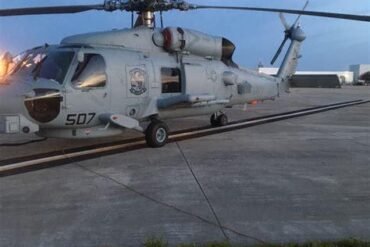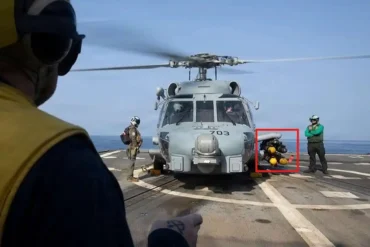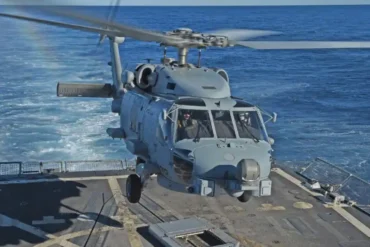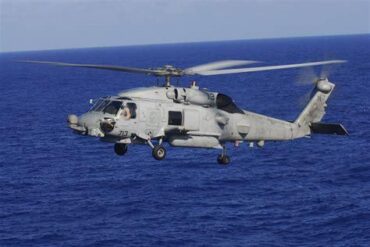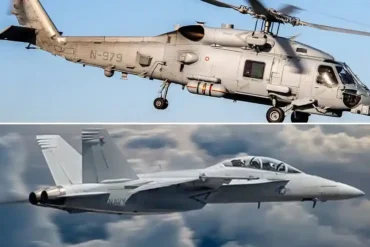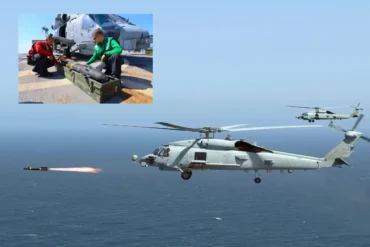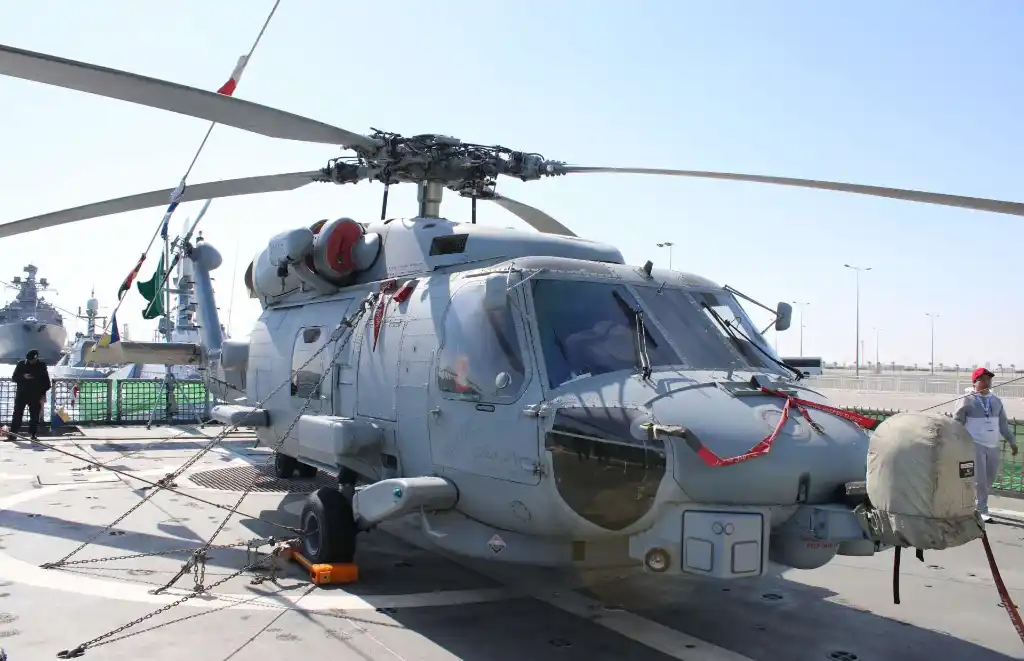
The Royal Saudi Naval Forces have delivered a clear signal of their evolving maritime doctrine by conducting MH-60R Seahawk combat operations from an Al Jubail-class corvette, a combination observed in full detail during DIMDEX 2026 in Doha. The sight of the helicopter operating seamlessly from the flight deck of the corvette Onaizah underscored a deliberate shift toward aviation-centric surface warfare, where a relatively compact warship is transformed into a multi-domain naval platform capable of projecting power well beyond its own sensors and weapons.
At the Qatar National Convention Centre and nearby Hamad Port, where visiting warships were moored, the Saudi corvette and its embarked helicopter attracted sustained attention from military delegations and analysts alike. This pairing illustrated how the Royal Saudi Navy is integrating air and surface assets to address the complex security environment of the Arabian Gulf and the Red Sea, regions defined by dense commercial traffic, shallow waters, and an increasingly contested threat spectrum.
Al Jubail-Class Corvette as an Aviation-Centric Combatant
The Al Jubail-class corvette was conceived not merely as a missile-armed patrol ship, but as a platform designed to host and exploit a 10-ton class naval helicopter. Its full-length flight deck, reinforced hangar, and integrated aviation support systems allow sustained rotary-wing operations in conditions that would previously have limited smaller surface combatants.
This design philosophy enables the corvette to act as a forward sensor node. While the ship’s own radar and missile systems provide point and area defense, the embarked helicopter dramatically extends detection, classification, and engagement ranges. In practical terms, the ship-helicopter team functions as a single combat system, with the aircraft scouting far ahead while the corvette remains emission-controlled and tactically discreet.
MH-60R Seahawk Optimized for Shipboard Warfare
The MH-60R Seahawk, often referred to as the “Romeo,” is purpose-built for maritime operations. Its folding main rotor and tail pylon, corrosion-resistant structure, and deck-handling provisions allow rapid spotting and securing even in high sea states. Powered by T700-GE-401C engines delivering up to 1,890 shaft horsepower, the aircraft combines endurance with agility, reaching speeds of around 180 knots and operating at ranges approaching 380 nautical miles.
Saudi-configured aircraft include APX-123 IFF transponders, embedded GPS/INS navigation, and Link 16 connectivity, ensuring seamless integration with allied and national command networks. These features allow the helicopter to function not just as a sensor or shooter, but as a node within a wider combat information architecture.
Sensor Fusion and Over-the-Horizon Awareness
The true strength of the MH-60R lies in its sensor suite and the way those sensors are fused into a coherent tactical picture. Central to this capability is the AN/APS-153(V) multi-mode radar, which provides surface search, inverse synthetic aperture radar imaging, and automatic periscope detection. This radar is particularly effective in littoral environments, where distinguishing small craft from background clutter is a persistent challenge.
Data gathered by the helicopter is transmitted back to the ship via Hawklink, a high-capacity data link designed to move radar tracks, electro-optical video, and acoustic information in near real time. This allows the corvette’s combat information center to see, decide, and act on contacts well beyond the ship’s own horizon, a decisive advantage in modern naval engagements.
Anti-Submarine Warfare in Shallow and Contested Waters
Anti-submarine warfare is where the MH-60R brings disproportionate value to a corvette-sized platform. The aircraft integrates sonobuoy processing with the AN/AQS-22 Airborne Low Frequency Sonar, widely regarded as one of the most capable dipping sonars in service today. Optimized for shallow and acoustically complex waters, this system allows rapid localization and tracking of submarines that would be difficult for hull-mounted sonars to detect.
Cueing and identification are enhanced by the AN/AAS-44C(V) electro-optical/infrared turret with laser designation, while the ALQ-210 electronic support measures suite passively detects and geolocates hostile emitters. Together, these systems create a layered ASW capability that can prosecute contacts independently or hand off targeting data to the host ship.
Flexible Weapons for Surface and Subsurface Threats
The Saudi MH-60R weapons fit follows a logical detect-to-engage sequence. The approved configuration includes AGM-114R Hellfire II missiles, 70 mm Advanced Precision Kill Weapon System rockets, and crew-served M240D and GAU-21 machine guns. This mix allows graduated responses, from warning shots against suspicious vessels to precision strikes on fast attack craft or shore-based targets.
In line with global MH-60R employment, the aircraft is also compatible with Mk 54 lightweight torpedoes, enabling it to transition seamlessly from detection to engagement in an anti-submarine scenario. For a corvette, this effectively creates an organic underwater strike capability without the need to maneuver the ship into a vulnerable position.
Strategic Implications for Saudi Maritime Security
For Saudi Arabia, these operations are about geography and necessity. The kingdom must safeguard critical energy infrastructure in the Gulf while also securing the Red Sea approaches toward the Suez Canal. Threats range from unmanned systems and anti-ship missiles to mines and a growing undersea challenge, including Iranian Ghadir-class mini-submarines optimized for shallow waters.
By pairing the Al Jubail-class corvette with the MH-60R Seahawk, the Royal Saudi Navy gains a rapid-response surveillance, ASW, and surface strike capability ideally suited for convoy escort and offshore defense. The demonstration at DIMDEX 2026 made that intent unmistakable: Saudi sea control is no longer ship-centric, but built around an integrated ship-helicopter kill chain designed for modern maritime conflict.