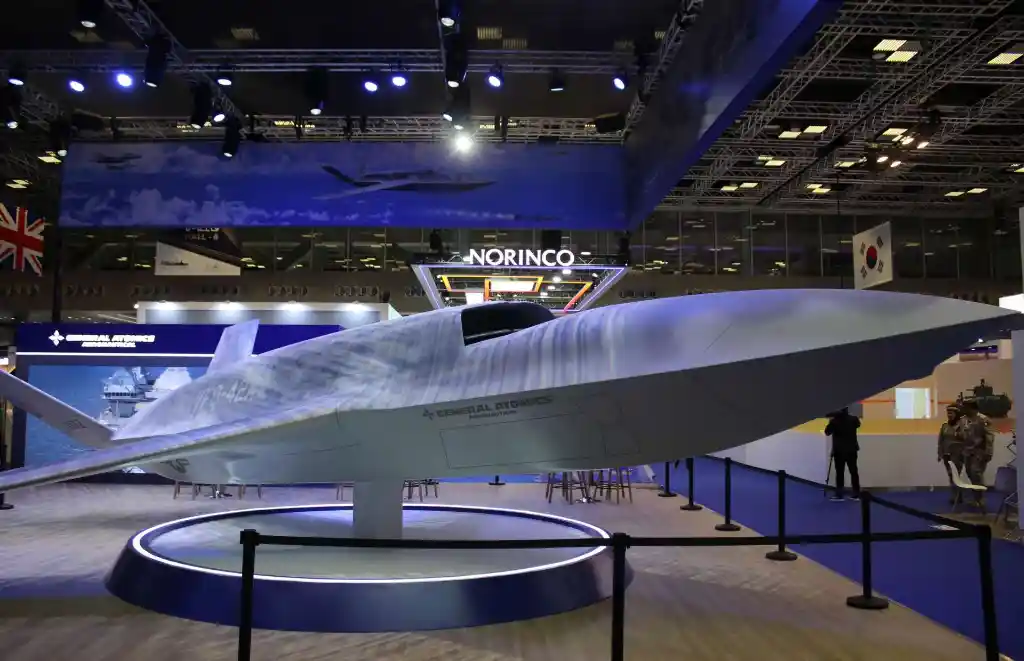
The public unveiling of a full-scale YFQ-42A uncrewed fighter at DIMDEX 2026 in Doha marked a decisive moment in the evolution of modern airpower. In a venue traditionally dominated by maritime security systems, the appearance of a jet-sized uncrewed combat aircraft immediately reframed the exhibition’s narrative. The display underscored a strategic message from Washington: future air superiority will be defined not only by exquisite manned fighters, but by mass, autonomy, and manned–unmanned teaming at scale.
Developed by General Atomics Aeronautical Systems (GA-ASI), the YFQ-42A embodies the U.S. Air Force’s determination to field affordable, survivable uncrewed fighters capable of operating alongside fifth- and sixth-generation aircraft. Shown on the floor of the Qatar National Convention Centre, the aircraft’s real-size airframe conveyed industrial seriousness and operational intent that no scale model could replicate. This was not a conceptual mock-up, but a production-representative prototype designed to fight in high-threat, contested airspace.
The choice of Doha for this debut carried geopolitical weight. Qatar sits at the crossroads of regional air and maritime security, hosting advanced allied forces and operating a sophisticated mixed fighter fleet. Revealing the YFQ-42A at DIMDEX sent a clear signal to regional partners and competitors alike: uncrewed fighters are moving from theory to operational reality, and they will shape coalition air operations in the decades ahead.
From Maritime Expo to Airpower Showcase
DIMDEX has long been known for warships, coastal defense systems, and maritime surveillance technologies. The YFQ-42A’s presence disrupted that expectation, drawing sustained attention from air force commanders, defense planners, and industry executives. Its unveiling reframed the exhibition as a venue where cross-domain power projection—air, sea, and networked sensors—converges.
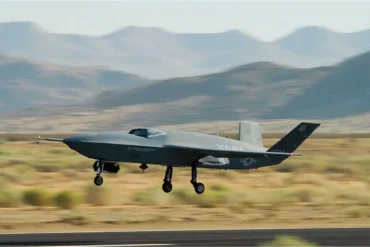
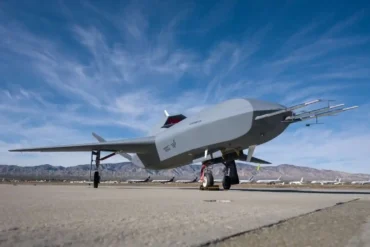
The aircraft’s clean, cockpitless fuselage immediately distinguished it from traditional unmanned aerial vehicles. This was not an attritable drone designed for short missions and limited survivability. Instead, the YFQ-42A projected the mass and proportions of a true combat jet, signaling its role as an integral node in future air superiority architectures rather than a disposable adjunct.
Design Philosophy: A Fighter Without a Cockpit
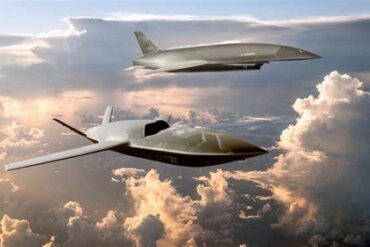
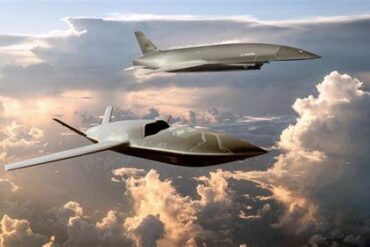
At first glance, the YFQ-42A’s configuration reveals a careful balance between stealth, payload capacity, and manufacturability. The blended fuselage and dorsal air intake feed a single turbofan engine, while a V-tail arrangement reduces radar signature and mechanical complexity. The absence of a cockpit allows designers to optimize internal volume for fuel, sensors, and weapons rather than human life-support systems.
The lower fuselage features a ventral weapons bay sized for internal carriage, preserving low observability while maintaining combat relevance. Sharp edges and smooth upper surfaces suggest deliberate attention to signature management, reflecting lessons learned from decades of stealth aircraft development. GA-ASI has emphasized that the airframe is optimized not for long-endurance loiter, but for high-speed penetration and coordinated strike operations.
The “Missile Truck” Concept and Air-to-Air Dominance
One of the most compelling aspects of the YFQ-42A is its role as a forward air-to-air weapons carrier. The internal bay is designed to accommodate missiles in the AIM-120 AMRAAM class, enabling the aircraft to act as a distributed magazine in the sky. In operational terms, this allows manned fighters to conserve their own limited missile loads while directing uncrewed partners to deliver additional shots deep into contested airspace.
This concept fundamentally alters the calculus of air combat. Instead of relying on a small number of expensive crewed fighters to carry all available weapons, commanders can field formations where uncrewed fighters multiply available firepower, complicate enemy targeting, and absorb risk. The result is thicker salvos, greater tactical flexibility, and enhanced survivability for human pilots.
Collaborative Combat Aircraft and the Scale Imperative
The YFQ-42A is the production-representative prototype for Collaborative Combat Aircraft (CCA) Increment 1, a U.S. Air Force program explicitly framed around scale. The service has been clear about its ambition to field at least 1,000 uncrewed combat aircraft, creating affordable mass to counter numerically superior adversaries.
Flight testing of the YFQ-42A began in California in August 2025, focusing on airworthiness, autonomy maturation, and mission-system integration rather than headline-grabbing performance metrics. The “YFQ” designation itself is revealing: “Y” denotes prototype status, “F” confirms a fighter mission set, and “Q” formally recognizes the aircraft as uncrewed. This nomenclature reflects a doctrinal shift, treating uncrewed platforms as fighters in their own right, not secondary UAVs.
Autonomy, Networking, and the Software-Defined Future
The true power of the YFQ-42A lies less in its airframe and more in its software-defined architecture. Designed for semi-autonomous operation, the aircraft is intended to execute complex tasks such as formation keeping, threat reaction, and cooperative targeting with minimal human input. Human operators remain in the loop for mission command and weapons authorization, but the aircraft’s onboard systems manage the tactical details at machine speed.
Robust, jam-resistant networking is central to this vision. The YFQ-42A must maintain connectivity with manned fighters, airborne early warning platforms, and ground or maritime sensors in environments saturated with electronic warfare. Its effectiveness as a “fighter drone” scales directly with the resilience of its datalinks and the sophistication of its mission computer, making cyber and electronic protection as critical as aerodynamic performance.
Strategic Implications for Qatar and the Gulf
For Qatar and its regional partners, the debut of the YFQ-42A resonates far beyond the exhibition hall. Doha operates advanced Western fighters and hosts key allied forces, positioning it at the center of coalition air operations in the Gulf. In a region characterized by long-range drones, cruise missiles, and rapid escalation risks around critical infrastructure, uncrewed fighters offer a compelling force multiplier.
A CCA-type platform could dramatically expand air defense magazine depth, sustain more interceptors on station, and reduce the operational burden on pilots. While export pathways for such systems remain politically sensitive, their conceptual presence at DIMDEX signals that future regional airpower will hinge on networked autonomy and distributed lethality, not just on acquiring the latest crewed jet.
A Glimpse Into the Next Airpower Paradigm
The full-scale YFQ-42A on display in Doha was more than an exhibition piece; it was a tangible indicator of where U.S. and allied airpower is headed. By combining stealth-informed design, internal air-to-air armament, and scalable autonomy, the aircraft represents a bridge between today’s manned fighters and tomorrow’s fully networked combat ecosystems.
As defense planners digest the implications of this debut, one conclusion is unavoidable. The future of air combat will not be decided solely by individual aircraft performance, but by how effectively manned and uncrewed fighters operate together as a system. In unveiling the YFQ-42A at DIMDEX 2026, the United States made clear that this future is no longer distant—it is already taking shape.