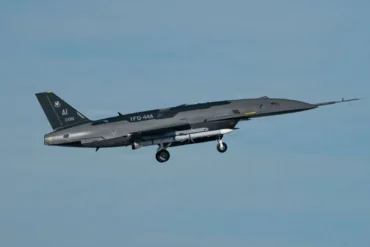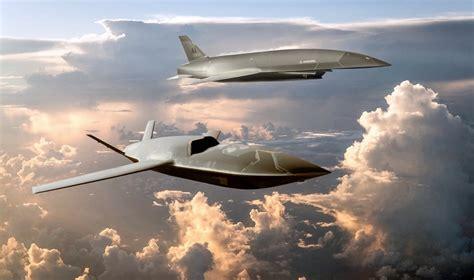
The veil has finally been lifted on one of the U.S. Air Force’s most anticipated next-generation platforms. We now have our first definitive look at General Atomics Aeronautical Systems, Inc. (GA-ASI)’s YFQ-42A prototype, a formidable contender in the fiercely competitive Collaborative Combat Aircraft (CCA) program. This unveiling marks a significant milestone, offering tangible evidence of the rapid progress being made in developing autonomous, uncrewed wingmen designed to revolutionize aerial warfare. The YFQ-42A, alongside Anduril Industries’ YFQ-44A, represents the vanguard of the CCA program’s Increment 1, with both revolutionary designs slated to achieve their maiden flights later this year. The anticipation surrounding these aircraft is immense, as they promise to redefine air combat doctrine by introducing attritable, yet highly capable, assets that can operate in concert with crewed fighters.
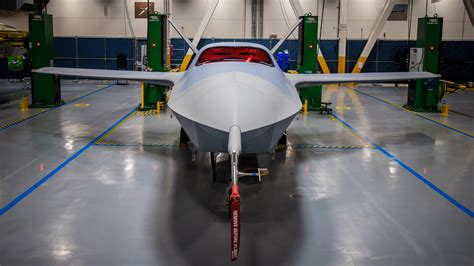
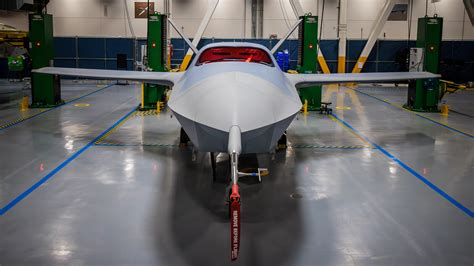
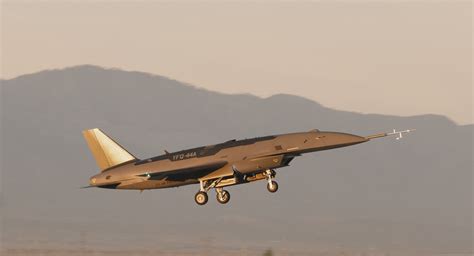
The dramatic reveal came courtesy of Chief of Staff of the U.S. Air Force, Gen. David Allvin, who shared the striking image of the YFQ-42A via social media. This strategic dissemination underscores the Air Force’s commitment to transparency and its eagerness to showcase the advancements in its CCA initiative. The timing of this visual release is noteworthy, following the Air Force’s May 1st announcement confirming the commencement of ground testing for both Increment 1 CCA designs. It was on that occasion that the initial images of Anduril’s YFQ-44A were also made public, setting the stage for this subsequent unveiling of its General Atomics counterpart. The clear, head-on photograph provides an unprecedented opportunity to scrutinize the YFQ-42A’s design philosophy and its potential capabilities.
Gen. Allvin’s accompanying statement on X (formerly Twitter) was imbued with a palpable sense of confidence and strategic foresight. “THE WORLD’s FIRST LOOK AT OUR NEW YFQ-42A!” he proclaimed, emphasizing the groundbreaking nature of the aircraft. “As the @DeptofDefense matches threats to capabilities under @SecDef’s [Secretary of Defense Lloyd Austin’s] leadership, Collaborative Combat Aircraft will prove not only cost-effective, but truly lethal…No doubts these uncrewed fighters will put our adversaries on notice!” This declaration highlights the dual imperatives driving the CCA program: enhancing combat lethality while managing acquisition and operational costs, a crucial balance in an era of evolving global threats and fiscal considerations. The term ‘fighter drone‘ aptly captures the intended role – an autonomous platform capable of engaging in high-stakes aerial combat scenarios.
Echoing the Air Force leadership’s enthusiasm, David Alexander, President of General Atomics Aeronautical Systems, Inc., expressed immense pride in the YFQ-42A’s development. “The YFQ-42A is an exciting next step for our company,” Alexander stated. “It reflects many years of partnership with the U.S. Air Force of advancing unmanned combat aviation for the United States and its allies around the world, and we’re excited to begin ground testing and move to first flight.” This statement underscores GA-ASI’s long-standing expertise in unmanned aerial systems (UAS) and its deep collaboration with the Air Force, a partnership that has yielded iconic platforms like the MQ-9 Reaper and the MQ-1C Gray Eagle. The YFQ-42A clearly builds upon this rich heritage, pushing the boundaries of what unmanned combat aircraft can achieve.
Design Scrutiny: Stealth, Stature, and Sensor Suites
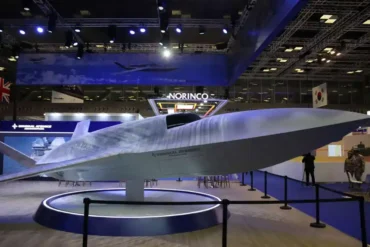
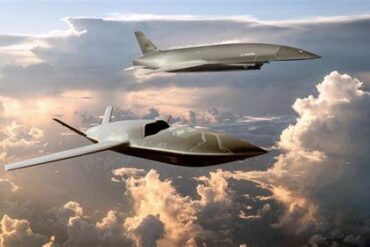
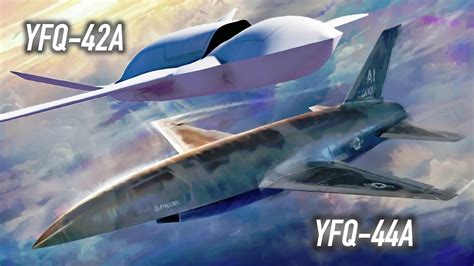
The initial visual assessment of the YFQ-42A reveals a design that is largely consistent with previously released renderings and physical models showcased by General Atomics. The aircraft exhibits distinct low-observable (stealthy) features, characterized by blended wing-body contours, chines, and an overall shaping intended to minimize its radar cross-section. There are discernible familial resemblances to past GA-ASI designs, notably the Avenger (Predator C), particularly in its general planform and intake design, though the YFQ-42A appears to be a more refined and purpose-built combat airframe. A striking difference emerges when compared to its Increment 1 competitor, Anduril’s YFQ-44A; the YFQ-42A is visibly less slender, possessing a more robust and voluminous fuselage. This increased internal volume could confer advantages in terms of fuel capacity, payload flexibility, or the housing of larger, more powerful sensor suites and processing capabilities, though it might also present different aerodynamic and signature trade-offs.
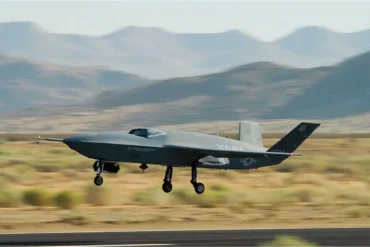
General Atomics has been transparent about the YFQ-42A’s lineage, confirming its derivation from the experimental XQ-67A drone. The XQ-67A itself was a product of the Air Force’s once-classified Off-Board Sensing Station (OBSS) program. A cornerstone of the OBSS initiative was the innovative ‘genus/species’ concept. This modular design philosophy involves a common core ‘genus’ – comprising essential components like the chassis, landing gear, and core mission and flight control systems – from which multiple ‘species’ of drones, each tailored for different mission sets, can be rapidly and cost-effectively developed. The Air Force has explicitly stated that lessons learned from this genus/species approach are being broadly integrated into the overarching CCA program. General Atomics has further validated this concept through its Gambit family of drones, all of which share a common foundational ‘chassis’. The XQ-67A, having been in flight testing for over a year, has provided GA-ASI with an invaluable risk reduction asset, allowing for the maturation of key technologies and design elements now incorporated into the YFQ-42A.
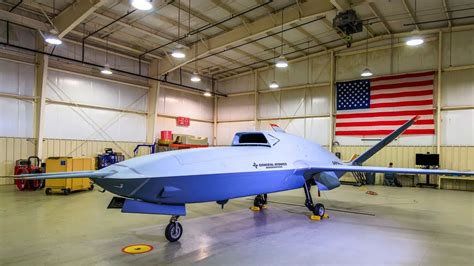
A closer examination of the YFQ-42A’s nose section, though partially obscured by a prominent flight-test data probe, reveals intriguing details. A distinctly different colored panel is visible on the underside of the forward nose, featuring what appears to be a grill-like structure and an additional, undefined feature positioned above it. The precise function of these elements remains speculative at this stage. However, past renderings of General Atomics’ CCA design have consistently depicted a trapezoidal window in this same general vicinity. Such windows are typically associated with forward-facing electro-optical and/or infrared (EO/IR) sensor systems, crucial for target identification, tracking, and situational awareness. The placement under the nose is an optimal location for an Infrared Search and Track (IRST) system. IRSTs offer a passive means of detecting and tracking airborne targets, including stealth aircraft, by their heat signatures. This capability would align perfectly with the air-to-air combat role anticipated to be the primary focus for Increment 1 CCAs, at least in their initial operational phase. General Atomics has a track record in this area, having utilized its stealthy Avenger drones to demonstrate advanced air-to-air combat capabilities, sometimes equipped with podded IRST systems, further suggesting the YFQ-42A will likely feature an integrated, high-performance IRST.
Interestingly, Anduril’s YFQ-44A prototype features a prominent, forward-facing camera system mounted atop its nose. While this could serve multiple purposes, including providing visual inputs for remote piloting or enhancing situational awareness during the initial flight test envelope, it’s plausible that the YFQ-42A incorporates a similar, albeit perhaps more integrated or differently positioned, optical system within its nose assembly. The quest for superior sensor data is paramount in modern air combat, and both CCA contenders are expected to field sophisticated suites to detect, track, and engage threats effectively, or to relay critical targeting information to manned platforms.
Versatile Payloads and Expeditionary Operations
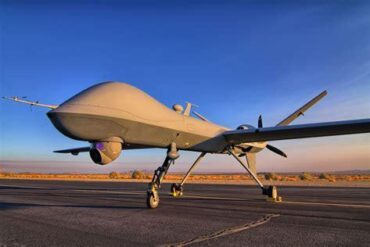
Beyond its sensor capabilities, the YFQ-42A image offers glimpses of its ventral payload bay doors and its tricycle landing gear configuration. The presence of an internal payload bay is a critical design feature, contributing to the aircraft’s stealth profile by eliminating external stores that would increase radar reflectivity. Mike Atwood, Vice President for Advanced Programs at General Atomics Aeronautical Systems, Inc. (GA-ASI), provided compelling insights into the strategic thinking behind this design choice during a panel discussion at the Air & Space Forces Association’s (AFA) 2024 Warfare Symposium. Atwood highlighted the dual utility of the internal bay, stating, “I think CCA can actually be, in some cases, a mobility aircraft. One of the reasons that GA chose to have an internal weapons bay was for carrying not just missiles and kinetics, but to do that logistics.” This innovative perspective suggests the YFQ-42A could potentially be tasked with transporting essential supplies, equipment, or even specialized sensor pods to austere forward locations, significantly enhancing operational flexibility and supporting distributed operations.
Atwood also shed light on another crucial design consideration driven by the Air Force’s evolving operational concepts: the landing gear. He recounted experiences with operations from rudimentary airfields, stating, “We showed up at these World War II leftover airfields. And we quickly realized these airfields are in really bad shape, really bad shape, and we started to really appreciate runway distance.” This operational reality directly influenced the design of the YFQ-42A’s undercarriage. “It’s hard to make a fast-moving aircraft use a lot less runway. And so what we realized is we needed a trailing-arm landing gear.” A trailing-arm landing gear configuration is renowned for its robustness and ability to absorb the impacts of landing on uneven or unprepared surfaces. This design helps to mitigate stress on the airframe, reducing wear and tear and enhancing the aircraft’s suitability for operations from short and potentially rough airfields. It also aids in rough field takeoffs, further expanding the YFQ-42A’s operational envelope. This ruggedness is paramount for aligning with the Air Force’s Agile Combat Employment (ACE) doctrine. ACE emphasizes rapid, short-notice deployments to dispersed, often austere, locations with minimal infrastructure. The Air Force has confirmed that the Increment 1 CCAs, including the YFQ-42A, are the first aircraft, crewed or uncrewed, to be designed from the ground up with ACE principles as a core requirement, underscoring their intended role in a more distributed and resilient future force posture.
The Grand Strategy: CCA Program Scope and Future Trajectory
The U.S. Air Force’s ambition for the Collaborative Combat Aircraft program is substantial. Current plans call for the acquisition of at least 1,000 CCAs, with the potential for even larger numbers as the concept matures and its value is demonstrated across various mission sets. This acquisition will unfold across a series of iterative development cycles, or Increments, allowing for the progressive incorporation of new technologies and capabilities. Service officials have previously indicated that the initial Increment 1 CCA fleet could comprise between 100 and 150 aircraft. However, a critical decision looms: whether this initial tranche will consist solely of General Atomics’ YFQ-42As, Anduril’s YFQ-44As, or a strategic mix of both distinct designs. Each platform likely offers a unique blend of capabilities, performance characteristics, and cost profiles, and the Air Force will carefully weigh these factors.
The timeline for this pivotal decision is relatively near. “A competitive Increment 1 production decision is expected in fiscal year 2026,” the Air Force stated in its early May announcement regarding the commencement of ground testing. Fiscal year 2026 begins on October 1, 2025, indicating that within the next 18-24 months, the landscape of the Air Force’s future uncrewed combat air fleet will become significantly clearer. The performance of the YFQ-42A and YFQ-44A during their upcoming flight test campaigns will be instrumental in shaping this decision.
While Increment 1 focuses on establishing the foundational capabilities for CCAs, the Air Force is already deep in the process of finalizing the requirements for Increment 2. These subsequent CCAs are anticipated to differ significantly from their Increment 1 predecessors. In March, Air Force Maj. Gen. Joseph D. Kunkel, Director of Force Design, Integration, and Wargaming and Deputy Chief of Staff for Air Force Futures, provided insights into this evolution. He indicated that the second phase of the CCA program could prioritize designs that are potentially less complex and more affordable than the initial Increment 1 platforms. This suggests a tiered approach, perhaps with Increment 1 CCAs representing higher-end capabilities and Increment 2 focusing on more attritable, mass-producible systems for different roles or risk profiles. This iterative strategy allows the Air Force to learn from early deployments and adapt its acquisition strategy to meet emerging threats and technological advancements effectively.
The public debut of the YFQ-42A is more than just the unveiling of a new piece of hardware; it is a clear signal of the transformative shift underway in air power. As the YFQ-42A and its Anduril counterpart, the YFQ-44A, progress through rigorous ground and flight testing, more details about their specific capabilities, performance envelopes, and intended operational roles will undoubtedly emerge. The journey of these fighter drones from prototype to operational asset will be closely watched by allies and adversaries alike, as they represent a critical component of the U.S. Air Force’s vision for maintaining air superiority in the complex and contested environments of the 21st century. The Collaborative Combat Aircraft program is not merely about adding more aircraft to the inventory; it’s about fundamentally changing how the Air Force fights and wins.