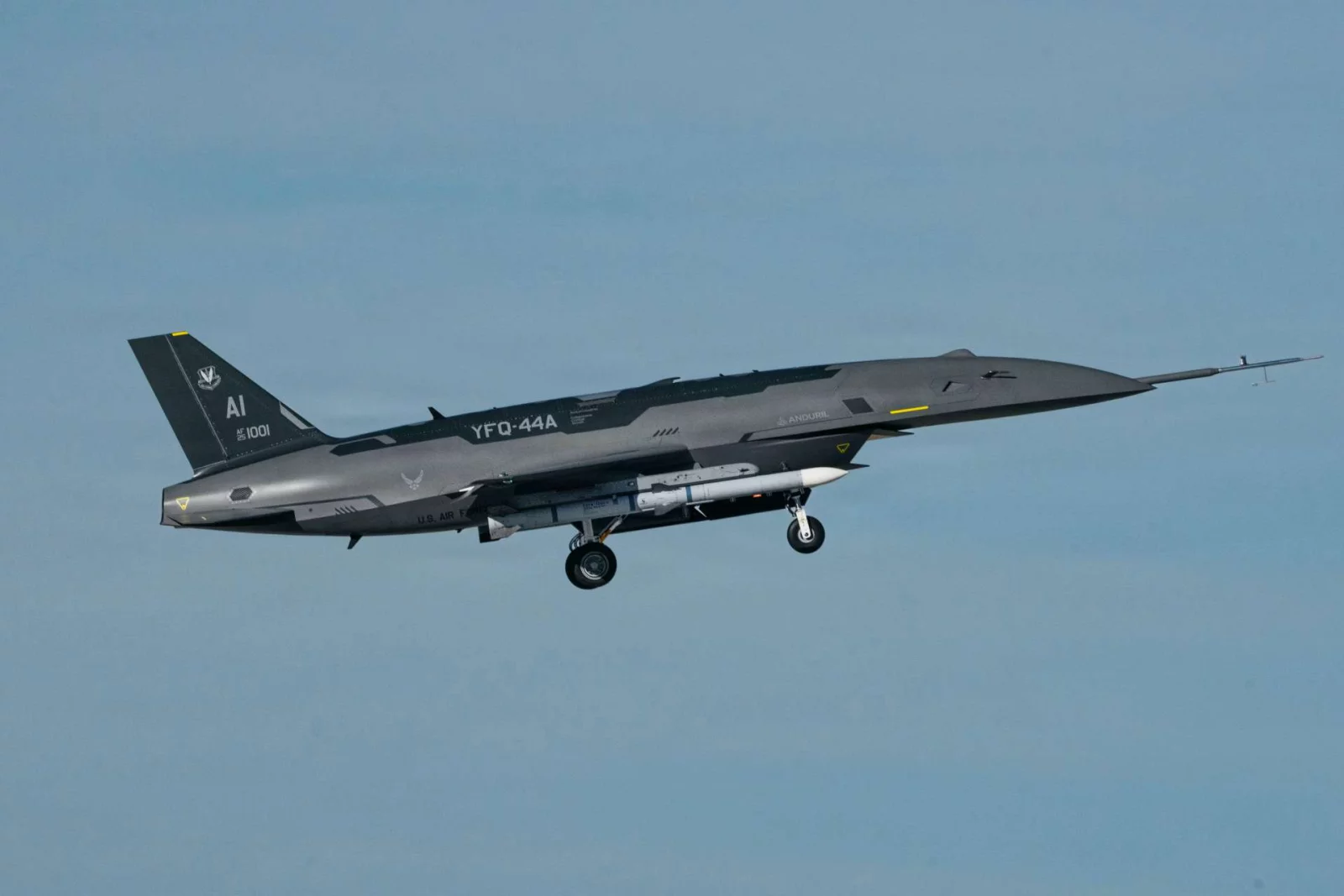
The U.S. Air Force has taken a decisive step toward operationalizing autonomous air combat capabilities by beginning AIM-120 AMRAAM integration on the YFQ-44 Fury, a next-generation uncrewed jet developed under the Collaborative Combat Aircraft (CCA) program. The milestone, announced on February 23, 2026, marks the transition from foundational flight trials into disciplined weapons integration testing—an unmistakable signal that autonomous platforms are moving beyond surveillance roles and toward direct participation in high-end air warfare.
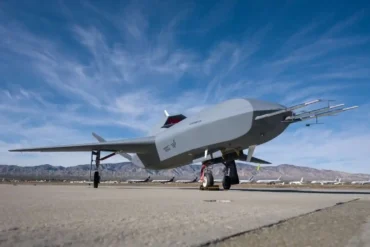
At the center of this development is a series of captive-carry flights conducted in Aurora, Colorado, where the YFQ-44 is flying with an inert AIM-120 beyond-visual-range (BVR) air-to-air missile mounted beneath its wing. While the missile contains no live propulsion or warhead components, its weight, aerodynamic profile, and interface connections replicate operational conditions. This methodical phase is designed to gather hard data on airworthiness, structural loads, aerodynamic behavior, and avionics compatibility before progressing to separation trials and eventual live-fire testing.
The transition into weapons integration represents a fundamental evolution for the CCA concept. Rather than serving merely as remote sensors or electronic warfare adjuncts, platforms like the YFQ-44 are being engineered as armed force multipliers capable of carrying frontline munitions. The Air Force’s deliberate pairing of Fury with the combat-proven AMRAAM demonstrates a clear operational intent: autonomous aircraft are expected to integrate seamlessly into the same kill chains and engagement frameworks that govern crewed fighters.
The YFQ-44 Fury: Compact, Agile, and Built for Combat Collaboration
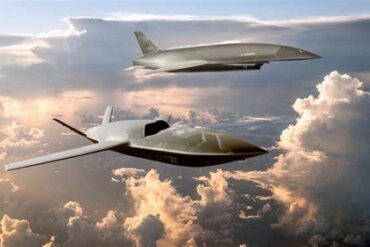
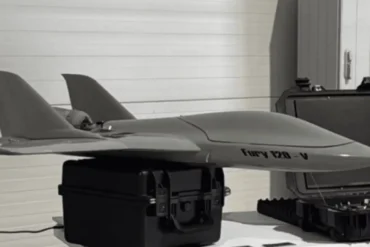
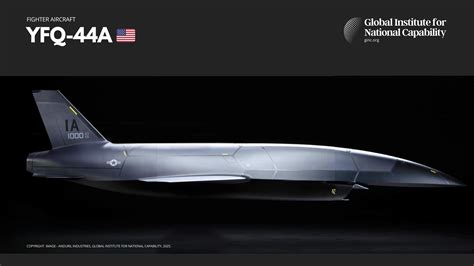
The YFQ-44 Fury, developed by Anduril Industries, is one of two Increment 1 aircraft selected for the Air Force’s CCA initiative. Roughly half the size of an F-16, the aircraft combines a compact fighter-like profile with high-performance agility. Its trapezoidal swept wings, chin-mounted air intake, and cruciform tail configuration are optimized for maneuverability in the transonic regime, reflecting design priorities that prioritize survivability and responsiveness in contested airspace.
Powered by a Williams FJ44-4M turbofan generating approximately 4,000 pounds of thrust, Fury is capable of approaching Mach 0.95, reaching altitudes near 50,000 feet, and sustaining operational g-loads consistent with frontline tactical aircraft. Short bursts of up to 9 g allow the aircraft to maneuver aggressively during high-threat engagements, while sustained loads around 4.5 g enable stable mission performance at altitude. With a maximum gross takeoff weight in the 5,000-pound class, the platform embodies the Air Force’s pursuit of “affordable mass”—deploying multiple capable airframes rather than relying solely on a limited fleet of expensive crewed jets.
Its architecture includes external hardpoints capable of carrying two AIM-120 missiles, complemented by a forward modular mission bay. That bay can accommodate advanced sensors such as active electronically scanned array (AESA) radar, infrared search and track (IRST) systems, or electronic warfare payloads. This flexibility underscores Fury’s intended role as a multi-mission node within a larger distributed combat network.
Disciplined Weapons Integration: What Captive-Carry Testing Proves
Captive-carry testing is a standard but critical phase in aircraft weapons certification. In this stage, the aircraft flies with the missile attached across its flight envelope—varying speeds, altitudes, and maneuver loads—to measure vibration, structural stress, aerodynamic interference, and electronic data-link integrity.
For the YFQ-44, engineers are scrutinizing:
- Structural load distribution on pylons and wing roots
- Missile-store clearance during high-angle maneuvers
- Aerodynamic drag and stability changes
- Data interface compatibility between the AIM-120 and Fury’s mission systems
Each sortie incrementally expands the flight envelope. The goal is not spectacle but validation—ensuring safe carriage under operationally realistic conditions. Only after data confirms acceptable margins will the program move to safe-separation tests, where inert missiles are released to observe trajectory and airflow interaction. Live-fire testing will follow in a later phase.
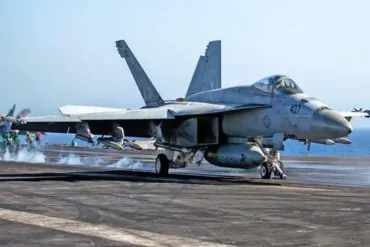
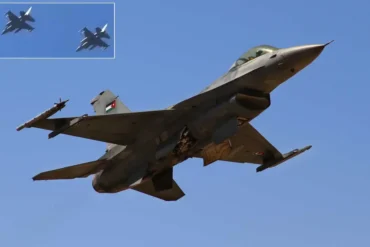
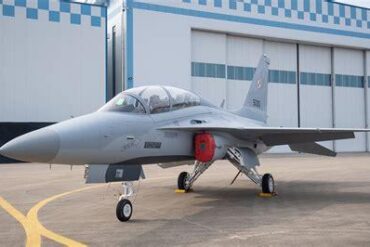
This careful progression mirrors the integration path used for crewed fighters such as the F-35 Lightning II and F-15EX Eagle II, reinforcing that autonomous aircraft are being certified under the same rigorous standards applied to manned platforms.
Why the AIM-120 AMRAAM Matters
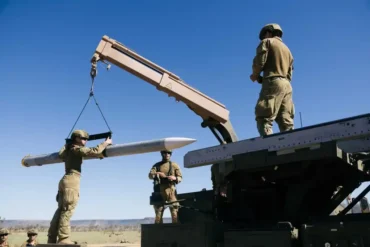
Selecting the AIM-120 Advanced Medium-Range Air-to-Air Missile (AMRAAM) as Fury’s first integrated weapon is strategically significant. Since its introduction in the early 1990s, AMRAAM has become the backbone of Western air superiority. It is deployed by over thirty allied air forces and integrated into both airborne and ground-based systems, including NASAMS air defense networks.
The missile’s active radar guidance allows engagement of targets beyond visual range, enabling pilots—or in this case, remotely supervised autonomous systems—to launch and then maneuver defensively while the missile guides itself to impact. Its deep integration into NATO doctrine, logistics chains, and digital command-and-control networks makes it the logical baseline armament for any aircraft intended to operate within coalition frameworks.
By proving compatibility with AMRAAM, the Air Force validates that the YFQ-44 can plug directly into established engagement architectures. The drone is not an experimental outlier; it is being prepared to operate with the same munitions, tactics, and data protocols already used by frontline fighters.
Collaborative Combat Aircraft: A Networked Force Multiplier
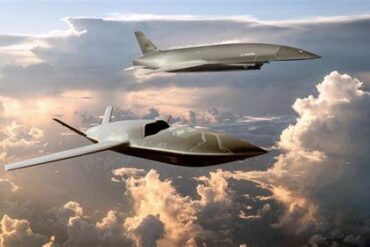
The Collaborative Combat Aircraft program envisions a distributed force structure in which uncrewed platforms operate alongside crewed fighters in tightly coordinated formations. Rather than concentrating sensors and weapons on a few high-value aircraft, the CCA concept disperses capability across multiple nodes.
In practical terms, a formation might consist of a lead F-35 supported by several Fury-class drones. These drones could:
- Extend the sensor horizon beyond the crewed aircraft’s line of sight
- Carry additional air-to-air missiles, effectively acting as forward “missile trucks”
- Conduct electronic attack or decoy operations
- Absorb risk in heavily defended airspace
This model complicates adversary targeting calculations. Instead of facing a single aircraft with limited magazine depth, opponents would confront a layered formation capable of generating greater initial volume of fire while preserving the safety of human pilots.
The Air Force has emphasized that human operators will retain ultimate authority over weapons release decisions. The autonomy embedded within CCA platforms is designed to assist with navigation, formation keeping, sensor fusion, and threat response—not to remove human judgment from lethal decisions. The integration of AMRAAM underlines that Fury is entering this operational ecosystem as a legitimate combat participant, not a peripheral sensor platform.
Rapid Development and Compressed Timelines
The speed at which the YFQ-44 has progressed from conceptual design to weapons integration is notable. Originating as a high-performance aggressor drone concept at Blue Force Technologies before its acquisition and transformation into a CCA candidate, the aircraft moved from clean-sheet design to first flight in approximately 18 months. Flight trials began in late 2025, and the transition to captive-carry testing less than a year later reflects a deliberate effort to compress traditional acquisition cycles.
This acceleration does not imply relaxed standards. Instead, it leverages commercially derived propulsion systems, modular avionics, and digital engineering tools to streamline development while maintaining compliance with formal developmental-test protocols. The Air Force’s approach signals a broader institutional shift toward agile procurement models suited to rapidly evolving threat environments.
Tactical Implications for Future Air Warfare
The implications of integrating BVR missiles onto autonomous aircraft extend well beyond this single test event. In a high-threat conflict scenario, air superiority may hinge on magazine depth, distributed sensing, and survivability in contested electromagnetic environments. Autonomous aircraft carrying standard air-to-air munitions offer a scalable method of increasing force density without proportionally increasing pilot risk.
A future strike package built around crewed fighters and multiple Fury-class drones could deliver:
- Greater missile capacity during the opening phase of an air campaign
- Enhanced survivability through distributed formation geometry
- Increased operational tempo by accepting higher attrition risk for uncrewed assets
This shift represents a structural adaptation to peer-level adversaries equipped with long-range air defenses and advanced fighter fleets. Rather than concentrating capability in a small number of highly sophisticated aircraft, the CCA concept spreads risk and capability across a networked formation.
At the same time, the Air Force’s transparent emphasis on inert testing and structured progression underscores that this is a controlled developmental phase. Captive-carry flights with inert AMRAAMs are data-gathering exercises, not operational deployments. The measured cadence reflects a commitment to safety, reliability, and responsible integration.
A Defining Step Toward Armed Autonomous Airpower
The commencement of AIM-120 integration on the YFQ-44 Fury marks a defining moment in the evolution of autonomous military aviation. It confirms that the Air Force intends for uncrewed aircraft to assume meaningful combat roles alongside crewed fighters, armed with the same frontline weapons and embedded within the same operational frameworks.
As testing progresses toward separation trials and live-fire events, Fury’s role within the CCA ecosystem will become clearer. What is already evident is that autonomous aircraft are transitioning from experimental adjuncts to structured components of future airpower doctrine. By demonstrating that a compact, high-performance drone can carry and integrate the AMRAAM BVR missile, the U.S. Air Force is laying the groundwork for a more distributed, resilient, and scalable approach to air superiority in contested environments.
The milestone is technical, deliberate, and incremental—but its strategic direction is unmistakable. Autonomous fighter drones are moving from concept to combat credibility, reshaping the architecture of modern air warfare.