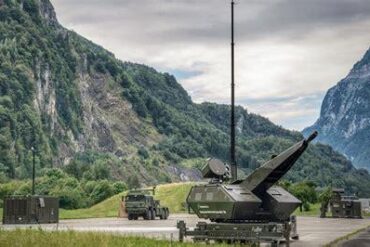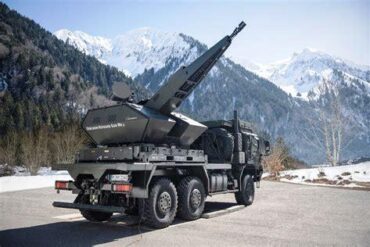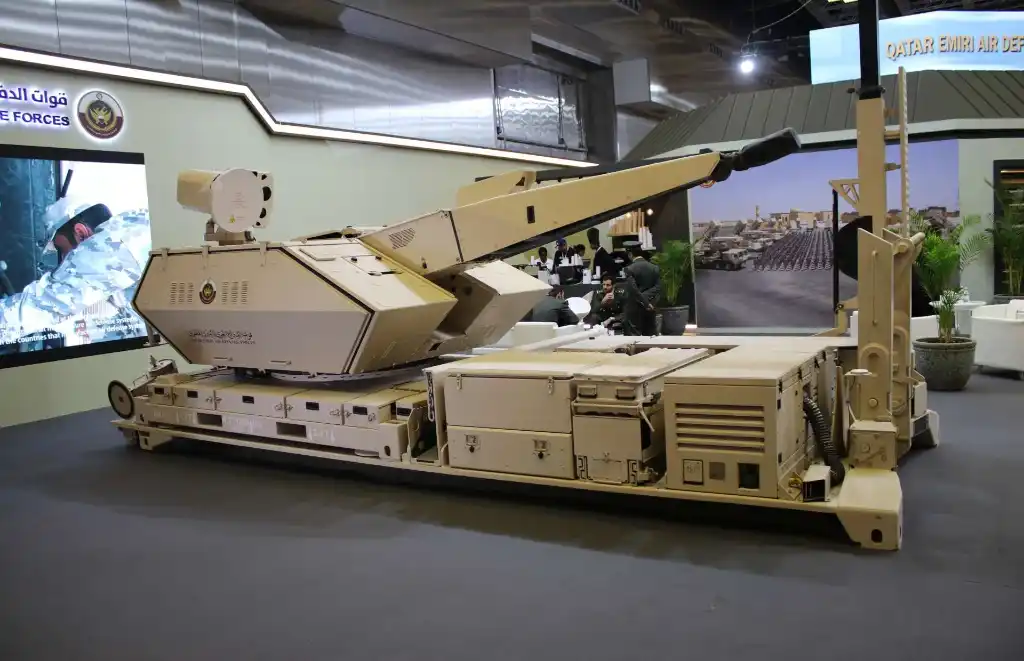
Qatar used the global stage of DIMDEX 2026 in Doha to underline a decisive shift in modern air defense priorities, spotlighting the Rheinmetall Oerlikon Skynex 35mm short-range air defense system as a frontline response to rapidly evolving aerial threats. Displayed as a ready and operational capability rather than a conceptual solution, Skynex reflects Doha’s growing emphasis on point defense, resilience, and cost-efficient protection of critical national infrastructure in an era dominated by unmanned and low-cost attack systems.
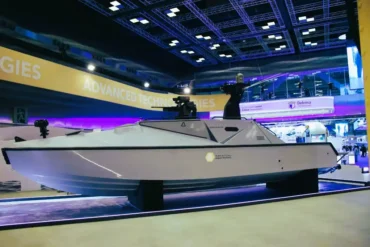
The ninth edition of the Doha International Maritime Defence Exhibition and Conference opened on January 19, 2026, at the Qatar National Convention Centre, with air and missile defense emerging as a dominant theme across land, sea, and joint operational domains. At the Qatar Emiri Air Defence Forces stand, the Skynex system drew particular attention as a tangible illustration of how Gulf states are adapting to the proliferation of drones, loitering munitions, rockets, and low-flying cruise missiles that increasingly define regional security calculations.
Unlike legacy air defense narratives focused on high-altitude threats and ballistic trajectories, Qatar’s presentation emphasized the growing danger posed by low-cost, high-volume saturation attacks. These threats are designed to overwhelm expensive interceptor missiles and exploit vulnerabilities close to defended assets. Skynex is positioned precisely to counter this challenge, forming the innermost layer of a layered air and missile defense architecture intended to deny adversaries easy access to strategic targets.
Air Defense Takes Center Stage at DIMDEX 2026
DIMDEX 2026 underscored how maritime security is now inseparable from air defense, especially for states whose ports, airbases, and energy-adjacent facilities form compact but densely critical networks. Qatar’s geography and strategic posture make the protection of these nodes essential to national security and economic continuity. By highlighting Skynex, Doha signaled that close-range air defense has become as strategically relevant as surface combatants and long-range interceptors.
The Skynex configuration displayed in Doha centered on the 35mm gun effector, reinforcing the relevance of gun-based systems in modern counter-UAS and counter-rocket, artillery, and mortar environments. This approach reflects a regional reassessment of cost-exchange ratios, where firing a missile at a low-cost drone is no longer considered sustainable during prolonged or repeated engagements.
From Evaluation to Operational Urgency
Qatar first revealed the Skynex system publicly in October 2022 during a dedicated air defense exercise, indicating that the architecture had moved beyond evaluation. What has changed since then is the urgency of deployment. Regional conflicts and global observations have demonstrated how mixed salvos of drones, rockets, and cruise missiles can be used to probe defenses, exhaust interceptors, and generate strategic effects disproportionate to their cost.
Skynex addresses this operational reality by providing a persistent, magazine-rich, and rapidly responsive defense layer. It is designed to operate continuously, sustain repeated engagements, and integrate seamlessly with higher-tier air defense systems already fielded by Qatar. In doing so, it strengthens overall defensive depth while preserving expensive missile interceptors for higher-end threats.
Networked Command and Control at the Core
At the heart of Skynex lies the Oerlikon Skymaster battle management system, which functions as the central command-and-control node. Skymaster fuses data from multiple sensors into a coherent and continuously updated air picture, automates threat evaluation, and assigns targets to available effectors with minimal operator workload. This network-centric design allows Skynex to operate as a distributed system, with sensors and guns deployed across a defended area yet acting as a single coordinated entity.
The standard Control Node 1 is housed in a hardened 20-foot container, complete with its own power generation, cooling, and secure communications. Operated typically by four personnel, the node supports scalable console expansion when engagement density increases, ensuring that command capacity grows alongside threat volume rather than becoming a bottleneck.
Sensor Fusion Built for Low-Altitude Threats
Skynex’s sensor architecture is optimized for the detection and tracking of small, fast, and low-observable targets. Rheinmetall’s X-TAR3D tactical acquisition radar provides a three-dimensional air picture with an instrumented range of up to 50 kilometers, specifically tuned for low-altitude performance. Its electronic counter-countermeasures, including track-on-jammer capability, enhance survivability in contested electromagnetic environments.
For deployments emphasizing rapid reaction and dense target environments, Skynex can integrate the Multi Sensor Unit, combining a non-rotating 3D AESA radar with electro-optical tracking and AI-assisted classification. This configuration supports emissions-managed operations and can cue both guns and, in expanded variants, missile-based effectors. The optional integration of passive electronic support measures further extends early warning while reducing radar exposure.
The 35mm Gun Effector and AHEAD Advantage
The tactical centerpiece of Skynex is the unmanned Oerlikon Revolver Gun Mk3, chambered in 35×228 mm. With a nominal rate of fire of 1,000 rounds per minute and an effective engagement range of up to 4,000 meters, the system is optimized for rapid reaction against fleeting targets. Each gun carries 252 ready-to-fire rounds and integrates its own radar, electro-optical sensors, and laser rangefinder, enabling autonomous tracking once cued by Skymaster.
Its defining feature is AHEAD programmable air-burst ammunition, which releases a precisely timed cloud of tungsten sub-projectiles in front of the target. This mechanism dramatically increases hit probability against small and agile threats while maintaining a favorable cost profile. The inclusion of self-destructing sub-projectiles minimizes collateral risk, a critical consideration for defending infrastructure in close proximity to civilian and industrial assets.
Strategic Fit Within Qatar’s Layered Defense
For Qatar, Skynex represents the hard end of the counter-UAS stack, complementing longer-range missile systems already integrated into national air defense networks. High-end interceptors remain essential for ballistic and high-altitude threats, but they are ill-suited for routine engagement of small drones probing defended perimeters. Skynex fills this gap by providing continuous, sustainable protection at the last line of defense.
The system also contributes to counter-rocket and mortar scenarios by enabling rapid warning, precise engagement, and consequence management around defended sites. This capability is particularly relevant for airbases, ports, and energy-related infrastructure that underpin Qatar’s national resilience and strategic relevance.
Deterrence Through Denial and Adaptability
The visibility of Skynex at DIMDEX 2026 carries a clear deterrence message. By denying adversaries the ability to exploit low-cost aerial attack options, Qatar complicates hostile planning and raises the threshold for effective aggression. Rheinmetall’s modular design philosophy further enhances this effect, allowing Skynex to accept future sensors and effectors without overhauling its command backbone.
As unmanned threats continue to proliferate, Qatar’s emphasis on integrated, layered, and economically sustainable air defense positions Skynex not as a niche solution, but as a central pillar of modern national defense strategy.