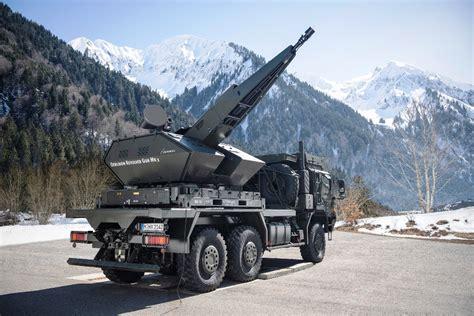
Germany has officially completed the delivery of four fully equipped Skynex short-range air defense systems to Ukraine, a move that decisively enhances the Ukrainian military’s capability to defend against Shahed drones and cruise missile threats targeting vital power infrastructure. Rheinmetall CEO Armin Papperger confirmed the completion during a Capital Markets Day investor call on 18 November 2025, marking a quiet yet strategically vital chapter in Ukraine’s evolving air-defense architecture.
Strengthening the Shield: A Critical Milestone in Air Defense
The delivery of the four Skynex systems marks the culmination of a procurement path that began in late 2022 with an initial order of two systems, followed by an additional two in early 2024. Now fully operational and deployed across western Ukraine, these systems provide layered, mobile, and highly effective point-defense coverage for critical grid nodes and power stations — assets routinely targeted by Russian loitering munitions and cruise missiles.
At the core of this defense suite lies a networked system architecture, integrating:
- The Oerlikon Skymaster (CN-1) battle management node.
- X-TAR3D X-band tactical acquisition radar.
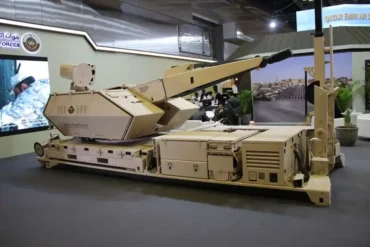
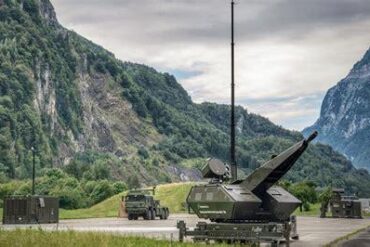
- Up to four Oerlikon Revolver Gun Mk3 turrets per system.
This robust configuration provides Ukraine with a 360-degree aerial threat picture and 4 km-radius active engagement zone, capable of independently tracking and engaging multiple targets simultaneously.
Inside the System: Technology Behind Skynex’s Lethality
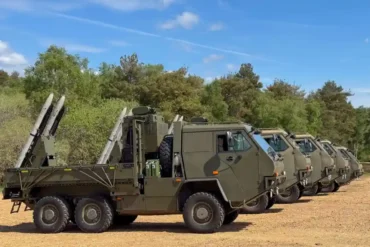
Skynex’s strength comes not only from its multi-layered architecture but also from the design precision and tactical flexibility of its key components. Mounted on HX 8×8 military trucks, the entire Skynex package operates in a mobile, shoot-and-scoot format, significantly enhancing survivability in the fluid battlespace of Ukrainian air defense.
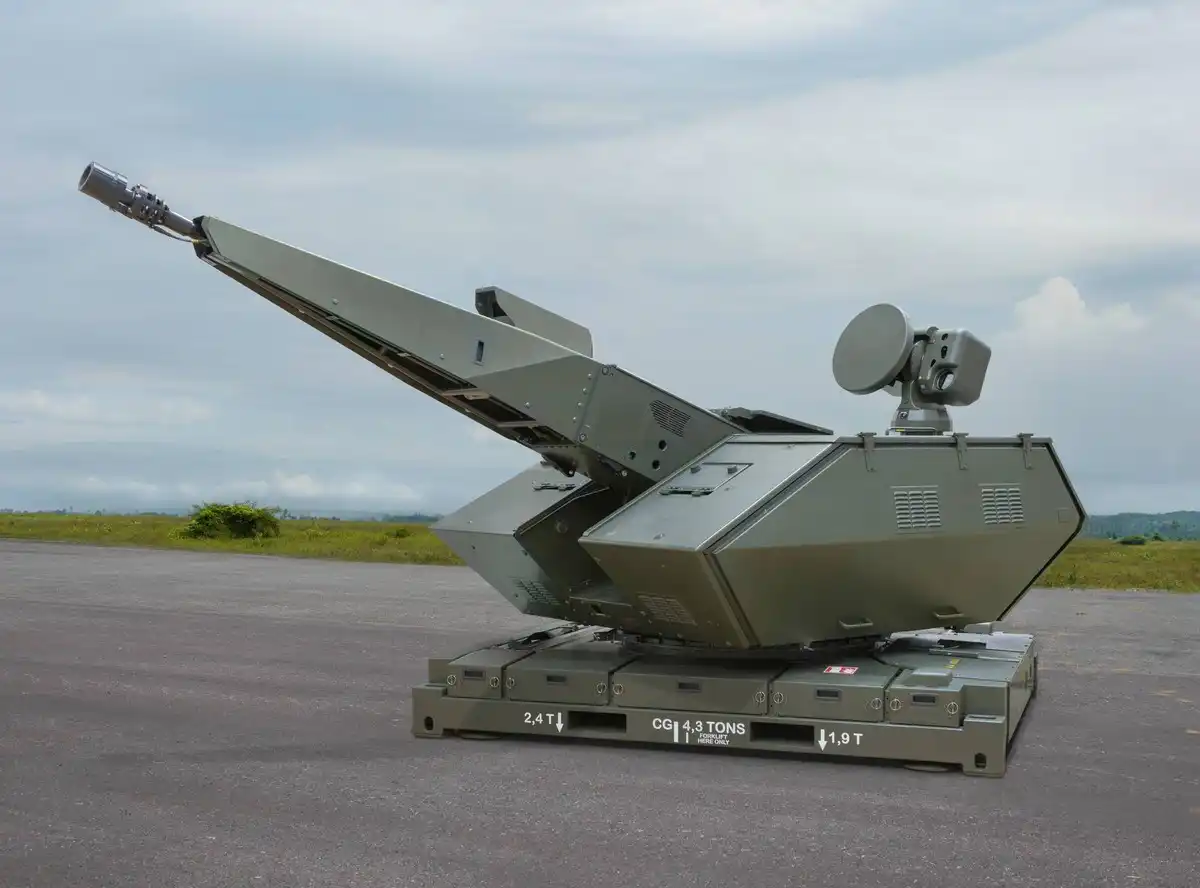
The Revolver Gun Mk3 is a 35×228 mm remote-controlled automatic cannon, rooted in Rheinmetall’s trusted KDG lineage. Its ISO container-compatible turret houses a 5-ton weapon platform capable of achieving:
- Effective range: 4,000 m
- Ceiling: ~3,500 m
- Cyclic rate: 1,000 rounds/min
- Selectable single-shot mode: 200 rounds/min
These statistics translate into remarkable reaction time and accuracy, especially when engaging fast, low-flying targets like Kh-101 or Kalibr missiles in their terminal phase.
AHEAD Ammunition: The Game-Changer for Drone Warfare
The real technological edge lies in the PMD062 AHEAD programmable airburst round. Each cartridge packs 152 tungsten subprojectiles, each weighing 3.3 grams. As the shell exits the barrel, an inductive system programs the time-fuze to detonate mid-flight, spreading a cone-shaped metal cloud across the target’s path. This cloud formation delivers:
- Superior hit probability for low-RCS threats (Shahed drones, quadcopters, FPVs).
- Minimal overkill compared to missile-based interceptors.
- Economical usage at a fraction of missile cost per engagement.
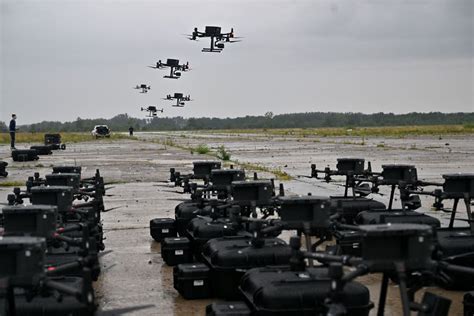
This design gives Ukrainian gunners the ability to intercept dozens of drones per raid, as evidenced during an August 2025 strike, where 42 drones and 11 cruise missiles were neutralized in a single coordinated defense.
From Point Defense to Networked Integration
Each Mk3 turret is more than a gun — it is an autonomous shooter equipped with:
- X-band radar for immediate tracking.
- Electro-optical sensors for high-fidelity target visualization.
- Ballistic computers for rapid lead-angle and burst-time calculation.
This means that once a threat track is handed off from Skymaster or an allied 3D radar, each gun can execute the full kill chain independently, keeping operators safe in distant control shelters.
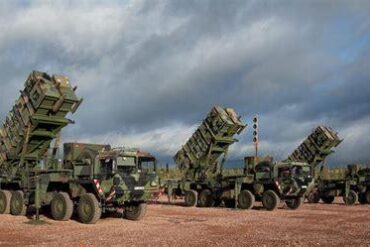
The flexibility of command integration allows Skynex to operate as a local asset under broader air defense umbrellas such as Patriot, IRIS-T SLM, or NASAMS. These missile systems focus on ballistic or supersonic threats, while Skynex takes over the final 4 km kill zone for slower aerial intruders, preserving missile inventories and ensuring cost-effective intercepts.
Strategic Deployment: Air Command “West” in Action
Ukraine’s Air Command West has taken the lead in deploying Skynex batteries to reinforce electricity generation and distribution nodes. These rear-area targets are frequent victims of Russia’s Shahed swarm tactics. Using thermal imaging and radar feeds, Skynex units monitor airspace continuously, springing into action with minimal latency. Footage from recent operations shows turrets slewing rapidly between targets, prioritizing threats by trajectory and proximity.
Analysts note the shift in Ukrainian military doctrine: Skynex is no longer seen as a niche or experimental tool. It has matured into a frontline solution for counter-UAS and cruise missile defense, allowing defenders to rationalize engagement chains and layer their responses more effectively.
Sustaining the Fight: Ammunition Supply and Industrial Base
One of the biggest challenges in deploying advanced systems is long-term sustainment. In this area, Skynex excels due to Ukraine’s existing use of the Gepard 35 mm platform, already supplied with massive ammunition stockpiles from Germany. Rheinmetall is:
- Expanding production of 35 mm AHEAD rounds at its Várpalota plant in Hungary.
- Fulfilling multi-year contracts under the German Ukraine-support budget.
- Delivering new orders to unidentified European operators, likely acting as further pipeline support for Ukraine.
This industrial backing ensures that Ukraine can continue to operate Skynex over multiple winter campaigns, rather than rely on limited, boutique batches.
From Kyiv to NATO: A Growing Family of Skynex Users
Ukraine is not alone in recognizing the Skynex system’s value. Qatar was the first operator, fielding a variant with eight guns and X-TAR3D radar to defend energy infrastructure. Since then:
- Italy has signed contracts worth €280 million for up to four systems, with deliveries slated from 2026.
- A European customer (unconfirmed) has ordered more batteries and ammunition for 2025.
- Rheinmetall is adapting the Skyranger 35 turret for Leopard 1 platforms as another Ukrainian aid component.
These deals suggest that the 35 mm and AHEAD-based solution is on track to become a NATO standard for very short-range air defense — bridging the gap between costly interceptors and man-portable solutions.
Tactical and Political Ramifications for Europe and Beyond
For Ukraine, Skynex is more than hardware — it represents a new model of cost-conscious, precision-driven defense. As Russian forces escalate their drone and missile campaign heading into winter, Ukraine can meet them with a dense, high-volume curtain of tungsten, fired from mobile platforms, backed by growing industrial capacity.
For Germany and its allies, this project underscores a successful case study in defense diplomacy and industrial logistics. The system’s proven battlefield effectiveness now bolsters the case for the European Sky Shield Initiative, positioning Skynex as a foundational layer in continental airspace protection.
Conclusion: A New Era in Layered Air Defense
The full deployment of Germany’s Skynex systems to Ukraine signals a decisive shift in modern air-defense strategy. Blending radar sophistication, autonomous control, and precision fragmentation, Skynex delivers a capability that balances combat efficiency with fiscal responsibility. As Ukraine faces another winter under the shadow of Russian aerial threats, it does so with a system purpose-built to intercept — and outlast — wave after wave of drones and missiles.
The Skynex narrative is not merely a story of battlefield technology. It is a testament to the power of international cooperation, smart engineering, and adaptive tactics in shaping the frontlines of a 21st-century war.