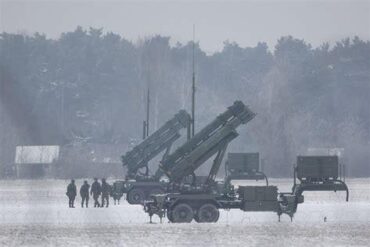
The United States Army has awarded Raytheon a $183.7 million Foreign Military Sales (FMS) contract aimed at reinforcing the United Arab Emirates’ Patriot missile defense network, a system considered one of the most capable ground-based air and missile defense architectures in the world. The agreement, announced in the U.S. Department of Defense contract releases on March 4, 2026, focuses on sustaining and modernizing key components of the UAE’s Patriot infrastructure as tensions in the Persian Gulf security environment continue to intensify.
The contract funds hardware kits, installation, system inspections, logistics support, and program management services required to maintain the operational readiness of Patriot missile defense batteries deployed across the Emirates. Work on the program will be managed primarily from Raytheon’s defense facilities in Tewksbury, Massachusetts, one of the company’s principal hubs for missile defense technology development and lifecycle support.
Although the Pentagon did not publicly detail every subsystem included in the package, the contract strongly resembles what defense planners call a “keep-it-lethal” modernization program—a long-term sustainment effort designed to ensure that high-demand air defense systems remain operational, technologically aligned with newer configurations, and ready for rapid combat deployment.
The contract’s estimated completion date of March 3, 2031 suggests that the agreement is not a single delivery of hardware but a multi-year sustainment initiative. The cumulative ceiling value of the program, reaching approximately $281.1 million, indicates continued upgrades, inspections, and logistical support aimed at maximizing the operational availability of UAE Patriot units during a period when Gulf air defense forces are under persistent pressure from Iranian missile and drone capabilities.
Why the Patriot System Matters in the Gulf’s Evolving Air Defense Battlespace
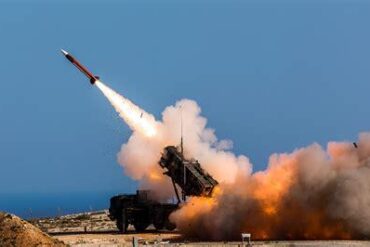
The Patriot missile defense system occupies a critical position within the “lower tier” of integrated air and missile defense, a defensive layer designed to intercept ballistic missiles, cruise missiles, aircraft, and increasingly sophisticated unmanned aerial vehicles during the final stages of their flight.
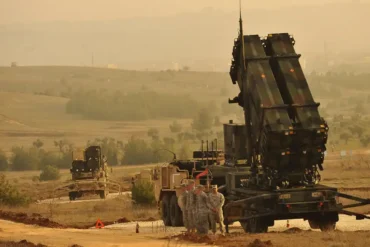
Modern Patriot firing units are composed of six essential elements:
- Interceptor missiles
- Launcher platforms
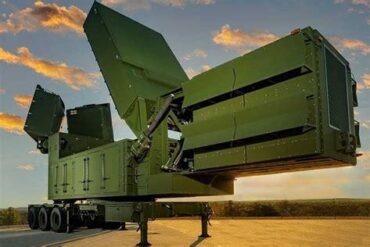
- Multifunction phased-array radar
- Engagement Control Station
- Power generation units
- Antenna mast group for communications and remote launch control
Unlike older air defense systems that separate surveillance and fire-control radars, Patriot uses a single multifunction radar capable of detection, tracking, identification, and missile guidance. This integration significantly reduces the system’s physical footprint while enabling rapid deployment around strategic assets such as air bases, ports, oil facilities, and command centers.
In a region where military planners must defend energy infrastructure and maritime logistics nodes, the ability to quickly reposition and activate a missile defense battery is not just convenient—it is strategically essential.
PAC-2 and PAC-3 Interceptors: The Dual Backbone of Patriot’s Firepower
The UAE’s Patriot network relies heavily on a combination of PAC-2 Guidance Enhanced Missiles (GEM-T) and the more advanced PAC-3 interceptor family.
The PAC-2 GEM-T missile remains an effective solution for engaging aircraft and cruise missiles while maintaining the ability to intercept certain ballistic targets. It uses a blast-fragmentation warhead and track-via-missile guidance, allowing the interceptor to detonate near its target and destroy it through a high-velocity cloud of metal fragments.
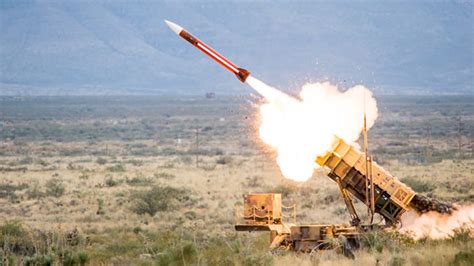
The PAC-3 interceptor, however, represents a fundamentally different technological philosophy. Instead of exploding near its target, the missile uses a hit-to-kill kinetic impact method, physically colliding with the incoming ballistic missile warhead at extreme speeds.
The PAC-3 Missile Segment Enhancement (MSE) variant significantly expands the system’s reach and maneuverability. Equipped with a larger dual-pulse rocket motor, upgraded guidance electronics, and improved structural design, the MSE interceptor can engage more challenging ballistic missile threats at longer distances and higher altitudes.
Testing has demonstrated the interceptor’s ability to defeat medium-range ballistic missile targets, making it particularly relevant in the Gulf where Iranian missile forces include a wide variety of short- and medium-range ballistic missiles capable of striking across the region.
Magazine Depth and Tactical Endurance in Mass Missile Attacks
Modern air defense planners worry less about single incoming missiles and more about large coordinated salvos, often referred to as “mass raids.” Iran and its regional proxy forces have repeatedly demonstrated tactics designed to overwhelm defensive systems through sheer volume.
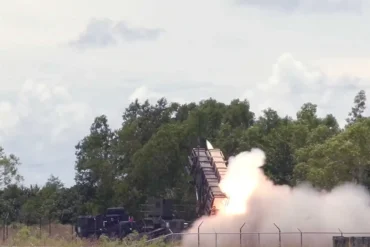
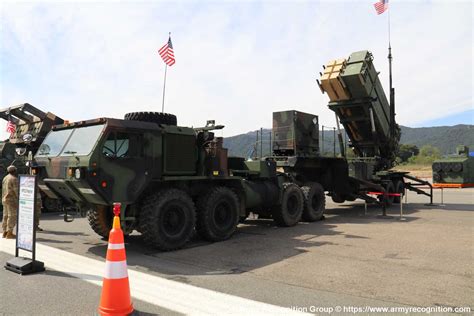
The M903 Patriot launcher is designed to mitigate this threat through flexible missile loading configurations. Depending on mission requirements, each launcher can carry:
- Up to 12 PAC-3 MSE interceptors
- Up to 16 PAC-3 CRI missiles
- A smaller number of PAC-2 missile canisters
A typical Patriot battery fields six to eight launchers, providing dozens of interceptors ready for immediate use. This configuration allows commanders to balance engagement range, target type, and magazine capacity.
Equally important is Patriot’s remote launch capability, which allows launchers to operate up to roughly 10 kilometers away from the radar and command center. This dispersal reduces vulnerability to enemy strikes while expanding the protected area around key infrastructure.
In practice, this means a single Patriot battery can shield an entire cluster of strategic assets, such as an airport, naval base, or refinery complex.
Iran’s Expanding Missile and Drone Arsenal
The urgency behind the new U.S. Army contract cannot be understood without examining the rapid evolution of Iranian strike capabilities.
Iran has spent decades building a diverse arsenal of ballistic missiles, land-attack cruise missiles, and one-way attack drones. In recent years, these systems have been deployed not only by Iranian forces but also by allied militias and proxy groups across the Middle East.
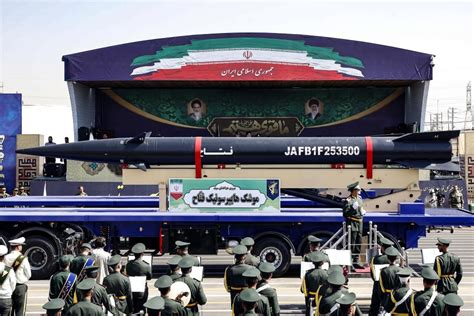
Recent intelligence and media reporting indicates that Tehran has used coordinated missile and drone attacks to pressure U.S. allies and threaten shipping routes in the Strait of Hormuz, the narrow maritime chokepoint through which a significant portion of the world’s oil supply passes.
For the United Arab Emirates, whose economy depends heavily on global trade and energy exports, maintaining uninterrupted maritime traffic through the Strait is a strategic imperative.
Any successful missile attack on ports, oil facilities, or airports could have cascading economic consequences across the region.
The UAE’s Long-Term Investment in Layered Missile Defense
The new Patriot sustainment contract represents only the latest phase in the UAE’s multi-decade investment in missile defense architecture.
In 2019, the United States approved a potential Foreign Military Sales package that included up to 452 PAC-3 MSE interceptors, along with radar components, launcher equipment, and logistical support services. The proposed sale was framed explicitly as a measure to strengthen the Emirates’ homeland defense against regional missile threats.
Over time, the UAE has sought to evolve from point defense—protecting individual bases—to a layered national air defense network capable of covering major population centers and critical infrastructure.
Such systems typically integrate multiple defensive layers, including:
- Long-range radar networks
- Ballistic missile interceptors
- Medium-range air defense systems
- Short-range counter-drone defenses
Within this architecture, Patriot serves as the backbone of terminal ballistic missile defense, intercepting threats in the final seconds before impact.
Combat Experience: Missile Defense Under Real-World Attack
Unlike many countries that operate missile defense systems primarily for deterrence, the UAE has already used Patriot interceptors in real combat scenarios.
In early 2022, Houthi militants in Yemen launched ballistic missiles toward the Emirates during a period of heightened regional tension. Reports from Reuters and other international media indicated that Patriot batteries successfully intercepted incoming missiles, preventing potential damage to urban and infrastructure targets.
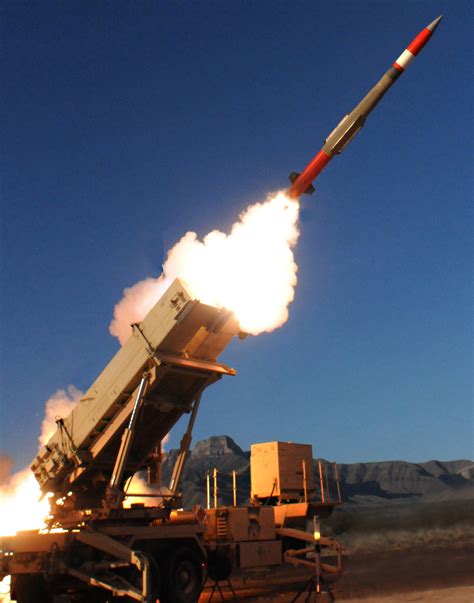
Those events highlighted a reality that Gulf defense planners have long recognized: missile defense is not an abstract strategic concept but a daily operational necessity in a region where armed groups and regional powers possess growing missile arsenals.
The lessons from those engagements reinforced the importance of system reliability, interceptor stockpiles, and rapid maintenance support, all elements addressed by the new U.S. Army contract.
Sustainment: The Hidden Backbone of Missile Defense Power
Missile defense systems are often judged by their interceptors and radar technology, but the real determinant of combat effectiveness is usually sustainment.
Sensors must remain calibrated. Software must remain updated. Launchers must remain mechanically reliable. Interceptor missiles must be stored, tested, and replaced according to strict technical schedules.
A missile defense system that looks formidable on paper can become ineffective if maintenance cycles, spare parts, or logistics pipelines fail.
The new Raytheon contract directly targets this challenge by bundling hardware refresh packages, installation services, inspection programs, and long-term logistics support into a single integrated sustainment effort.
Such programs ensure that Patriot batteries maintain high operational readiness rates, enabling them to remain on alert for extended periods during regional crises.
Strategic Implications for Gulf Security
The significance of the Patriot sustainment program extends beyond simple equipment maintenance. It reinforces a broader strategic partnership between the United States and the United Arab Emirates, centered on maintaining regional stability and deterrence against missile threats.
For Washington, supporting Gulf missile defense networks helps protect U.S. military bases, naval forces, and regional logistics hubs that operate alongside allied infrastructure.
For the UAE, the program strengthens its ability to defend critical economic assets and maintain uninterrupted global trade flows, particularly through the vital corridors connecting the Persian Gulf to international shipping routes.
The long performance window extending to 2031 signals that Patriot will remain a central component of the Emirates’ defensive strategy for years to come. Even as drone warfare evolves and new missile technologies emerge, integrated missile defense systems will continue to form the backbone of national resilience in the Gulf.
In a region where strategic pressure increasingly arrives in the form of salvos of drones, cruise missiles, and ballistic missiles launched in coordinated waves, the ability to maintain ready, reliable missile defenses may ultimately determine whether infrastructure survives the opening hours of a future conflict.