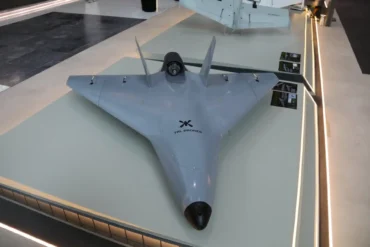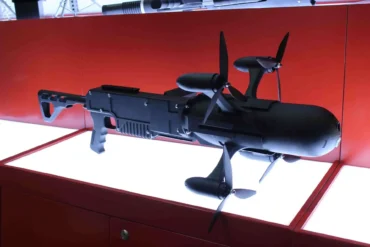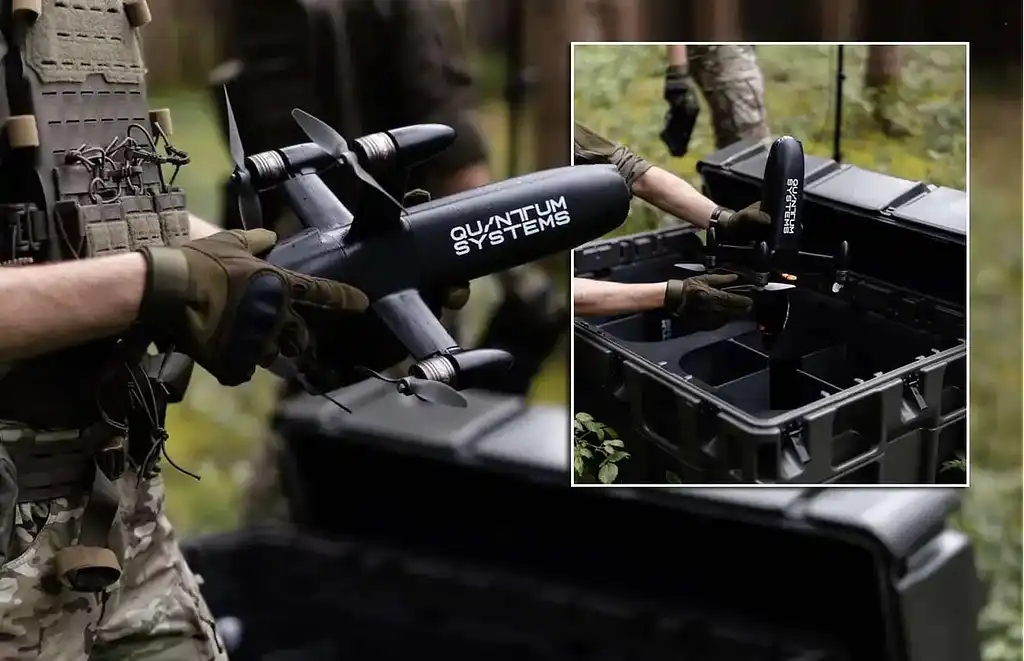
Germany’s Quantum Systems has officially revealed the Jäger interceptor drone, a low-cost, rocket-assisted counter-UAS platform designed to neutralize fast-moving enemy drones with unmatched precision and affordability. As drone warfare rapidly evolves across Europe’s frontlines, particularly in Ukraine, Jäger represents a decisive leap in tactical air defense technology—one built for agility, scalability, and resilience in contested airspace.
Unlike traditional interceptors relying on fragmentation warheads, Jäger employs a hit-to-kill principle, weaponizing its own velocity and impact mass to destroy hostile targets. This design choice drastically reduces cost and complexity, allowing NATO and allied forces to deploy the system in numbers that can match the scale of low-cost drone threats now saturating modern battlefields.
Rocket-Boosted Speed and Electric Precision
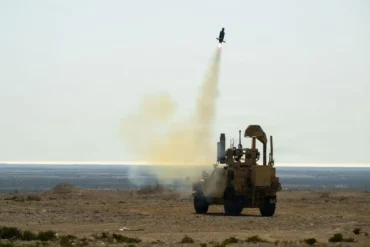
At its core, the Jäger interceptor is an ingenious blend of rocket-assisted launch and electric propulsion, enabling rapid engagement without compromising stealth. Upon activation, four electric lift propellers lift the drone from its compact containerized launcher to an altitude of around 100 meters. Then, a solid-fuel booster ignites, propelling the drone to 4,000 meters in roughly 30 seconds.
Once at altitude, the Jäger transitions to quiet, electric-powered flight, reducing its acoustic and infrared signatures during the final approach. This hybrid propulsion not only minimizes detection but also allows for jam-resistant control and GNSS-independent navigation, making it fully capable of operating in GPS-denied environments—a common challenge on today’s electronic warfare battlefields.
Compact Design and Tactical Reach
Weighing just 2.5 kilograms, with about 800 grams of payload capacity, the Jäger is a masterclass in aerospace minimalism. It can reach speeds of 365–405 km/h and boasts an effective engagement radius of 25 kilometers with a service ceiling of 5,000 meters. These figures give it the reach and velocity to outpace Group 1 and Group 2 UAVs while even challenging smaller Group 3 drones.
The drone’s hit-to-kill mechanism eliminates the regulatory and safety complexities of explosive warheads while maintaining lethal efficiency against quadcopters, fixed-wing reconnaissance UAVs, and loitering munitions. This allows forces to deploy Jäger in sensitive environments without the risks tied to traditional munitions.
Affordable Defense for a Drone-Saturated Battlefield
One of Jäger’s most strategic advantages lies in its cost-effectiveness. Priced in the low four-figure euro range per unit, it fundamentally shifts the cost equation of drone defense. Rather than expending expensive missiles on cheap threats, operators can now deploy Jäger as an economical, scalable, and reusable solution within layered defense networks.
Its affordability enables sustained, high-volume counter-drone operations, aligning the economics of defense with the reality of attrition warfare. As NATO forces face increasing drone swarms and kamikaze UAVs, a low-cost yet high-performance interceptor like Jäger offers a pragmatic balance of capability and endurance.
Electronic Warfare Resilience and Automation
Drawing heavily on its combat experience in Ukraine, Quantum Systems has engineered the Jäger with jam-resistant datalinks and GNSS-independent guidance, ensuring operational reliability in electromagnetically contested zones. This capability is particularly vital against adversaries equipped with sophisticated jamming and spoofing technologies.
The system’s high automation level further enhances its value. Jäger autonomously handles terminal engagement, drastically reducing operator workload and compressing the sensor-to-shooter timeline. This autonomy ensures that mobile units and dispersed teams can respond to drone incursions almost instantly—launching a Jäger from its containerized box within seconds of detection.
Combat Lessons and the Future of European Air Defense
Quantum Systems’ prior reconnaissance drone deployments have provided invaluable insight into real-world electronic warfare, directly shaping Jäger’s hardened communication systems and modular design. By emphasizing rapid deployment and minimal signature, the company addresses a core requirement of 21st-century mobile air defense—speed, flexibility, and survivability.
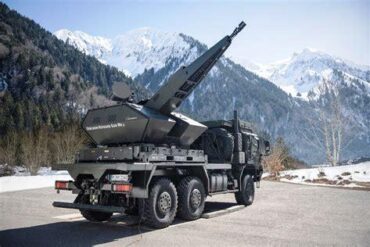
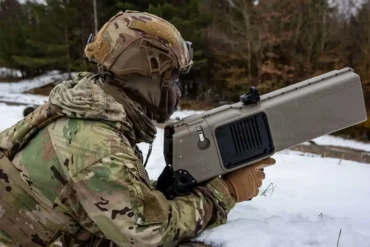
If integrated into NATO’s defensive architecture, Jäger could serve as a battalion-level or brigade-level interceptor, filling a critical gap between RF jammers, kinetic guns, and SHORAD missile systems. Its modular launchers can be mounted on vehicles, trailers, or static installations, supporting both forward-deployed and rear-echelon units.
Germany’s Strategic Shift Toward Scalable Counter-UAS Systems
The unveiling of Jäger marks a strategic milestone for Germany’s defense industry. With Russia’s invasion of Ukraine accelerating the global race for scalable drone defense, Jäger positions Germany as a frontline innovator in low-cost, high-performance counter-drone solutions. Its ability to bridge affordability, speed, and survivability exemplifies the country’s new defense-industrial pragmatism—where innovation meets mass production.
Ultimately, whether Berlin or its NATO partners move swiftly from testing to field deployment will define Europe’s readiness for the next evolution in unmanned warfare. As drone swarms, loitering munitions, and electronic attacks continue to dominate the modern battlespace, systems like the Quantum Systems Jäger represent not just technological progress—but the future of accessible, adaptive air defense.