Belarus has stepped into the intensifying global race for short-range counter-drone solutions with the unveiling of a compact, drone-based interceptor developed by the national defense research organization LEMT. Presented publicly for the first time at UMEX 2026, the system reflects a deliberate shift toward man-portable, autonomous, and kinetically destructive counter-UAV weapons designed to counter the growing battlefield presence of small, low-cost drones.
The LEMT system is conceived as a drone-based equivalent to a man-portable air defense system, tailored not for fast jets or helicopters but for the persistent threat posed by quadcopters and light fixed-wing UAVs. Unlike electronic warfare systems that rely on jamming or spoofing, this solution embraces physical interception, using a dedicated interceptor drone to ram and destroy hostile aerial targets at short range.
In an era where small drones are increasingly used for reconnaissance, artillery spotting, and precision strikes, the Belarusian concept underscores a broader defense trend: simplicity, autonomy, and portability are becoming just as critical as raw performance.
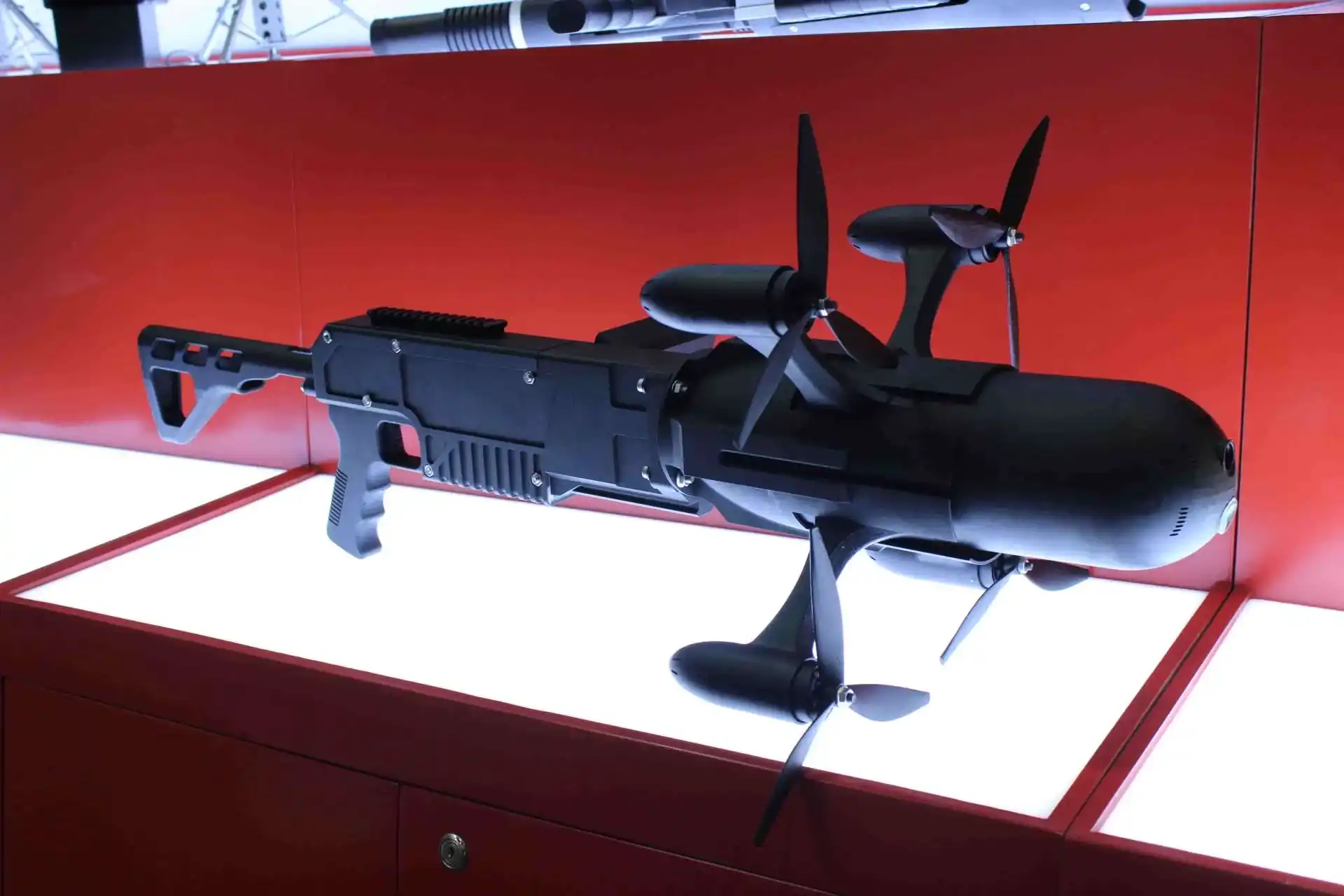
The core of the system is a rifle-like launcher that integrates detection, guidance, and firing functions into a single unit operated by an individual soldier. The launcher houses the interceptor drone directly at its forward end, creating a unified weapon that can be carried, aimed, and deployed in a manner familiar to infantry personnel already trained on shoulder-fired systems. This design philosophy emphasizes rapid reaction and minimal logistical burden in frontline environments where drone threats often appear with little warning.
The interceptor itself departs from traditional missile architecture. Instead of a rocket motor and explosive fragmentation warhead, it is a multi-propeller UAV built around a ramming principle. Once launched, the drone accelerates toward its target and neutralizes it through direct physical collision, eliminating the need for proximity fuzes or blast effects that could endanger friendly forces operating nearby.
Kinetic Interception Over Electronic Suppression
LEMT’s choice to pursue kinetic interception reflects the evolving limitations of electronic countermeasures. As drones increasingly adopt frequency hopping, autonomous navigation, and hardened datalinks, jamming alone can no longer guarantee neutralization. A physical interceptor, by contrast, remains effective regardless of onboard autonomy or resistance to electronic attack.
Target acquisition is handled by an integrated dual-sensor seeker, combining a standard video camera with a thermal imaging system. This configuration allows the interceptor to detect and track aerial targets with low visual contrast, including drones painted in neutral colors or operating against cluttered backgrounds. Thermal sensing also improves performance during night operations, haze, or reduced visibility, conditions under which many small UAVs attempt to exploit their advantage.
The seeker feeds data into onboard processing algorithms capable of identifying, tracking, and classifying targets. Neural network-based processing supports automatic target recognition, enabling the system to distinguish between different UAV types and prioritize threats based on size, speed, and behavior.
Launcher Design and Operational Concept
The launcher displayed at UMEX 2026 was presented as a full-scale mock-up, offering insight into the system’s intended ergonomics and battlefield role. It features a shoulder stock, a forward grip for stability, and a compact central housing likely containing control electronics, power supply, and communications hardware. The interceptor drone is mounted prominently at the front, with exposed propellers arranged around a streamlined fuselage optimized for rapid acceleration.
A notable design element is the interceptor’s ability to launch at a 90-degree flight angle, enabling vertical or near-vertical takeoff. This capability allows the system to engage hovering drones or targets directly overhead, a common challenge for ground-based counter-UAV weapons. Vertical launch also reduces the space required for deployment, making the system suitable for urban terrain, forested areas, or defensive positions with limited clear arcs of fire.
Once a target is detected and designated, the operator can choose between operator-assisted engagement or a fully automatic mode. In automatic mode, the interceptor conducts the entire mission—from launch to interception—without further human input. This reduces operator workload and enables rapid response to fleeting drone threats.
Performance Parameters and Engagement Envelope
According to specifications presented at UMEX 2026, the complete system—including launcher and interceptor—has a total weight of approximately 6 kilograms, reinforcing its classification as a genuinely man-portable weapon. The interceptor drone itself is listed with a maximum weight of up to 3 kilograms, with a payload capacity of 0.5 kilograms allocated to sensors and guidance hardware.
Performance figures indicate a maximum flight range of 6 kilometers, a flight endurance of roughly 10 minutes, and a top speed reaching 200 kilometers per hour. These parameters position the system squarely in the short-range counter-UAV role, optimized for point defense rather than wide-area coverage.
Lock-on ranges vary by target type. Small commercial quadcopters such as the DJI Phantom 4 can be acquired at distances of around 200 meters, while larger platforms like the Matrice 300 extend detection to approximately 400 meters. For even larger drones, including the Matrice 600 or light fixed-wing UAVs, lock-on ranges can reach 500 meters, providing sufficient engagement distance for high-speed interception.
Beyond Aerial Targets: Expanding Autonomous Roles
While the primary mission is counter-UAV interception, LEMT has indicated that the system’s architecture supports broader autonomous functions. These include aerial surveillance, target data collection, and the transmission of target coordinates and sighting angles to other weapon systems. The concept also includes the ability to engage ground targets autonomously in automatic mode, hinting at future adaptations beyond pure air defense.
Such versatility reflects a growing interest in multi-role autonomous weapons capable of performing reconnaissance, targeting, and strike functions within a single platform. For militaries facing dense drone environments, this flexibility could reduce the need for multiple specialized systems.
Strategic Significance of the UMEX 2026 Debut
The unveiling of the LEMT interceptor at UMEX 2026 highlights how even relatively small defense ecosystems are responding to the ubiquity of drones in modern conflict. By focusing on portability, autonomy, and kinetic certainty, Belarus positions this system as a practical solution for frontline units that require immediate, reliable protection against low-altitude UAV threats.
As armed forces worldwide continue to adapt to contested airspaces dominated by small drones, concepts like the LEMT man-portable interceptor illustrate one clear trajectory: the future of counter-UAV warfare is increasingly personal, autonomous, and physically decisive.