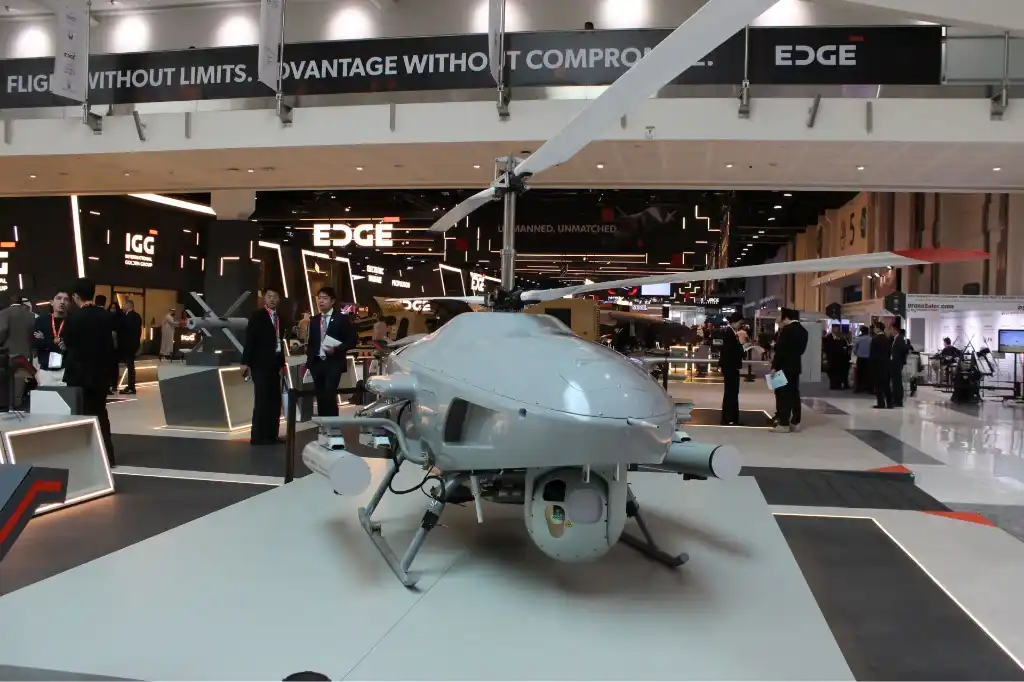
China’s defense industry marked a notable milestone at UMEX 2026 with the public debut of the Golden Eagle CR500B armed unmanned helicopter, a system that underscores Beijing’s accelerating push toward weaponized rotary-wing unmanned platforms. Presented by China North Industries Corporation (NORINCO), the CR500B was positioned not as a conceptual prototype but as a mature, mission-ready evolution of the earlier CR500A, reflecting a deliberate shift from surveillance-centric roles toward integrated strike and armed reconnaissance missions.
The unveiling took place at UMEX 2026, an exhibition dedicated to unmanned systems and emerging defense technologies, where the emphasis increasingly lies on combat-ready autonomy rather than experimental concepts. NORINCO’s presentation made clear that the CR500B is intended to operate in complex tactical environments, filling operational gaps between traditional crewed helicopters and fixed-wing unmanned aerial vehicles. By retaining the proven airframe philosophy of the CR500A while substantially expanding combat capability, the platform represents a calculated refinement rather than a radical redesign.
At its core, the Golden Eagle CR500B is described as a multi-role unmanned helicopter capable of reconnaissance, target acquisition, and precision strike within a single sortie. This consolidation of functions reflects a broader doctrinal trend toward shortening the sensor-to-shooter chain, enabling faster engagement decisions and reducing dependence on multiple supporting assets. Designed for vertical take-off and landing, the system can be deployed from confined areas, improvised forward sites, or austere terrain, including mountainous and plateau regions where conventional air infrastructure is limited.
A defining feature carried over from the CR500A is the coaxial contra-rotating rotor configuration, which eliminates the need for a tail rotor. This design choice reduces the aircraft’s physical footprint while improving stability and control, particularly during hover and low-speed maneuvering. The compact airframe facilitates transport, storage, and rapid field deployment, aligning with expeditionary operational concepts. NORINCO emphasizes the integration of advanced flight control algorithms, intended to enhance precision, resilience, and safety during autonomous or remotely piloted operations in contested environments.
The mission payload architecture of the CR500B reflects its armed orientation. The unmanned helicopter is equipped with a multi-function electro-optical sensor pod that integrates television and infrared imaging with a laser rangefinder and laser designator. This sensor suite enables persistent surveillance, accurate target identification, and precision guidance for onboard munitions. Real-time data transmission through an integrated data-link system allows seamless information sharing with ground command elements, reinforcing its role within networked battlefield architectures.
What clearly differentiates the CR500B from its predecessor is the addition of lateral hardpoints for air-to-ground munitions. At UMEX 2026, the platform was displayed carrying Blue Arrow 5 light anti-armor missiles, signaling a transition from permissive support roles to direct engagement capability. This configuration enables the unmanned helicopter to conduct precision strikes against lightly armored vehicles, fortified positions, or time-sensitive targets, either independently or in coordination with other unmanned and crewed assets.
Published performance data highlights a substantial enhancement over the CR500A. The maximum take-off weight increases to 600 kilograms, compared to 500 kilograms previously, allowing greater payload flexibility. Endurance is stated at up to five hours when carrying both electro-optical sensors and multiple missiles, an improvement over the four-hour endurance of the earlier variant under high payload conditions. The operational ceiling doubles to 6,000 meters, while the combat radius expands to 150 kilometers, extending the platform’s reach and survivability in high-altitude or extended-range missions.
These performance gains translate directly into operational flexibility. The CR500B can loiter for extended periods while maintaining the ability to engage targets immediately upon identification, reducing response times and enhancing tactical responsiveness. Increased altitude capability improves sensor coverage and survivability, particularly in environments where ground-based threats or terrain masking present challenges. The expanded combat radius allows commanders to project unmanned rotary-wing firepower deeper into contested areas without exposing crewed platforms.
Comparing the CR500A and CR500B reveals a clear evolution in operational philosophy. The earlier CR500A was marketed primarily as a modular platform for surveillance, communications relay, target designation, and decision-support roles, with limited emphasis on organic strike capability. In contrast, the CR500B retains these foundational missions while embedding weapons integration as a core function. This shift reflects a growing confidence in unmanned systems as frontline combat assets rather than auxiliary enablers.
From a strategic perspective, the Golden Eagle CR500B embodies the convergence of persistence and lethality within a single unmanned platform. By combining continuous observation with immediate strike capability, the system reduces operational friction and dependency on external shooters. Such integration is particularly relevant in scenarios involving dispersed forces, rapid maneuver warfare, or constrained airspace, where responsiveness and autonomy are decisive factors.
Through the introduction of the CR500B, NORINCO strengthens its position in the expanding global market for armed unmanned rotary-wing systems. As unmanned helicopters increasingly gain acceptance as precision strike platforms, the emergence of systems like the Golden Eagle CR500B signals a broader shift in modern warfare, where autonomous and remotely piloted assets assume roles once reserved exclusively for crewed aircraft, reshaping tactical balances and operational doctrines worldwide.