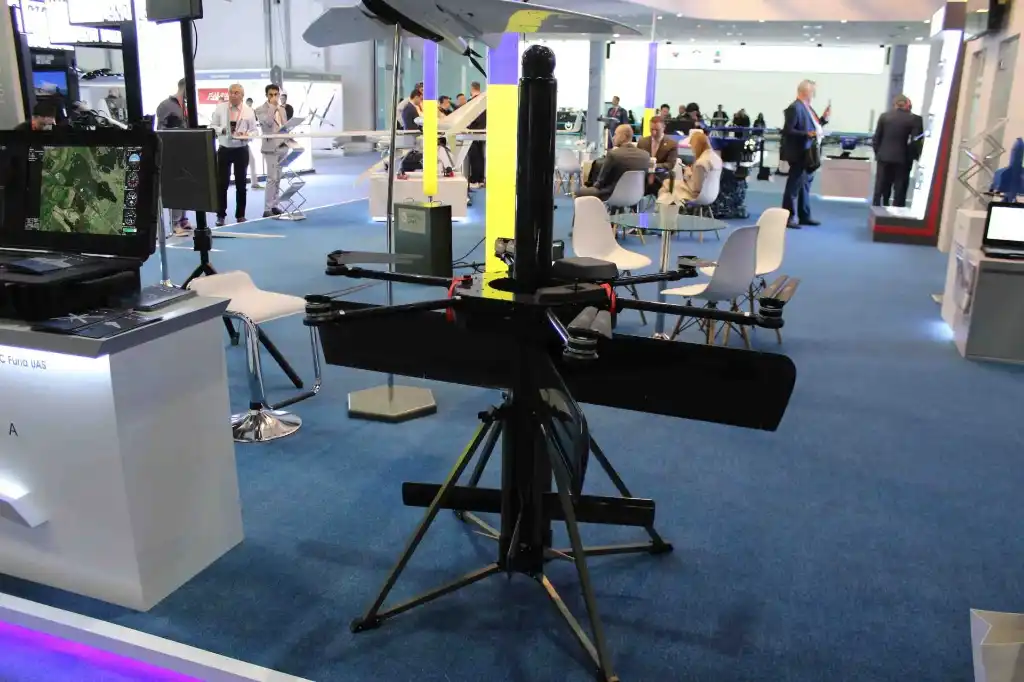
Ukraine’s defense industry used the global stage at UMEX 2026 in the United Arab Emirates to signal a decisive shift in modern battlefield tactics with the presentation of the ST-35 Silent Thunder loitering munition. Developed by Kyiv-based Athlon Avia, the system reflects hard-earned operational experience translated into a compact, flexible weapon optimized for dense, contested, and urban environments.
The debut of the ST-35 Silent Thunder at one of the world’s most influential unmanned systems exhibitions underscored Ukraine’s growing role as both a user and innovator of combat-proven drone technology. Rather than focusing on sheer range or payload size, the system emphasizes precision, discretion, and operator control, characteristics increasingly valued in modern conflicts where collateral damage and response time carry strategic weight.
Designed as a vertically launched loitering munition, the ST-35 introduces an unconventional employment concept that decouples launch, reconnaissance, and strike phases. This approach allows small units to conduct high-value precision attacks without exposing manned aircraft or fixed launch infrastructure, a capability that has become essential in saturated air-defense and urban warfare scenarios.
A Vertical Launch Concept Built for Urban Battlespaces
At the core of the ST-35 Silent Thunder’s architecture is its vertical launch system, a solution engineered to overcome the spatial and tactical constraints of urban terrain. Instead of relying on runways, rails, or vehicle-mounted catapults, the loitering munition is lifted into the air by a dedicated multirotor platform. This carrier drone elevates the munition to an altitude of approximately 400 to 600 meters before releasing it to begin autonomous fixed-wing flight.
This method allows operators to deploy the system from courtyards, rooftops, forest clearings, or narrow streets, drastically expanding the range of viable launch sites. Once released, the ST-35 transitions smoothly into horizontal flight, heading toward a designated area of interest while the multirotor returns to base or reconfigures for relay duties. The result is a launch profile that is both tactically flexible and difficult to detect, particularly in environments cluttered with civilian structures.
Loiter, Observe, Decide: A Human-Centric Strike Philosophy
Unlike preprogrammed one-way drones, the ST-35 Silent Thunder is designed around a loiter-and-decide employment model. After reaching its patrol zone, the munition can remain airborne for up to 60 minutes, continuously reassessing the tactical picture. Operators retain full authority to delay, redirect, or abort an attack based on evolving conditions, a critical feature in urban combat where targets may appear only briefly.
The system can rely on its own electro-optical or infrared sensors or accept targeting data from external reconnaissance assets. This separation of sensing and striking functions enables engagement of concealed or intermittently exposed targets such as mobile command posts, electronic warfare vehicles, or artillery firing positions. By waiting for optimal conditions, the ST-35 supports selective engagement rather than preplanned destruction, reducing unnecessary damage and increasing mission effectiveness.
Precision Effects with Modular Warhead Options
The ST-35 Silent Thunder carries a 3.5-kilogram warhead within a total maximum takeoff weight of 9.5 kilograms, striking a balance between lethality and portability. Athlon Avia has designed the system to support a wide range of warhead types, including high explosive, thermobaric, incendiary, cumulative anti-armor, fuel-air explosive, and fragmentation variants. This modularity allows operators to tailor effects to specific mission requirements.
Accuracy remains a defining characteristic. With a stated circular deviation of up to three meters and a reported target hit probability of 95 percent, the munition is optimized for precision strikes against radar systems, communication nodes, ammunition depots, fuel storage sites, and fortified firing positions. The steep terminal dive profile further enhances effectiveness in built-up areas by limiting lateral blast effects and reducing risk to nearby civilian infrastructure.
Aerodynamics, Propulsion, and Low-Signature Design
The ST-35 employs an X-layout biplane aerodynamic configuration, chosen to provide stable loitering performance and controlled behavior during the terminal attack phase. Electric propulsion minimizes acoustic and thermal signatures, making the drone harder to detect during both transit and loitering. This low-observable approach aligns with its intended role as a silent overwatch weapon, capable of lingering above contested zones without drawing immediate attention.
Guidance is fully automated once a target is designated, with television and infrared channels enabling day-and-night operations. Upon confirmation, the system transitions seamlessly into an automatic dive, maintaining sensor lock until impact. This combination of autonomy and human oversight reflects a mature design philosophy shaped by real-world operational demands rather than theoretical performance metrics.
Integrated Communications Through Airborne Relay Support
A distinctive feature of the ST-35 system is the reuse of its launch multirotor as an airborne communications relay. After releasing the munition, the carrier drone can be reconfigured with a relay module and redeployed to an altitude of roughly one kilometer. From this vantage point, it maintains robust control and data links between the operator and the loitering munition throughout the mission.
This airborne relay capability mitigates line-of-sight limitations caused by buildings, terrain, or electronic interference. It also allows operators to remain at safer standoff distances while retaining full situational awareness. The integration of launch and relay functions into a single platform reduces system complexity while enhancing operational resilience in electronically contested environments.
Portable System Design for Small Tactical Units
Mobility is central to the ST-35 Silent Thunder’s concept of operations. The complete system is designed for backpack transport, with a standard mission load consisting of three loitering munitions operated by a three-person team. Each backpack weighs approximately 15 kilograms, enabling rapid movement on foot without dedicated vehicles.
The system package includes the munition, multirotor, ground control station, antenna complex, optical payloads, warheads, spare parts, and tools. Deployment follows a streamlined sequence from site preparation and pre-flight checks to vertical launch, target engagement, and post-mission recovery of the relay drone. This design supports decentralized operations, empowering small units with precision strike capabilities once reserved for higher-echelon assets.
From Ukrainian Innovation to Global Market Presence
Athlon Avia first unveiled the ST-35 in 2019, with guided flight trials and entry into service following in 2020. Founded in 2014, the company has built its reputation on unmanned systems shaped by active conflict experience and sustained life-cycle support. The appearance of the ST-35 Silent Thunder at UMEX 2026 signals continued international outreach and positions the system as a competitive offering in the global loitering munition market.
As urban warfare and time-sensitive targeting define contemporary conflicts, the ST-35 exemplifies a shift toward precise, controllable, and ethically conscious strike systems. Its presentation in the UAE highlights not only Ukraine’s technological adaptability but also the evolving expectations of modern military operations worldwide.