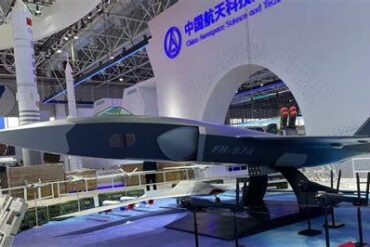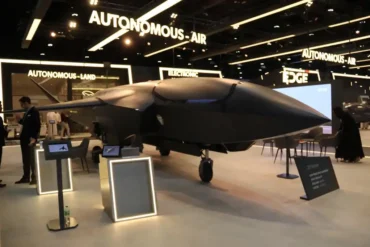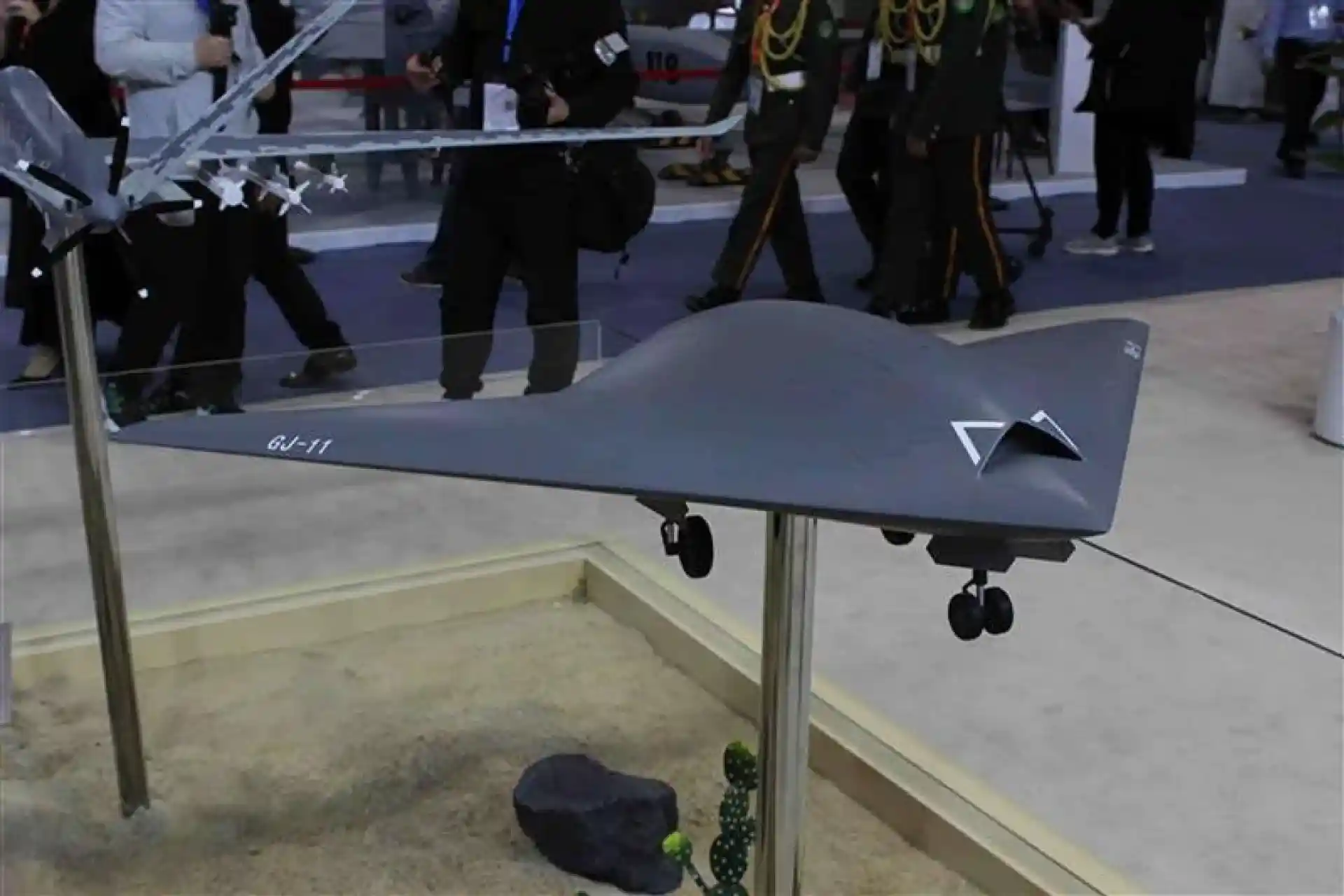
China’s decision to showcase the GJ-11 Dark Dragon unmanned combat aerial vehicle at UMEX 2026 in Abu Dhabi marks a carefully timed signal to a region actively redefining its future airpower doctrine. The exhibition coincides with the United Arab Emirates’ search for a loyal wingman drone capable of operating alongside crewed combat aircraft in long-range strike, reconnaissance, and electronic warfare missions. Rather than a speculative concept, the GJ-11 arrives as a platform backed by more than a decade of development, flight testing, and increasingly visible operational integration.
The appearance of the Dark Dragon at UMEX reflects the accelerating global shift toward manned-unmanned teaming, a concept now central to air forces seeking to penetrate dense air defenses while reducing pilot risk. For Gulf states facing complex regional security environments, the attraction lies in pairing high-end fighters with stealthy autonomous systems that can scout ahead, jam sensors, or deliver precision weapons without exposing crewed assets. China’s presentation directly aligns with this requirement, positioning the GJ-11 as a mature solution rather than an experimental prototype.
Beyond marketing intent, the timing is notable because the UAE has publicly signaled interest in expanding its unmanned strike portfolio beyond traditional remotely piloted aircraft. Wingman drones represent a qualitative leap, demanding advanced autonomy, secure datalinks, and seamless coordination with frontline fighters. The GJ-11’s UMEX presence therefore serves as both a technological statement and a strategic invitation, highlighting China’s readiness to engage with partners seeking next-generation unmanned capabilities.
A Stealth UCAV Shaped by Long-Term Development
Known earlier as Sharp Sword, the GJ-11 was developed for the People’s Liberation Army Air Force by the Shenyang Aircraft Design Institute and Hongdu Aviation Industry Group under the broader AVIC framework. First unveiled in 2009, the program reached a major milestone with ground testing in December 2012 and a successful maiden flight in November 2013. That achievement placed China among a small group of nations to demonstrate a flying-wing UCAV capable of sustained, controlled flight.
Early configurations featured a more exposed exhaust design, but subsequent refinements significantly reduced infrared and radar signatures. By the time a polished mockup appeared during China’s 2019 National Day parade, the aircraft’s tailless flying-wing profile had become emblematic of China’s stealth ambitions. Later displays at Airshow China and the 2025 Victory Day parade reinforced the impression of a platform steadily transitioning from development to operational relevance.
Design, Performance, and Payload Capabilities
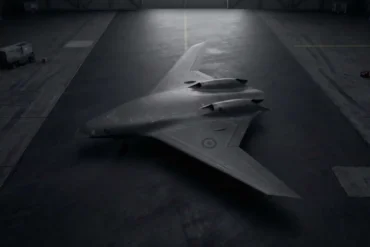
The GJ-11 Dark Dragon employs a tailless flying-wing airframe with carefully contoured surfaces and serrated internal weapon bay doors to minimize detectability. Reported dimensions place its length between 11.6 and 12.2 meters, with a wingspan exceeding 14 meters, giving it a substantial internal volume for fuel and payload. Estimates suggest a maximum takeoff weight above 20 tons and an internal payload capacity approaching 2,000 kilograms, a figure that positions it firmly in the heavy UCAV category.
Powered by a single turbofan engine, the aircraft is credited with a top speed exceeding 1,100 km/h, allowing it to keep pace with fast-moving strike packages. Its sensor suite is designed for multi-domain awareness, combining infrared surveillance, electronic support measures, and AESA radar systems capable of air-to-surface and air-to-air functions. This fusion enables the Dark Dragon to perform deep reconnaissance, target acquisition, and precision strike missions while operating inside contested airspace.
Weapons and Mission Flexibility
Armament options associated with the GJ-11 underscore its strike orientation. Internally carried munitions include FT-7 small-diameter guided weapons and LS-6-500 series GPS/INS-guided bombs, allowing the aircraft to engage fortified targets while preserving stealth. Combined with its sensor reach, which reportedly includes electronic intelligence detection ranges extending hundreds of kilometers, the GJ-11 is optimized for missions where information dominance and first-strike capability are decisive.
Such attributes align closely with loyal wingman roles, where unmanned aircraft act as forward sensors or weapons carriers controlled by crewed fighters. The ability to dynamically re-task weapons or sensors in flight is central to this concept, and China has increasingly emphasized this flexibility in official demonstrations and footage.
Proven Steps Toward Manned-Unmanned Teaming
From 2022 onward, evidence of manned-unmanned cooperation trials has steadily accumulated. Computer-generated sequences released that year depicted multiple GJ-11s controlled from a two-seat J-20 stealth fighter, illustrating a command architecture designed for real-time coordination. The concept moved closer to reality in November 2025, when official footage showed a GJ-11 flying in formation with a J-20 and a J-16D electronic warfare aircraft, accompanied by radio exchanges confirming established control links.
These demonstrations matter for potential partners like the UAE, which already operates advanced fighters and seeks unmanned systems that can integrate rather than operate in isolation. The Dark Dragon’s visible progress from simulations to live formation flights strengthens its credibility as a wingman-capable platform.
Strategic Implications for the UAE and Beyond
The UMEX 2026 display does not introduce new specifications, but it reinforces the GJ-11’s status as a mature stealth UCAV with a clear operational trajectory. For the UAE, evaluating wingman drones is about more than procurement; it is about shaping a future force structure that blends autonomy, survivability, and strategic reach. China’s offering enters a competitive landscape, yet its emphasis on demonstrated manned-unmanned teaming and heavy strike capability distinguishes it from lighter, ISR-focused drones.
As air forces worldwide race to field loyal wingman systems, the GJ-11 Dark Dragon stands as a tangible expression of China’s ambitions in this domain. Its presence at UMEX signals not only technological confidence but also a willingness to engage with partners seeking to redefine how airpower is generated, coordinated, and projected in the coming decade.