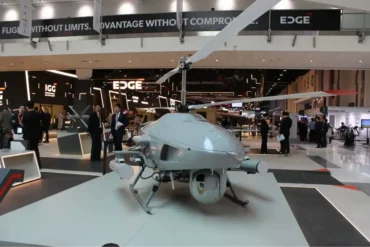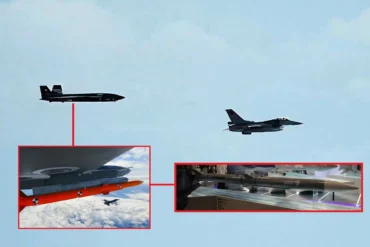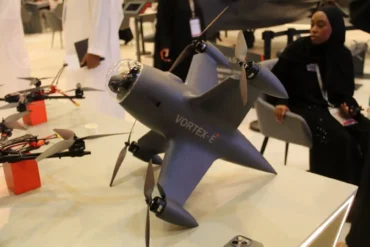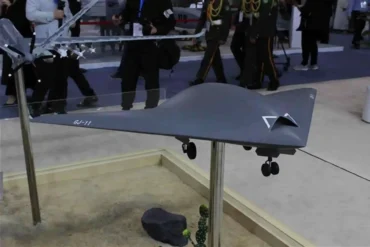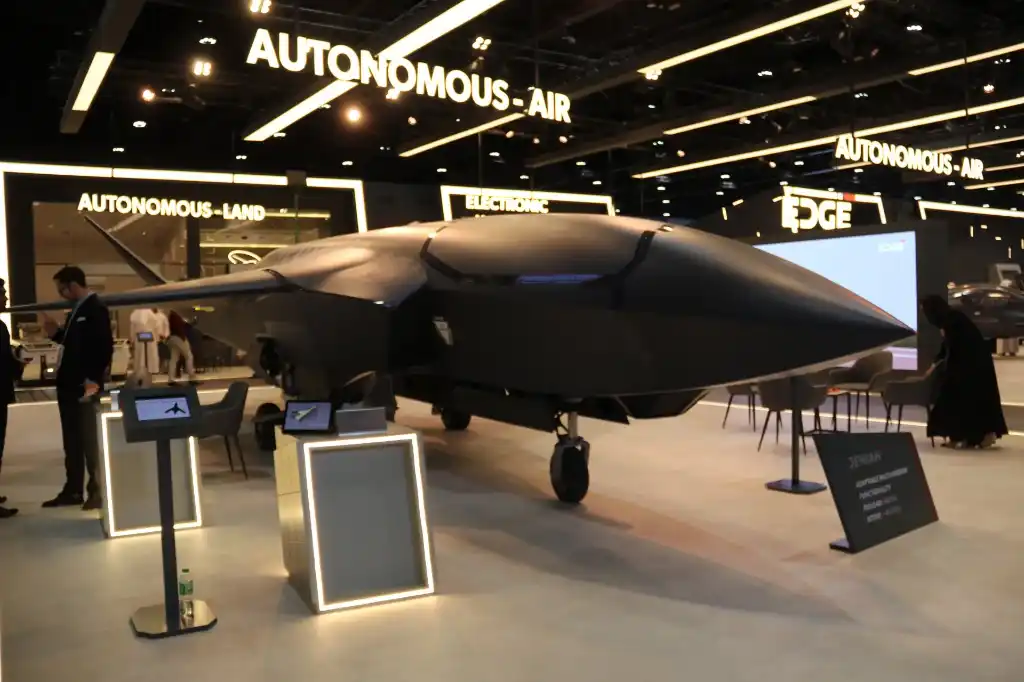
The unveiling of the Jeniah Unmanned Combat Aerial Vehicle at UMEX 2026 marks a decisive moment in the evolution of the United Arab Emirates’ defense-industrial ambitions. Displayed by EDGE Group at the region’s premier unmanned systems exhibition in Abu Dhabi, the aircraft represents far more than a new platform in development. It is a clear declaration that the UAE has entered the exclusive circle of nations capable of designing and fielding heavy, stealth-oriented combat drones built for high-intensity, contested warfare.
Jeniah is not positioned as an experimental demonstrator or a limited reconnaissance asset. From its scale, propulsion choice, and internal weapons carriage, the platform is unmistakably designed for deep-strike and survivable penetration missions. Its presence at UMEX 2026 reinforced a broader shift underway in Gulf military planning, where autonomous systems are no longer supporting actors but central instruments of airpower.
The aircraft was developed by ADASI, a key subsidiary of EDGE Group, and stands as the largest unmanned combat aerial vehicle in the UAE’s portfolio to date. While Jeniah has been referenced previously, its full-scale exhibition placed renewed focus on the platform’s maturity and operational intent. Observers at UMEX noted that this was not a conceptual mock-up, but a system approaching the configuration of a deployable combat asset.
A Heavy UCAV Built for Penetration and Speed
Jeniah’s defining characteristic is its mass and aerodynamic configuration. With a maximum takeoff weight exceeding 4,000 kilograms, the drone occupies a category closer to light combat aircraft than traditional UAVs. Its 11-meter fuselage and 7-meter wingspan provide the internal volume necessary for fuel, sensors, and weapons while maintaining a low-observable profile through angular shaping and smooth surface integration.
Unlike many medium-altitude long-endurance drones that rely on turboprop propulsion, Jeniah is powered by a turbofan engine, enabling cruise speeds near Mach 0.7 and dash speeds exceeding 1,000 kilometers per hour. This performance envelope places it in a rare class of high-speed UCAVs optimized for rapid ingress and egress from defended airspace, reducing exposure time to enemy air defenses.
The aircraft’s stealth characteristics are reinforced by internal payload bays, eliminating the radar penalties associated with external stores. This configuration aligns Jeniah with modern strike doctrines that prioritize survivability against integrated air defense systems rather than persistence alone.
Modular Payloads and Multi-Domain Mission Design
A core strength of the Jeniah platform lies in its modular internal payload capacity, which supports up to 480 kilograms of mission equipment. This flexibility allows the drone to transition between roles without structural modification, making it suitable for precision strike, electronic warfare, maritime support, and high-risk intelligence missions.
Rather than being locked into a single weapons ecosystem, Jeniah is designed to integrate a mix of precision-guided munitions, electronic attack payloads, advanced ISR sensor packages, or deployable loitering munitions. This adaptability positions the platform as a joint-domain asset, capable of supporting land and naval operations from the same airframe.
While EDGE has not publicly disclosed the full sensor suite, industry assessments point toward a next-generation avionics architecture. This likely includes autonomous target recognition, electronic surveillance, and secure data-link integration with other air and ground platforms. The emphasis on open-systems architecture suggests future upgrades will focus on AI-driven mission autonomy and manned-unmanned teaming.
Strategic Autonomy and Industrial Significance
Jeniah’s appearance at UMEX 2026 is inseparable from the UAE’s broader defense doctrine, which increasingly prioritizes sovereign control over advanced combat technologies. By developing a heavy stealth UCAV domestically, the UAE reduces reliance on foreign suppliers and avoids constraints imposed by export control regimes such as ITAR.
This independence carries operational and political weight. It allows the UAE Armed Forces to customize mission systems, weapons integration, and software development without external approval, while also opening the door to flexible export partnerships. In an era where drone warfare has become central to regional conflicts, this autonomy provides both strategic resilience and diplomatic leverage.
EDGE Group’s rapid development cycles and vertically integrated structure have enabled the acceleration of programs like Jeniah from concept to near-operational maturity. The platform reflects a deliberate move away from incremental UAV development toward high-end, survivable combat systems comparable to those fielded by established drone powers.
A Signal to the Global UCAV Market
Beyond its domestic role, Jeniah is clearly positioned as an export-oriented platform. EDGE has already begun showcasing the system to international partners across Africa, Asia, and Eastern Europe—regions seeking advanced strike capabilities without the political limitations attached to Western systems.
In this context, Jeniah challenges entrenched assumptions about where cutting-edge combat drones originate. Its emergence underscores the rise of new defense manufacturers capable of delivering high-performance UCAVs at competitive cost points, reshaping procurement dynamics in the global south.
A New Phase in Gulf Airpower
The debut of Jeniah marks a strategic inflection point in the UAE’s military trajectory. It demonstrates that the country’s ambitions now extend beyond acquisition and operation into design, integration, and doctrinal innovation. As contested airspaces and electronic warfare environments become the norm, platforms like Jeniah represent the future of precision strike—fast, low-observable, and increasingly autonomous.
For regional and global observers, the message is unambiguous. The UAE is no longer content to adapt existing technologies. With Jeniah, it is shaping the next generation of aerial combat capability, projecting power not just across borders, but across the evolving landscape of modern warfare.