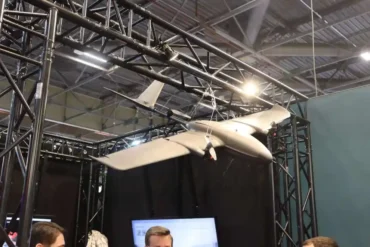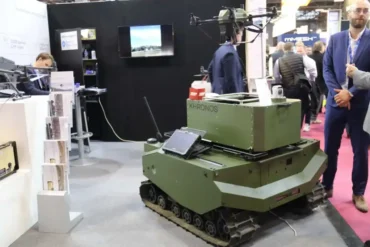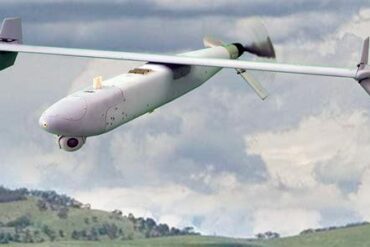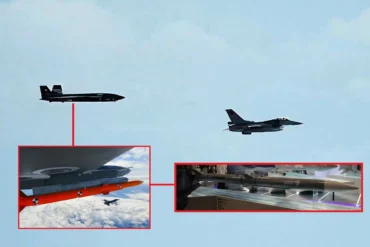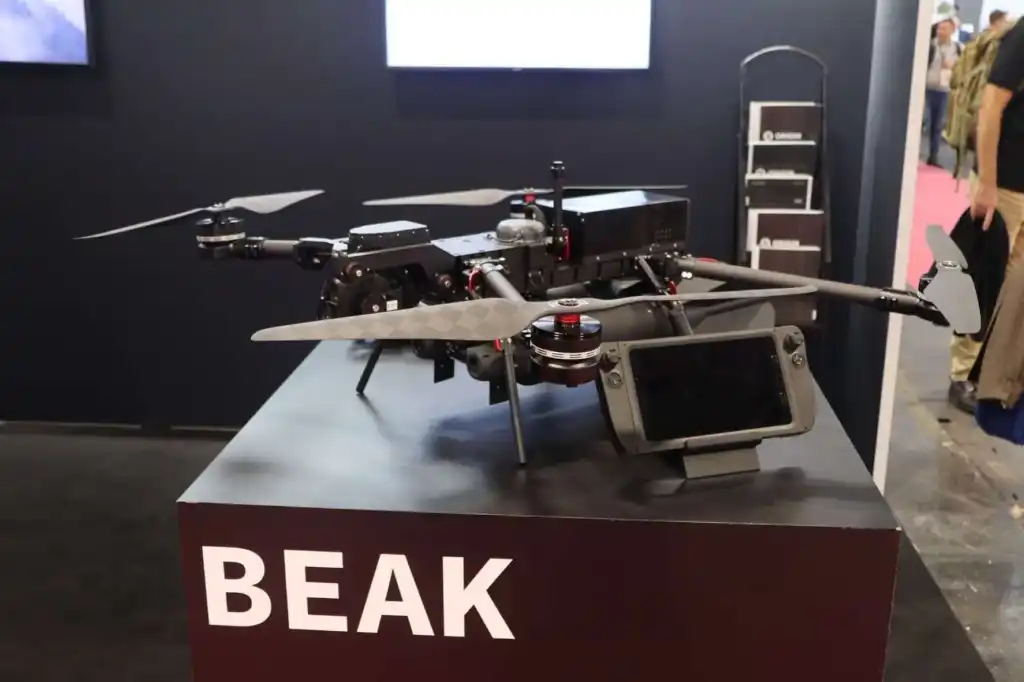
At Milipol 2025, Origin Robotics—a defense technology innovator from Latvia—made a bold statement that could reshape how infantry units deploy precision air power. The unveiling of the BEAK man-portable unmanned combat aerial vehicle (UCAV) paired with PGM-18 BEAK precision-guided munitions signaled a decisive shift in tactical warfare. This is not just another drone—it is a complete, man-portable strike system, engineered to deliver sub-2-meter precision in GNSS- and radio-denied environments.
The presentation emphasized that unmanned lethality is no longer the domain of strategic command levels or high-altitude drones. Origin Robotics has miniaturized and democratized precision strike capabilities, offering fire-and-forget munitions to squad-level infantry. This evolution in battlefield technology reflects not only engineering prowess but also an acute understanding of modern combat challenges—namely, contested airspace, dense urban operations, and saturated electronic warfare environments.
Precision Airpower in a Backpack: The BEAK UCAV Concept
The BEAK UCAV represents a rethinking of tactical air assets. Portable by a single operator and mission-ready in under five minutes, the drone is designed to support dynamic operational demands. The integration of the Reconfigurable Munition Integration Module (RMIM) allows for seamless switching between payload configurations—guided munitions, unguided bombs, or mixed armament—without altering the drone’s core structure. This level of field adaptability ensures mission-specific customization, even under time pressure.
BEAK’s airframe is built with modular payload flexibility, offering up to 4 kg of munitions capacity. When configured for precision strikes, it can carry two PGM-18 BEAK guided munitions, maintaining a circular error probable (CEP) of less than 2 meters. Alternatively, it can be loaded with up to four unguided warheads. This dual-role capability empowers commanders with tactical options—from surgical eliminations of high-value targets to broad-area suppression of enemy units.
Electro-Optical and Infrared Dominance: The ISR Backbone
Integral to the BEAK’s battlefield effectiveness is its advanced ISR suite. The electro-optical/infrared (EO/IR) system includes:
- A high-definition EO zoom camera with a global shutter and 8x optical zoom.
- A 4K spotter EO camera with a narrow field of view and digital magnification for terminal guidance.
- An infrared sensor capable of detecting human-sized targets at 1 km range during nighttime operations.
- A three-axis stabilization platform ensuring image clarity and motion compensation.
This comprehensive sensor package enables target acquisition, positive identification, and battle damage assessment (BDA), even in low-visibility or cluttered terrain. Combined with onboard processing, it enables standalone navigation and targeting in environments where traditional ISR assets are denied.
PGM-18 BEAK Munition: A Tactical Game Changer
The PGM-18 BEAK munition is the heart of the system’s strike capability. Developed specifically for UCAV deployment, it is a miniature precision-guided weapon capable of operating without GPS or active comms links. Instead, it uses a blend of:
- EO/IR terminal seekers
- Advanced computer vision algorithms
- Autonomous in-flight guidance
The result is true fire-and-forget capability with under-2-meter accuracy, even when launched at altitude or in complex wind profiles. Crucially, the guidance logic is resilient to jamming and spoofing, enabling confident targeting even in electronic warfare-heavy theaters.
Three warhead variants offer mission flexibility:
- HEAT (High-Explosive Anti-Tank): Penetrates up to 300 mm of RHA, ideal for armored vehicles.
- HE (High Explosive): Produces a 30-meter lethal radius, suitable for infantry concentrations or lightly protected vehicles.
- Thermobaric: Delivers overpressure effects with enhanced lethality in urban or enclosed environments.
When paired with the BEAK’s dual-launch configuration, dismounted forces can strike multiple targets sequentially or in coordination—without requiring repeated exposure or returning for re-arming.
Combat Resilience in the Electronic Warfare Era
In today’s spectrum-contested battlefield, resilience is paramount. The BEAK system excels in this regard. It features:
- A MANET datalink that maintains signal fidelity even in jammed RF conditions.
- Automatic interference avoidance algorithms for uninterrupted control.
- An anti-jamming GNSS module that applies real-time signal filtering and interference mitigation.
- A ground-based automatic tracking antenna to keep a stable, high-gain connection with the UCAV.
Should all external signals fail, BEAK initiates autonomous safe recovery, returning to base or a predesignated location. This fail-safe architecture ensures the mission’s integrity and the drone’s retrieval, mitigating the risk of system capture or battlefield loss.
Proven on the Frontlines: Ukrainian and NATO Adoption
The system is not theoretical—it is combat-proven. Both Ukrainian and Latvian armed forces are actively employing BEAK and PGM-18 munitions in live operations. Moreover, the drone has been adopted by at least one NATO member state in Central Europe, reinforcing its interoperability and doctrinal relevance.
The system is assigned a NATO Stock Number (NSN 1550550012667), marking a major milestone in allied standardization and logistical integration. Its acceptance into NATO inventories signifies more than technical credibility—it highlights the system’s alignment with joint operational needs, especially those shaped by multi-domain warfare scenarios.
The Strategic Shift: From Air Force to Infantry
The emergence of BEAK and the PGM-18 represents a paradigm shift in combat power distribution. Traditionally, precision strike assets were siloed within air forces or long-range artillery units. Today, that capability is entering the infantry’s backpack.
Three transformative trends converge in this system:
- Miniaturization of Precision Weaponry: The BEAK proves that cutting-edge lethality doesn’t require mass.
- Decentralization of Strike Authority: Infantry squads can now execute autonomous strikes, dramatically reducing kill chain time.
- EWS (Electronic Warfare Survivability): Resilience is no longer optional; it is baked into the core of the BEAK system.
This shift lowers the threshold for precision engagement, affecting not only battlefield tactics but also escalation dynamics and operational planning. Precision is now pervasive, even in asymmetric and hybrid conflicts.
A Doctrinal Evolution with Far-Reaching Implications
For military planners, policymakers, and procurement agencies, BEAK and PGM-18 offer a future-ready template. It enables:
- Decentralized operations with greater lethality.
- Smaller, more agile formations that don’t sacrifice firepower.
- Distributed denial strategies in forward-operating zones.
- Reduced dependency on vulnerable command-and-control nodes.
In an era where Russia’s war on Ukraine and NATO’s evolving deterrence posture define operational priorities, this kind of toolset is no longer optional—it is urgent.
Conclusion: The BEAK’s Flight Path Toward Widespread Adoption
With its dual-guided munitions, multi-role sensor suite, jam-resistant communication stack, and combat validation, the BEAK UCAV is more than a drone—it’s a new class of autonomous firepower. It redefines the infantry toolkit, making precision strike capability a man-portable asset.
As modern conflict zones grow denser, more electronic, and more asymmetric, systems like BEAK are poised to become force multipliers, not just for elite units but for line infantry squads across NATO and beyond. By uniting portability, accuracy, and resilience, Origin Robotics is not just introducing a product; it is pioneering a doctrinal shift in how wars are fought—and how technology empowers the individual warfighter.