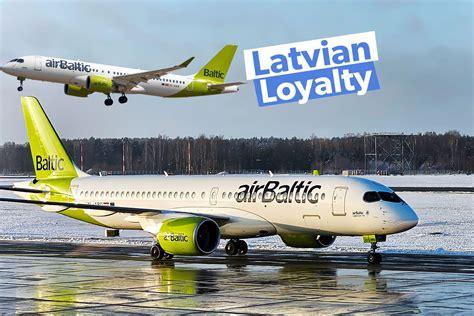
airBaltic, formally known as AS Air Baltic Corporation, is not merely Latvia’s national airline—it is the pride of the Baltic aviation sector. With a strategic base in Riga International Airport, robust government backing, and a fully modernized Airbus A220-300 fleet, airBaltic has carved out a distinctive niche in European aviation. Its journey from a post-Soviet regional experiment to a powerful, high-efficiency hybrid carrier embodies resilience, precision, and a vision deeply rooted in innovation and fiscal realism.
The Origins of airBaltic: Foundation Amidst Transition
Founded on 28 August 1995 and commencing operations just over a month later, airBaltic emerged from the ashes of Latvia’s earlier aviation efforts, including the defunct Latavio and the experimental joint venture Baltic International Airlines. The new flag carrier was born out of a strategic alliance between Scandinavian Airlines (SAS) and the Government of Latvia, combining Western managerial expertise with Eastern potential.
The airline’s inaugural commercial service took flight on 1 October 1995 using a Saab 340. From that moment, airBaltic positioned itself as a regional workhorse in the fragmented and turbulent skies of post-Soviet Eastern Europe.
Fleet Evolution and Design Identity
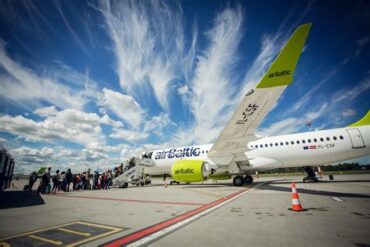
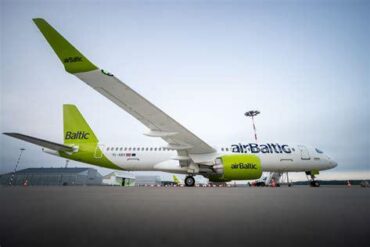
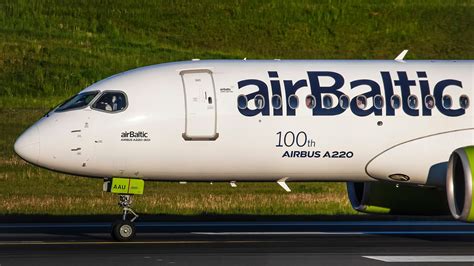
From Saab turboprops to Fokker 50s, Boeing 737s, and the Dash 8 Q400s, airBaltic continually reshaped its fleet to meet operational demands. However, its strategic shift came in 2016 with the introduction of the Bombardier CS300—a game-changing regional jet that would later be rebranded as the Airbus A220-300. airBaltic became the global launch operator for the CS300 and would eventually become the first airline worldwide to operate an all-A220 fleet.
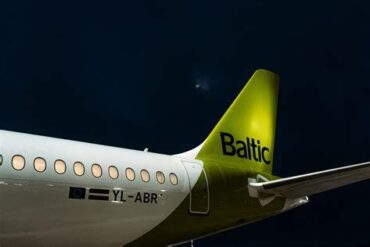
This decision wasn’t simply about aircraft—it was about brand evolution. The airline’s visual identity also transformed, from a conservative blue checkerboard tail to the now-iconic lime green vertical stabilizer, mirroring the brand’s modern, tech-forward, and environmentally conscious spirit.
Network Strategy: Regional Power, Global Reach
airBaltic operates a hybrid route model, focusing on point-to-point connectivity from the Baltics while supporting long-haul ambitions through codeshare agreements with heavyweights like Lufthansa, Finnair, and Delta Air Lines. It services 87 destinations across Europe, the Middle East, and the Caucasus, combining seasonal leisure traffic with vital year-round business links.
Key operational hubs include:
- Riga International Airport – Main hub and corporate headquarters.
- Tallinn (Estonia) – Secondary base.
- Vilnius (Lithuania) – Secondary base.
- Tampere (Finland) – First secondary hub outside the Baltics.
- Gran Canaria (Spain) – Seasonal winter base since 2023.
The airline’s presence in Tampere, for instance, reflects a bold Nordic expansion strategy, supported by its ability to optimize aircraft usage and maintain strong load factors even on niche routes.
airBaltic Club and Loyalty Innovation
The airBaltic Club serves as its frequent-flyer program, offering a layered incentive structure tailored to leisure and business travelers alike. In 2022, airBaltic innovated beyond traditional loyalty points by launching Planies, an NFT-based initiative that provides real-world airBaltic perks. This unique blend of Web3 technology with airline rewards marks one of the few successful integrations of digital collectibles in commercial aviation.
Navigating Crisis and Rebirth: From Collapse to Profitability
The road wasn’t always smooth. 2010 to 2011 marked a turbulent period defined by financial hemorrhaging, internal mismanagement, and controversial political entanglements. Losses soared to over €121 million in 2011, prompting the government to re-nationalize the carrier and inject €100 million in capital.
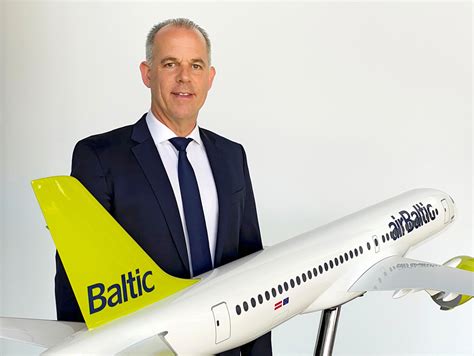
In October 2011, former Malév CEO Martin Gauss was appointed to reverse the decline. His cost-cutting measures, rigorous route evaluations, and modern fleet strategy transformed airBaltic’s operating model, culminating in modest profitability by 2013.
The COVID-19 pandemic dealt another serious blow. With operations suspended in March 2020, recovery was slow but steady. Strategic wet-leasing agreements with SWISS and Lufthansa Group helped offset fleet underutilization and positioned airBaltic as a reliable ACMI partner within Europe.
The All-Airbus A220 Fleet: Operational Efficiency Redefined
Today, airBaltic operates a fleet of 50 Airbus A220-300s, making it the largest A220 operator in Europe. The decision to transition entirely to this platform was driven by the A220’s fuel efficiency (20% lower fuel burn), lower CO₂ emissions, and optimized cabin configuration for short-to-medium haul flights.
Each aircraft features:
- 145 seats in 2-3 configuration
- Wider windows and quieter engines
- Free Wi-Fi via Starlink, slated for completion fleet-wide by 2025
This uniformity yields significant maintenance, training, and logistical efficiencies, giving airBaltic an operational edge and simplified scalability—particularly attractive to potential investors and alliance partners.

Ownership and Financials: State Backing Meets Strategic Partnerships
As of early 2025, the Government of Latvia retains 87.97% ownership, with the Lufthansa Group acquiring 10% via a €14 million convertible share deal, signaling strategic alignment and long-term partnership potential. The remaining ownership is scattered among minor stakeholders.
2023 Financial Snapshot:
- Revenue: €668 million
- Operating Income: €80 million
- Passengers: 4.5 million
- Load Factor: 77%
- Employees: 2,531
However, 2024 presented new challenges. Engine maintenance delays from Pratt & Whitney forced airBaltic to:
- Suspend 19 routes
- Reduce frequency on 21 routes
- Cancel 4,670 flights affecting 67,160 passengers
Despite this, airBaltic still maintained operations to over 70 destinations, leveraging wet leasing arrangements and flexible scheduling strategies.
Leadership Transition: A New Chapter Begins
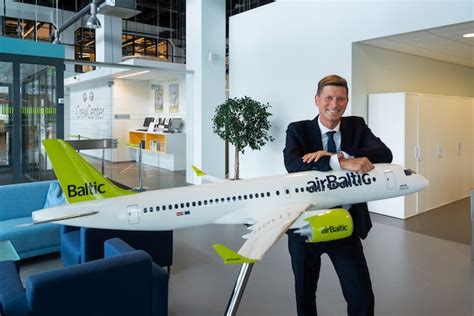
In April 2025, after 14 years at the helm, Martin Gauss stepped down, succeeded by Pauls Cālītis, a seasoned airBaltic veteran who began his career as a pilot and climbed the ranks to become COO before assuming the CEO role.
Cālītis brings over 30 years of airline operational insight to the position and is expected to spearhead the upcoming IPO, expand the fleet to 100 aircraft by 2030, and fortify the airline’s position as a central hub between Western Europe and the Nordics.
Sustainability and Technology: Future-Forward Thinking
airBaltic isn’t merely reacting to market conditions—it’s engineering the future of aviation in the region. The exclusive use of A220 aircraft reflects the airline’s carbon-reduction strategy, cutting emissions per passenger and aligning with EU climate targets.
It’s also investing in digital transformation:
- Early adopter of online check-in in the Baltics (2007)
- Partnership with Starlink for onboard connectivity
- Integration of AI-driven scheduling and crew optimization tools
- Launch of airBaltic NFTs tied to real-world benefits
These innovations help airBaltic maintain its lean cost base, improve customer experience, and appeal to tech-savvy travelers.
airBaltic’s Role in the Baltics and Beyond
With the collapse of Air Lituanica (2015), Estonian Air (2015), and Nordica (2024), airBaltic now stands as the sole flag carrier in the Baltic region, a responsibility it wields with calculated precision. It connects underserved cities, links island destinations, and provides essential economic stimulus through tourism and business connectivity.
Its hub-and-spoke model centered on Riga effectively transforms Latvia into a miniature aviation gateway, attracting transit passengers from Scandinavia, Eastern Europe, and beyond.
Conclusion: airBaltic’s Flightpath Toward Market Dominance
airBaltic’s evolution is one of the most compelling stories in European aviation—a small airline born out of necessity that has grown into a model of operational efficiency, technological innovation, and regional dominance.
As it prepares for a potential IPO, deepens its Lufthansa ties, and seeks to double its fleet within five years, airBaltic is no longer just Latvia’s airline. It is Europe’s rising hybrid carrier, standing at the crossroads of East and West, ready to define the future of air travel in the Baltic skies and beyond.