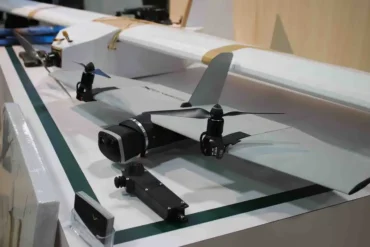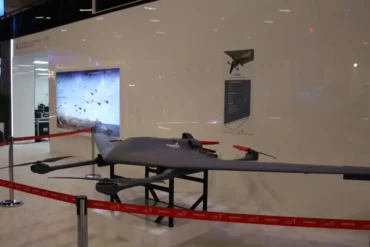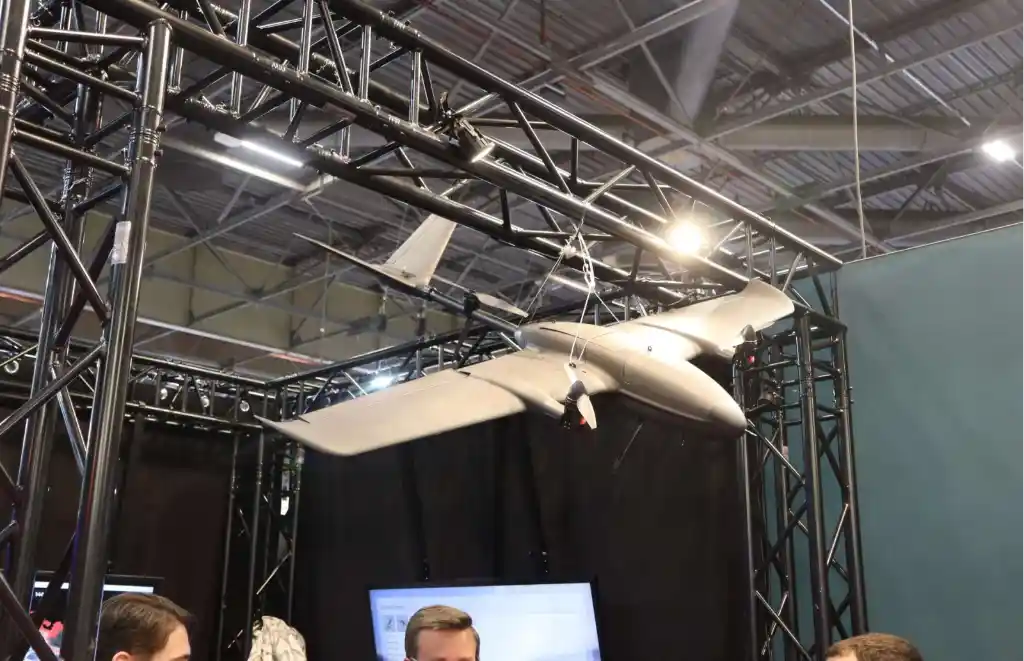
The unveiling of the MILAN-17 fixed-wing VTOL drone by German UAV innovator Dronivo GmbH at Milipol Paris 2025 marks a significant evolution in the tactical drone landscape. With its hybrid design, rapid deployment capability, and modular payload system, the MILAN-17 reflects the growing intersection of civil geospatial technologies and advanced homeland security applications. This launch not only signifies Dronivo’s strategic move into the defense and internal security sectors but also highlights a clear trend toward runway-independent, high-endurance ISR solutions.
Bridging Civil Geospatial Mapping and Tactical ISR Missions
Dronivo introduced the MILAN-17 platform in a dual showcase: first at INTERGEO 2025 in Frankfurt to the geospatial mapping community, followed by a homeland security-focused debut at Milipol Paris 2025. This bifurcated launch strategy underlines the company’s intention to consolidate both civilian aerial survey applications and tactical intelligence, surveillance, and reconnaissance (ISR) capabilities into one flexible UAV system.
At the heart of this strategy lies the aircraft’s modularity. The MILAN V17, optimized for civil geospatial roles, is effectively the same platform as the MILAN-17—its military-grade variant—distinguished primarily by its payload and software configurations. This cross-sector adaptability is rare and positions the drone as a powerful tool for both public agencies and defense forces.
Technical Architecture: Compact, Lightweight, Long-Endurance
The MILAN-17’s airframe reflects meticulous engineering tailored for field operations. Its compact tilt-rotor configuration provides vertical takeoff and landing (VTOL) capability, eliminating dependence on runways or launch catapults. At just 1,310 mm in body length and with a 1,700 mm wingspan, the drone achieves an effective balance between size, payload, and endurance. Key performance specifications include:
- Endurance: Up to 120 minutes
- Payload capacity: Up to 900 grams
- Maximum speed: 25 m/s
- Cruise speed range: 15–18 m/s
- Minimum speed: 9 m/s
- Maximum takeoff weight: 5.5 kg
Constructed with composite materials such as carbon fiber and EPP foam, the frame is robust enough for rough field handling while remaining light enough to maintain long air time. The platform is powered by a battery-electric system, typically using an 8S 14.5 Ah Li-ion pack, delivering sufficient power for tactical-grade payloads without compromising endurance.
Payload Versatility and Tactical Avionics
What transforms the MILAN V17 into the mission-ready MILAN-17 is its suite of tactical avionics and ISR-grade payloads. Central to its capability is the integration of:
- CubePilot Orange Plus class flight controller
- High-precision GNSS with HereLink telemetry
- Skydroid H16 ground control station, offering encrypted digital links and an intuitive Android-based interface
These elements support autonomous mission workflows, including automatic return-to-launch, loiter mode, and failsafe descent protocols, crucial for ISR operations in contested or populated environments.
The 900 g payload margin accommodates a wide range of ISR modules, including:
- Stabilized EO/IR gimbals for real-time surveillance
- Nadir mapping cameras for orthophotography and 2D mapping
- Lightweight LiDAR systems for 3D modeling in urban terrains
These options enable flexible mission profiles such as:
- Silent border reconnaissance
- Search and rescue overwatch
- Critical infrastructure monitoring
- Rapid post-disaster site mapping
In military operations, it offers pre-mission route scouting, convoy protection, and forward observation, bridging the gap between quadcopter agility and fixed-wing endurance.
Small-Unit Deployment Concept for Maximum Agility
One of MILAN-17’s key advantages is its rapid deployment and field versatility. The drone can be fully assembled or disassembled in under three minutes, without tools, significantly reducing exposure time in frontline or rooftop scenarios.
Vertical takeoff enables launch from tight or improvised locations such as forest clearings, rooftops, ship decks, or urban courtyards. Once airborne, it transitions into fixed-wing mode for longer endurance, maintaining high situational coverage without sacrificing maneuverability.
This hybrid flight model supports missions that traditionally require separate rotary-wing and fixed-wing drones, cutting costs and simplifying training. It also adheres to current military VTOL UAV doctrine, which increasingly favors multi-role, modular airframes capable of conducting both point-specific surveillance and wide-area reconnaissance.
Industrial Ecosystem and Lifecycle Support
Dronivo’s offering extends far beyond the airframe. The MILAN-17 is embedded within a full-stack defense ecosystem, where the UAV is only one element of a larger architecture. The company provides:
- Maintenance and repair (MRO) services
- Training programs for operators and technicians
- Custom R&D for tailored mission requirements
- Integration support for national drone networks
This 360-degree lifecycle support is critical for military and law enforcement procurement. Today’s defense buyers prioritize platform maturity, long-term support, and ecosystem integration just as much as performance metrics. In this context, Dronivo’s strategy of positioning itself as a turnkey UAS solutions provider strengthens its appeal to ministries and security agencies across Europe.
Competitive Landscape and Market Position
Although the MILAN-17 has been showcased to government delegations and military agencies during International Drone Network events, no public procurement contracts have yet been confirmed. The system is, however, clearly technically mature and mission-ready, giving it a competitive edge in ongoing acquisition programs. The European tactical VTOL UAV market is increasingly crowded, featuring a mix of domestic solutions and imported platforms. Competing models often originate from dual-use civil applications, similar to MILAN-17, but not all offer the same integration depth, endurance, or payload flexibility. The MILAN-17’s potential success will likely hinge on how well it demonstrates value in live deployments and pilot programs, particularly in areas such as:
- Urban ISR operations
- Border patrol
- Disaster response mapping
- Mobile force support for light infantry
As Dronivo continues to refine its systems and expand partnerships, the MILAN-17 stands as a formidable contender in the next wave of European ISR-capable VTOL drones.
Outlook: A Versatile Platform for the Future Battlespace
With its debut at Milipol Paris 2025, Dronivo has firmly positioned the MILAN-17 as a tactical ISR workhorse for the modern battlespace. By aligning its technology with the needs of internal security forces, military units, and civilian geospatial operators, the company aims to capture a broad segment of the rapidly growing VTOL UAV market.
Key differentiators such as fast deployment, modular payloads, robust communications, and long endurance give the MILAN-17 distinct appeal in both homeland security and expeditionary defense missions. While official procurement deals remain forthcoming, the MILAN-17’s demonstrated capabilities and lifecycle-ready ecosystem signal its readiness for large-scale adoption.
As tactical drone doctrine continues to evolve toward agile, hybrid, and modular UAV systems, the MILAN-17 represents a powerful glimpse into the future of small-unit aerial reconnaissance—one where performance, versatility, and field readiness are inseparable from strategic impact.