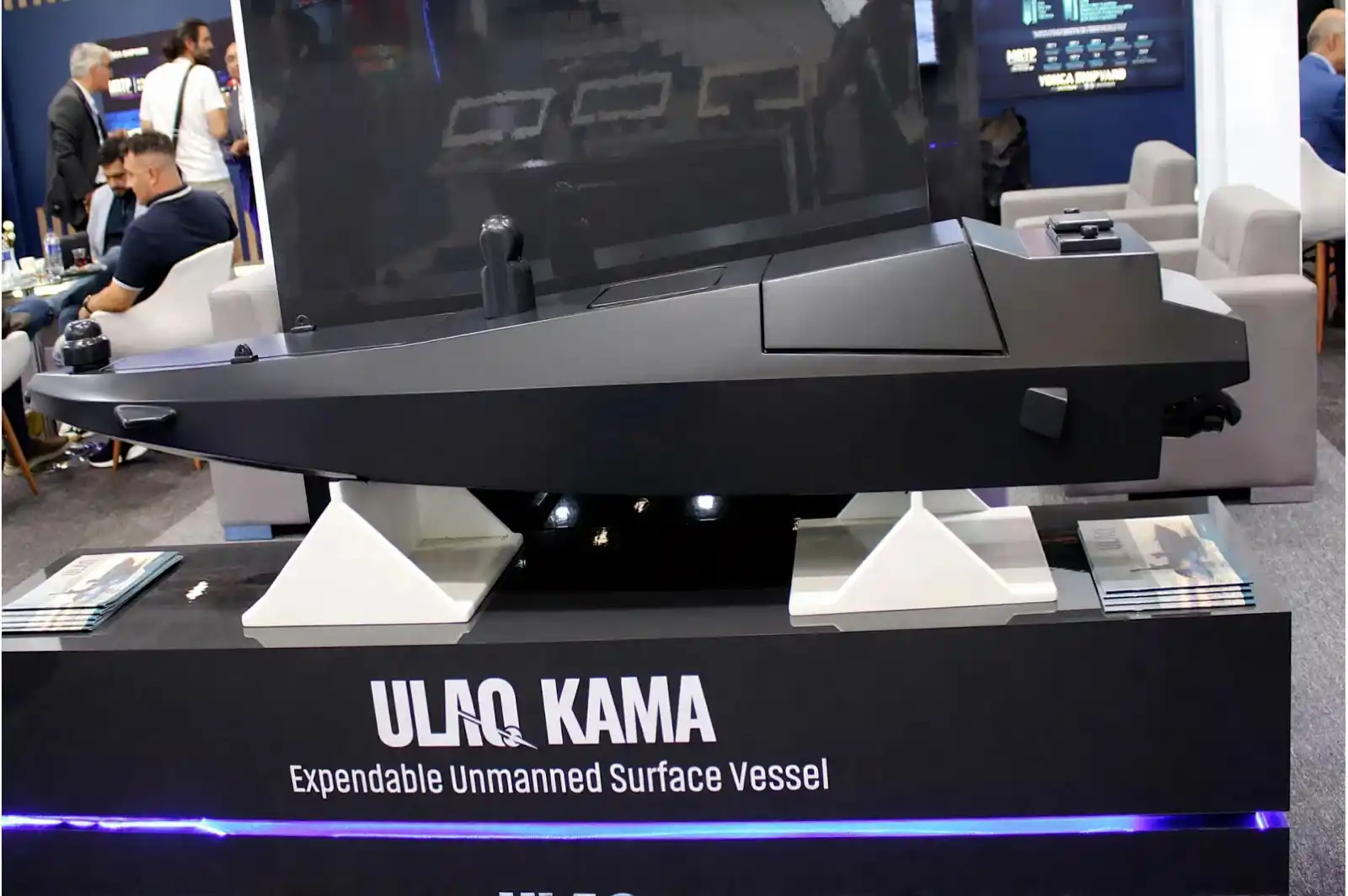
At the IDEF 2025 defense exhibition in Istanbul, Türkiye introduced its latest addition to the unmanned surface vessel (USV) domain — the ULAQ KAMA, a purpose-built, expendable strike drone designed for high-speed, high-risk maritime operations. Developed collaboratively by ARES Shipyard and Meteksan Defence, this new platform signals Türkiye’s commitment to expanding its arsenal of autonomous naval systems capable of performing strike and intelligence, surveillance, and reconnaissance (ISR) missions in contested waters.
A Leap in Autonomous Naval Warfare
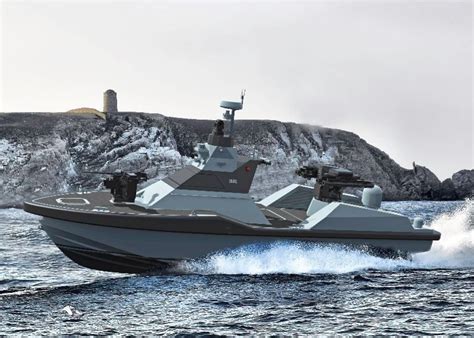
The ULAQ KAMA represents a significant evolution in Türkiye’s unmanned naval capabilities. Measuring 6.37 meters in length with a draft of just 0.30 meters, the vessel is built from advanced composite materials, offering an optimized balance of durability and low observability. Powered by a high-performance inboard engine with waterjet propulsion, it reaches speeds exceeding 50 knots and achieves an operational range of over 200 nautical miles. Its payload capacity of 200 kg supports either a lethal warhead for strike missions or specialized ISR modules, making it a highly versatile platform for multi-domain operations.
Beyond its physical design, ULAQ KAMA features a sophisticated sensor suite that includes AI-assisted GNSS, differential GNSS receivers, satellite communications, stabilized pan-tilt cameras, and optional thermal imaging modules. This suite enables operations in remote, semi-autonomous, or fully autonomous modes, including visual navigation in GPS-denied environments, a critical capability in modern electronic warfare.
Designed for Asymmetric Engagements
The emergence of ULAQ KAMA reflects Türkiye’s assessment of current naval threats, heavily influenced by lessons from the Russo-Ukrainian War and Houthi drone attacks in the Red Sea. These conflicts demonstrated how small, expendable, fast-moving platforms can disrupt and neutralize far more expensive naval assets. In this context, ULAQ KAMA is tailored for attritable missions, where cost-effective, high-impact drones overwhelm adversary defenses.
In terms of strike capability, the vessel can deliver a warhead either through remote detonation or contact-triggered payload activation. This operational flexibility allows it to function both as a precision strike tool and as part of swarm tactics, saturating enemy defenses to pave the way for larger naval operations. Its sea state endurance up to level 4 ensures deployment effectiveness even in moderately rough waters.
Comparative Edge Over Global Counterparts
When compared with other platforms, ULAQ KAMA holds a unique position. For instance, Ukraine’s MAGURA V5 naval drones have proven effective in direct strikes but lack the integrated ISR capabilities and autonomous navigation flexibility of the KAMA. Similarly, U.S. Navy MUSV systems focus on persistent surveillance but are less optimized for expendable, high-tempo strike operations. ULAQ KAMA fills this critical gap, offering a scalable, saturation-capable platform ideal for attritable missions.
Its deployment interface, compatible with standard laptops and offering ECDIS integration, ensures ease of operation across multi-domain environments. This makes it equally appealing for naval operators and joint force integration, providing seamless adaptability in NATO-aligned missions.
Strategic Implications for Türkiye and NATO
Strategically, ULAQ KAMA aligns perfectly with Türkiye’s “Blue Homeland” (Mavi Vatan) doctrine, which prioritizes maritime security in the Aegean, Eastern Mediterranean, and Black Sea. Its compact size, speed, and autonomy enable it to operate as a force multiplier in choke points like the Bosporus Strait or contested zones near Turkish territorial waters.
The vessel’s dual ISR-strike capability makes it an enabler of distributed lethality and swarm-based naval tactics, offering NATO forces a low-cost yet potent tool for deterring adversarial activities. For Türkiye, it represents a credible countermeasure against grey-zone tactics and escalating regional naval threats.
Production Capacity and Export Potential
From an industrial perspective, ARES Shipyard and Meteksan Defence have positioned ULAQ KAMA for rapid scaling. Their joint production infrastructure can deliver over 100 units within a year of an order, addressing the need for large-scale fleet deployment in minimal timeframes. While no official contracts were disclosed at IDEF 2025, defense insiders anticipate strong interest not only from the Turkish Navy but also from allied states seeking cost-effective unmanned strike solutions.
The affordability and scalability of ULAQ KAMA make it an attractive export prospect, particularly for nations aiming to enhance their naval deterrence without investing in costly traditional platforms.
Shaping the Future of Naval Defense
In an era where maritime warfare is defined by speed, attrition, and autonomy, the ULAQ KAMA stands out as a forward-thinking response to evolving challenges. By merging ISR capabilities with high-speed strike functionality, Türkiye has created a platform that can disrupt adversary operations while reshaping the dynamics of naval engagement. Its debut at IDEF 2025 is not just a showcase of technological advancement but also a declaration of Türkiye’s strategic intent to lead in autonomous maritime defense innovation.
As geopolitical tensions in the Eastern Mediterranean and Black Sea persist, ULAQ KAMA provides Türkiye and its allies with a flexible, resilient, and scalable tool to dominate the asymmetric battlespace of tomorrow.