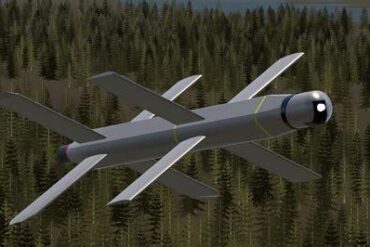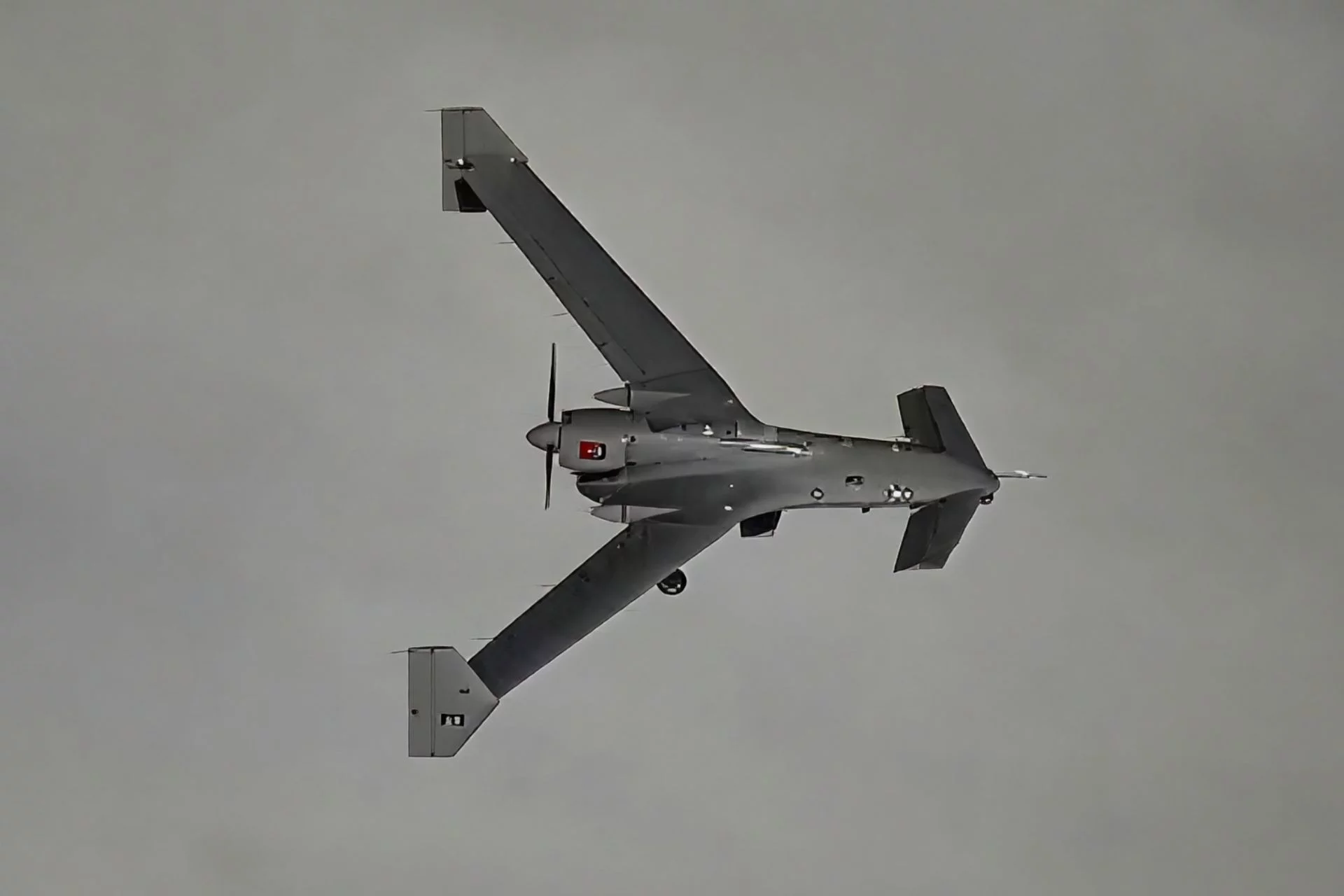
The global defense landscape is rapidly shifting toward autonomous systems capable of coordinated attacks, and Türkiye has now introduced another ambitious platform into that evolving battlefield equation. On 14 March 2026, Turkish defense manufacturer Baykar publicly revealed the K2 long-range loitering munition, a runway-operated unmanned aerial vehicle designed for deep-strike missions and coordinated swarm warfare.
The K2 represents a significant step in Türkiye’s expanding unmanned combat ecosystem. Unlike many conventional loitering munitions that rely on small airframes and short-range deployment methods, the new platform combines extended endurance, large payload capacity, and advanced cooperative autonomy. This combination positions the K2 as a hybrid between traditional kamikaze drones and medium-altitude unmanned combat aerial vehicles (UCAVs).
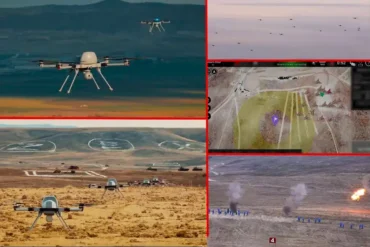
Baykar demonstrated the system during a series of flight tests conducted at the Keşan Flight Training and Test Center in Edirne Province, near the Saros Gulf. Several K2 aircraft conducted formation flights and coordinated maneuvers over the coastal test area, highlighting the platform’s ability to operate in autonomous swarms without direct pilot intervention. The demonstration provided a glimpse into how multiple aircraft can fly together, share operational data, and conduct synchronized strike missions across extended distances.
Baykar K2: A New Class of Long-Range Loitering Munition
At first glance, the Baykar K2 occupies a unique position in the unmanned aerial warfare spectrum. Most loitering munitions are small and disposable systems designed to hover over a battlefield before diving onto a target. The K2 expands that concept dramatically.
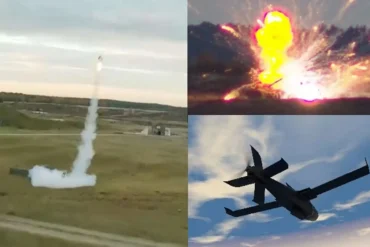
The platform reportedly features a maximum takeoff weight of approximately 800 kilograms, placing it closer to a tactical UAV than a small expendable drone. Within this mass envelope, the aircraft can carry a 200-kilogram warhead, significantly larger than the payloads typically found in conventional loitering munitions.
Operational parameters further highlight the system’s extended reach. Baykar indicates that the aircraft can exceed speeds of 200 kilometers per hour while remaining airborne for more than 13 hours. Combined with a range exceeding 2,000 kilometers, the K2 has the theoretical ability to strike high-value targets far beyond the immediate front line.
Such capabilities allow the platform to target a wide range of strategic assets, including:
- Logistics hubs and supply depots
- Radar and air defense installations
- Command and control facilities
- Naval vessels operating in contested waters
The concept behind the K2 is straightforward but strategically powerful: instead of deploying a single precision munition, a commander can launch multiple long-range loitering aircraft that cooperate in real time, overwhelming defensive systems through sheer coordination and numbers.
Autonomous Swarm Operations Demonstrated in Flight Testing
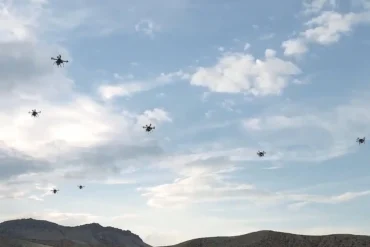
The most striking feature of the K2 demonstration was its autonomous swarm capability. During the test sequence, five aircraft performed coordinated formation maneuvers, flying in patterns such as right echelon, line formation, and V-shaped alignment.
Maintaining these formations requires continuous adjustment of speed, altitude, and position. Instead of relying on human pilots to manually manage each aircraft, the K2 employs onboard sensors combined with artificial intelligence-assisted flight software.
These systems enable the aircraft to:
- Monitor the position of neighboring drones
- Maintain safe separation distances
- Execute synchronized turns and maneuvers
- Share navigation and targeting data
Footage released by Baykar shows the aircraft performing a coordinated landing sequence before taxiing into a parked formation on the same runway. The display suggests that the system can operate as a fully integrated aerial network, where each drone contributes data to the group while executing its assigned mission.
Design Influences from the Bayraktar TB2
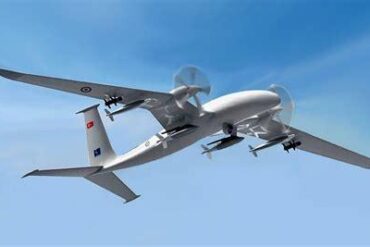
Observers quickly noticed that the K2 shares certain design traits with Baykar’s widely known Bayraktar TB2 unmanned combat aerial vehicle. The TB2 has become one of Türkiye’s most successful defense exports and has been widely deployed by the Turkish Armed Forces and numerous international operators.
However, the K2 is not simply a modified TB2. While some structural elements—such as fuselage proportions and propulsion layout—appear related, the aircraft introduces several distinct aerodynamic changes.
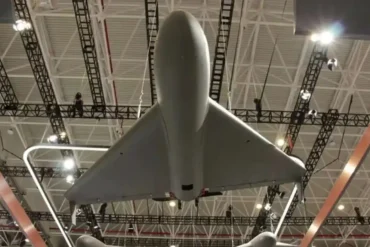
The TB2 uses straight wings and an inverted V-tail configuration, whereas the K2 adopts a tailless layout with swept wings. Additional aerodynamic features include wingtip control surfaces and forward lifting canards positioned near the front of the aircraft.
These canards serve a practical purpose. They incorporate flap mechanisms designed to reduce takeoff distance, enabling the aircraft to launch from relatively short runways. This design choice suggests that the K2 was engineered for expeditionary operations, where conventional launch infrastructure may not be available.
Beneath the fuselage sits a stabilized electro-optical sensor turret, providing the primary system for target detection, tracking, and terminal guidance. A secondary camera with night-vision capability supports operations in low-light or adverse visibility conditions.
Navigation Designed for Electronic Warfare Environments
Modern battlefields are increasingly dominated by electronic warfare systems that disrupt satellite navigation signals. Global Navigation Satellite Systems (GNSS), including GPS, can be jammed or spoofed, potentially leaving unmanned aircraft unable to determine their position.
The K2 has been designed with this threat environment in mind. When satellite navigation becomes unreliable, the aircraft reportedly switches to terrain-based visual navigation.
This method works by allowing the onboard sensors to scan ground features such as coastlines, roads, and terrain patterns. By comparing those images with stored map data, the aircraft can estimate its location and continue navigating toward its target.
This capability significantly improves survivability during GNSS-denied operations, where many autonomous systems would otherwise lose orientation. In essence, the K2 can “see” the landscape and determine where it is, rather than relying entirely on satellite signals.
Propulsion and Endurance Capabilities
While Baykar has not formally confirmed the propulsion system used in the K2, the aircraft’s performance profile suggests an engine in the 100-horsepower class, similar to the engines used by the Bayraktar TB2.
Türkiye has been investing heavily in indigenous propulsion technologies, including the TM100 engine, developed specifically for tactical UAVs in the one-ton category. If this engine powers the K2, it would provide the endurance required for long-range strike missions lasting more than half a day.
Extended endurance transforms how loitering munitions can be used. Instead of launching shortly before an attack, the aircraft can patrol distant areas for hours, waiting for the right moment to strike.
This persistent presence creates a new type of threat environment in which targets may be continuously monitored by autonomous strike systems capable of attacking at any moment.
Distributed Command and Leader Aircraft Concept
One particularly intriguing detail observed during the demonstration was the presence of an external pod mounted beneath one of the aircraft in the swarm formation. The pod was absent from the other drones, suggesting that the aircraft might serve a specialized role.
This configuration hints at the possibility of a leader-node architecture, where one drone acts as the central coordinator for the swarm. Equipped with additional communication equipment or mission management hardware, this leader aircraft could perform several critical tasks:
- Maintaining datalink connectivity across the swarm
- Distributing target assignments
- Relaying intelligence to command centers
- Synchronizing strike timing among multiple drones
Such an approach mirrors concepts being explored in other advanced drone programs around the world, where distributed networks of autonomous aircraft cooperate as a single combat system.
Potential Naval Integration with TCG Anadolu
Another subtle clue about the K2’s future role appears in the testing environment itself. Several scenes show the aircraft positioned on the same mock runway used during ground tests for the Bayraktar TB3, a short takeoff and landing UCAV designed for operations from the Turkish Navy’s TCG Anadolu amphibious assault ship.
This overlap suggests that the K2 could eventually operate in conjunction with the TB3 as part of a carrier-based unmanned strike ecosystem.
In such a configuration, TB3 aircraft equipped with advanced reconnaissance sensors could identify and track targets, relaying data to groups of K2 loitering munitions. The K2 swarm would then conduct the strike phase of the mission.
Operating from a large amphibious ship positioned far from hostile shore defenses would allow naval forces to conduct long-range precision strikes without risking manned aircraft.
The concept essentially transforms the ship into a floating drone strike base, capable of launching coordinated attacks hundreds or even thousands of kilometers away.
Türkiye’s Expanding Unmanned Warfare Strategy
The unveiling of the K2 underscores a broader strategic pattern in Türkiye’s defense industry. Over the past decade, Ankara has invested heavily in autonomous military technologies, indigenous propulsion systems, and export-oriented UAV programs.
These efforts have produced several influential platforms, including the Bayraktar TB2, which has gained global recognition through deployment in multiple conflicts, and the Bayraktar Akıncı, a high-altitude long-endurance UAV capable of carrying heavy payloads and advanced sensors.
The K2 represents the next evolutionary step in that trajectory. Instead of focusing solely on reconnaissance or precision strikes, the platform introduces large-scale autonomous swarm attack capabilities designed to overwhelm modern defenses.
In military theory, such systems represent a shift toward distributed and networked warfare, where groups of relatively inexpensive autonomous aircraft can perform missions once reserved for highly complex manned platforms.
The unveiling of the Baykar K2 suggests that swarm-enabled long-range loitering munitions may soon become a central feature of future combat operations, particularly in environments where traditional air power faces dense air defense networks and electronic warfare threats.