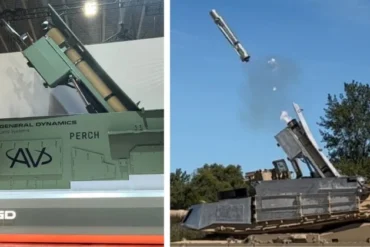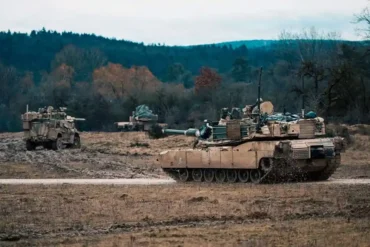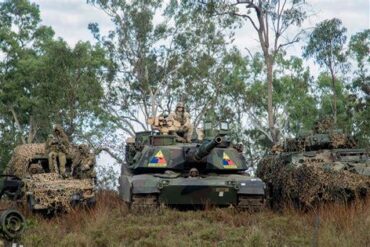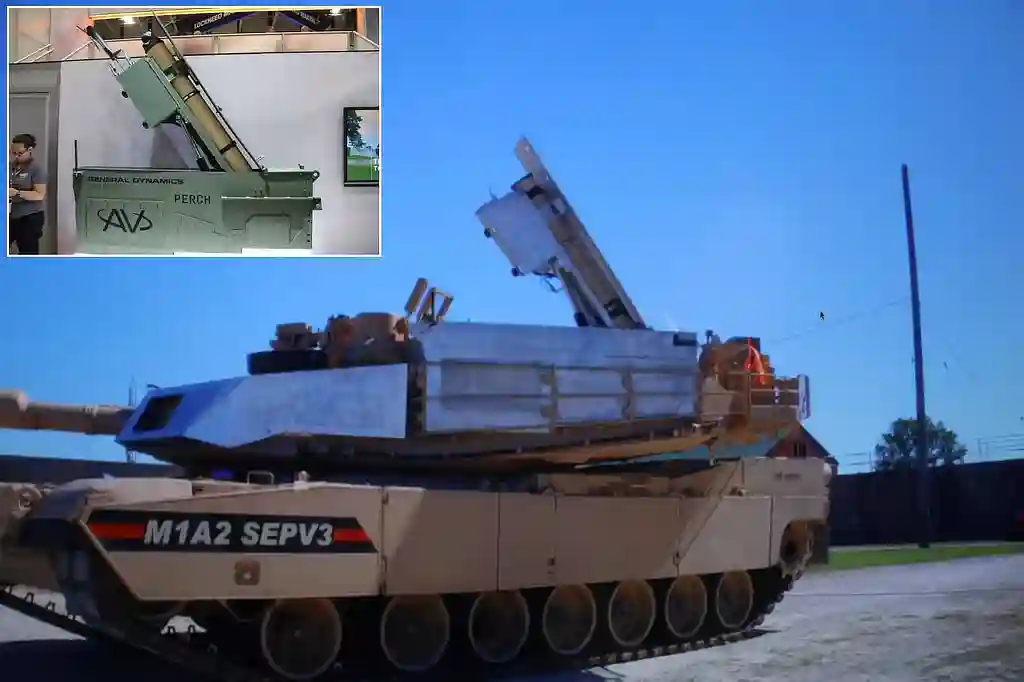
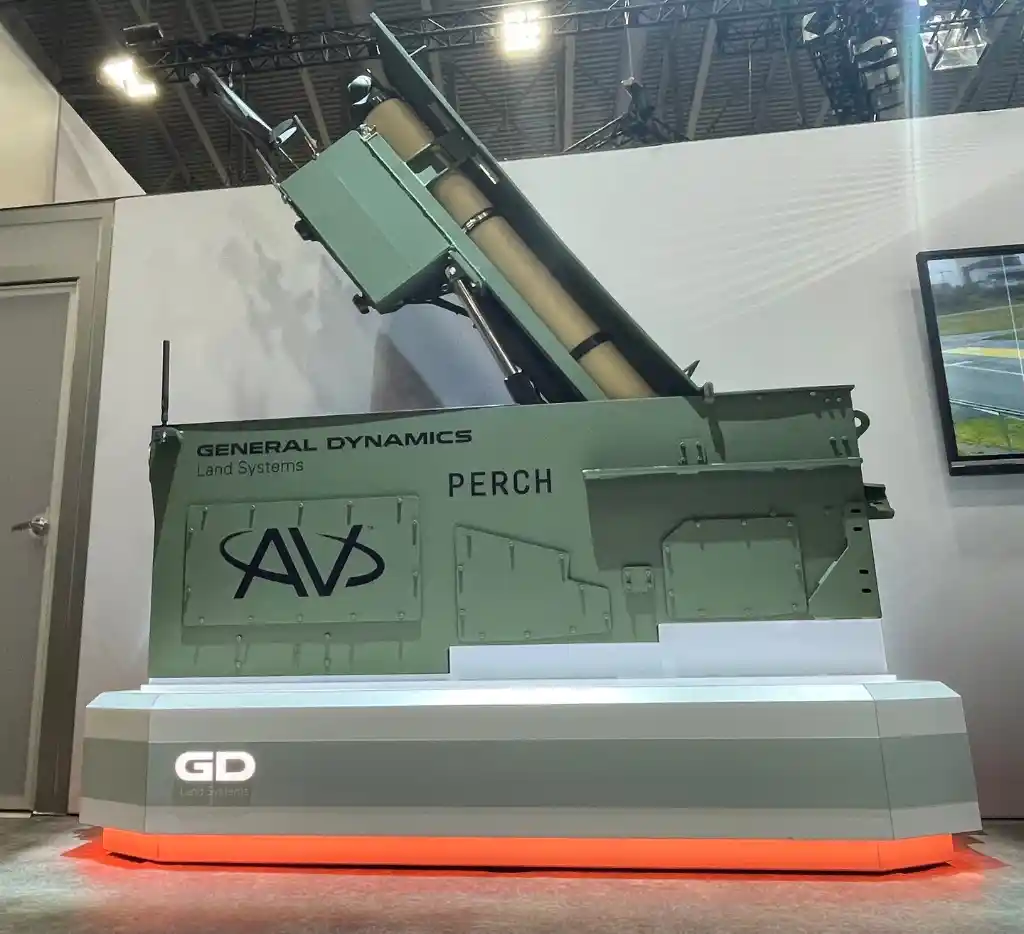
General Dynamics Land Systems (GDLS) has revealed one of the most significant evolutions in armored warfare at the Association of the United States Army (AUSA) 2025 Exposition in Washington, D.C. — the Precision Effects & Reconnaissance, Canister-Housed (PERCH) system. This newly introduced modular launcher redefines how the U.S. Army’s M1A2 Abrams SEPv3 engages in reconnaissance and precision strike missions, bridging the gap between heavy armor and aerial lethality.
Designed to seamlessly integrate with existing Abrams hardware, PERCH allows tank crews to deploy AeroVironment Switchblade 300 and 600 loitering munitions directly from their vehicles. This marks a historic first for U.S. armored formations, giving tanks the ability to strike targets beyond visual line of sight without relying on separate drone assets or forward observers.
A New Dimension for Armored Warfare
The PERCH system is not just an add-on — it’s a force multiplier that transforms how ground combat units operate. Mounted externally in a low-profile configuration, the canister system interfaces directly with the Abrams’ power supply and digital control architecture, requiring no cutting, welding, or permanent structural modifications. This non-invasive integration is a critical differentiator, enabling rapid deployment across platforms and ensuring compatibility with other U.S. Army armored vehicles such as the Stryker and Bradley.
The system’s modularity allows quick installation in the field, taking advantage of existing electronic interfaces and vehicle displays. Tank crews can manage launch and guidance operations using the same tactical display units already familiar from the Abrams’ fire control systems. This design philosophy ensures minimal retraining, allowing immediate operational readiness.
Switchblade Integration: Expanding the Abrams’ Tactical Reach
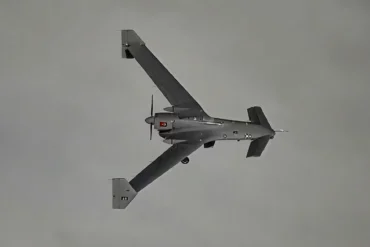
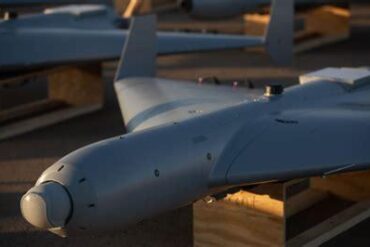
At the core of PERCH’s innovation is its integration with the AeroVironment Switchblade family of loitering munitions. These tube-launched, man-portable systems are widely regarded for their precision strike and surveillance capabilities.
- Switchblade 300: Weighing just over 5 pounds, it offers 15 minutes of loiter time, optimized for anti-personnel and light-vehicle targets. It uses GPS and real-time video guidance, giving operators the ability to identify and neutralize soft targets with pinpoint accuracy.
- Switchblade 600: Designed for armored or fortified targets, it delivers over 40 minutes of flight endurance and standoff engagement ranges beyond 40 kilometers. Equipped with an anti-armor warhead and electro-optical guidance, it effectively allows tank crews to strike before being seen.
By incorporating both munition types, the M1A2 Abrams SEPv3 now possesses an unprecedented over-the-horizon strike capability, allowing it to engage hidden or distant threats without breaking cover or altering formation.
Operational Impact: Reconnaissance and Precision at Range
Before PERCH, the Abrams was largely confined to line-of-sight engagements, relying heavily on external Intelligence, Surveillance, and Reconnaissance (ISR) assets such as drones or ground spotters. The introduction of PERCH fundamentally alters this dependency. Crews can now self-deploy aerial munitions for reconnaissance, target tracking, and engagement — effectively turning each Abrams into a self-contained hunter-killer platform.
This transformation enhances the survivability and autonomy of armored units. In GPS-denied or contested electromagnetic environments, where communications with external UAVs may be compromised, PERCH’s direct control integration ensures operational continuity. The real-time feedback from Switchblade drones provides situational awareness, enabling faster, data-driven decision-making during high-intensity engagements.
Design Philosophy: Seamless Integration, Maximum Lethality
One of PERCH’s defining strengths is its plug-and-play architecture. The canister launcher is mounted along the Abrams’ turret, preserving its 360-degree traverse and combat posture. The system draws from the tank’s power grid and integrates with existing C4ISR (Command, Control, Communications, Computers, Intelligence, Surveillance, and Reconnaissance) infrastructure.
Each canister is field-replaceable and supports rapid rearming, aligning with the Army’s push for modular combat logistics. This feature allows for sustained deployment during extended operations without significant downtime. The system’s architecture also includes provisions for future payload expansion, potentially supporting electronic warfare modules, sensor pods, or other autonomous drone systems in subsequent iterations.
Testing and Early Demonstrations
According to GDLS officials, PERCH has already been successfully tested on an M1A2 Abrams SEPv3 platform under U.S. Army evaluation. The demonstration validated electronic system integration, launch procedures, and the full mission cycle of the loitering munitions. Engineers confirmed that PERCH functioned as intended with the Abrams’ onboard systems, requiring no software overhauls or external controllers.
These successful trials signal that PERCH is ready for near-term deployment, pending final evaluation and procurement decisions. Though formal acquisition timelines have not yet been announced, defense analysts view the system as a high-readiness candidate for integration under upcoming Next-Generation Combat Vehicle (NGCV) modernization programs.
Future Potential: The Abrams as a Networked Strike Hub
Beyond its immediate battlefield application, PERCH represents a broader shift in combat vehicle doctrine. The line between heavy armor and aerial assets is blurring — and GDLS is positioning the Abrams not just as a tank, but as a networked strike hub.
By granting organic aerial capabilities to ground platforms, commanders can execute coordinated, multi-domain attacks without depending on external ISR assets or artillery support. Each tank becomes a node in a distributed kill web, capable of detecting, classifying, and destroying threats independently.
In high-tempo operations against near-peer adversaries, where survivability and rapid decision-making define outcomes, such capabilities provide a decisive edge. As GDLS engineers emphasized at AUSA, the PERCH system is designed with “future growth in mind,” meaning its modular bays could later accommodate electronic jammers, micro-UAVs, or even directed-energy payloads.
The Abrams Enters the Loitering Era
The PERCH system unveiled at AUSA 2025 signifies a paradigm shift in how heavy armor operates in modern warfare. By merging the brute force of the M1A2 Abrams with the precision and reach of the Switchblade loitering munitions, GDLS has created a hybrid capability that redefines battlefield dominance.
As multi-domain operations evolve, systems like PERCH will be crucial in maintaining the U.S. Army’s technological overmatch. The Abrams, long regarded as a symbol of armored might, now steps into a new role — not just as a tank, but as a networked precision-strike platform capable of engaging threats from the ground to the skies.