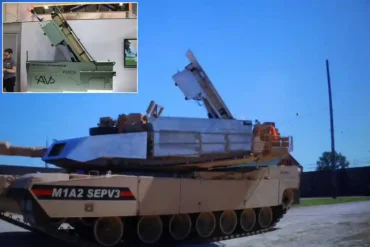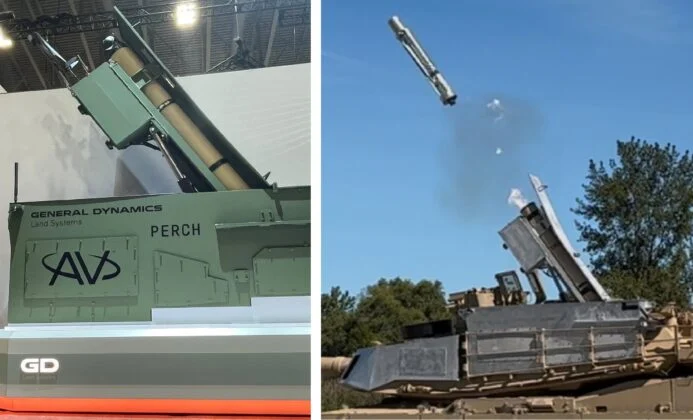
The U.S. Army has taken a decisive step in reshaping modern armored warfare by successfully testing the PERCH (Precision Effects & Reconnaissance, Canister-Housed) loitering munition system on the M1A2 Abrams SEPv3 main battle tank. This development marks a fundamental shift in how armored formations detect, assess, and destroy threats, transforming the Abrams from a line-of-sight direct-fire platform into a self-contained reconnaissance and precision-strike system capable of operating far beyond the visual horizon.
At the core of this advancement is the Army’s drive to provide tank crews with organic beyond-line-of-sight lethality, reducing dependence on external drone units, artillery, or air support. By embedding aerial reconnaissance and strike capabilities directly onto the tank, the Abrams gains the ability to see, decide, and strike independently while remaining protected by its armor.
Unlike earlier add-on concepts that required complex integration or separate control systems, PERCH is designed to work seamlessly with existing Abrams digital architecture. The launcher module bolts onto established mounting points, preserving the tank’s structure while enabling rapid adoption. This approach reflects a broader modernization philosophy focused on modularity, survivability, and speed of deployment across U.S. armored forces.
The implications extend beyond hardware. PERCH fundamentally alters how tank crews interact with the battlefield, compressing the sensor-to-shooter loop and giving commanders immediate tactical options previously unavailable at the platoon level.
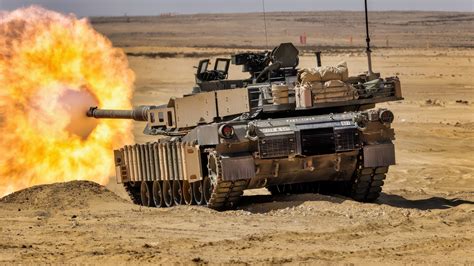
Redefining the Abrams as a Beyond-Line-of-Sight Combat System
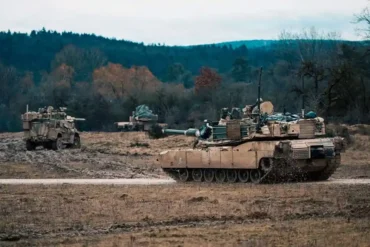
The M1A2 Abrams SEPv3 already represents the most digitally advanced variant of the iconic tank, featuring improved power generation, enhanced armor protection, and upgraded battle management systems. The addition of PERCH elevates this platform into a multi-domain combat node, capable of projecting force vertically as well as horizontally.
Beyond-line-of-sight capability has long been a vulnerability for tanks, especially in complex terrain where ridgelines, urban structures, and vegetation obscure threats. PERCH addresses this gap by allowing crews to deploy loitering munitions that scout, identify, and engage targets without exposing the tank. This ability to extend awareness and lethality beyond physical sightlines directly enhances crew survivability and mission success.
PERCH operates entirely under armor, controlled through the tank’s onboard interfaces. Crews do not need external terminals or specialized drone operators, ensuring that the system integrates naturally into existing armored workflows. This design choice reduces training burdens while maximizing combat relevance.
Switchblade 300 Block 20: Precision Against Hidden Threats
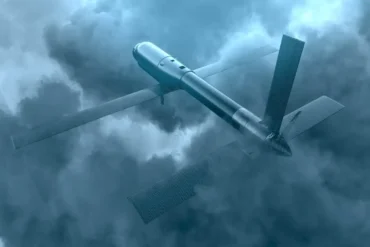
One of the two munitions enabled by PERCH is the Switchblade 300 Block 20, a lightweight loitering munition optimized for engaging infantry, light vehicles, and anti-tank teams. With more than 20 minutes of endurance, the 300 Block 20 provides persistent surveillance over contested areas, giving Abrams crews critical time to assess threats before committing the tank.
Its steep dive attack profile and selectable detonation options allow precise engagement in dense environments. Enemy teams hiding on rooftops, inside trench networks, or behind urban cover can be neutralized without collateral damage or prolonged exposure. The munition’s wave-off and re-attack capability ensures that operators retain control until the final moment, reducing the risk of unintended strikes.
For armored units facing dispersed infantry armed with modern anti-tank guided missiles, this capability is transformative. The Switchblade 300 enables Abrams crews to remove ambush threats proactively, reshaping the engagement before the tank enters danger.
Switchblade 600: Extending Anti-Armor Dominance
Complementing the lighter munition is the Switchblade 600, designed to defeat armored vehicles and fortified positions at extended ranges. With up to 40 minutes of loiter time and a warhead capable of penetrating heavy armor, the 600 provides Abrams units with a precision strike option far beyond the effective range of the 120mm smoothbore cannon.
This capability allows tank formations to shape the battlefield before contact, eliminating high-value targets such as enemy tanks, command vehicles, or hardened defensive positions. Unlike traditional indirect fires, the Switchblade 600 offers real-time visual confirmation, enabling crews to verify targets and adjust attacks dynamically.
The psychological impact is equally significant. Adversaries facing Abrams units equipped with loitering munitions must contend with constant aerial surveillance and the threat of sudden, precise strikes, complicating defensive planning and slowing maneuver.
Complementing Direct Fire With Intelligent Lethality
The Abrams’ 120mm cannon remains unmatched in direct-fire engagements, delivering overwhelming kinetic energy against exposed targets. However, its effectiveness depends on visibility and firing geometry. PERCH introduces a parallel strike paradigm, one that prioritizes intelligence, persistence, and precision over raw force.
Loitering munitions operate at a different tempo, allowing tanks to observe patterns of movement, confirm hostile intent, and strike when conditions are optimal. This layered approach to lethality enables commanders to choose the right tool for each tactical problem, conserving ammunition and reducing risk.
In practical terms, this means fewer blind advances and fewer surprises. Tanks no longer need to crest a hill or enter an intersection to discover what lies beyond. They can know in advance and act accordingly.
Urban and Complex Terrain Survivability
Urban warfare remains one of the most dangerous environments for armored units, with threats emerging from multiple elevations and angles. PERCH directly addresses this challenge by giving Abrams crews a persistent aerial vantage point. Intersections, alleyways, and rooftops can be scanned and cleared before movement, dramatically reducing vulnerability to ambush.
In mountainous or forested terrain, the system offers similar advantages. Switchblade munitions can patrol ridgelines, valleys, and choke points, identifying threats that would otherwise remain hidden until contact. This added decision space allows commanders to control the tempo of engagement, rather than reacting under fire.
Modular Design and Future Growth
A key strength of PERCH lies in its modular architecture. The launcher can be adapted to multiple platforms, including Stryker vehicles and potentially future armored systems. This flexibility ensures that investments in loitering munition integration deliver value across the force.
As drone technology evolves, PERCH can accommodate new payloads, improved sensors, and enhanced autonomy. Future iterations may incorporate AI-assisted target recognition, collaborative drone operations, or electronic warfare-resistant links, further expanding the Abrams’ role on the digital battlefield.
This adaptability aligns with the Army’s broader modernization strategy, emphasizing scalable solutions that evolve with emerging threats rather than fixed, single-purpose systems.
Implications for Multi-Domain Operations
The integration of PERCH reflects the U.S. Army’s commitment to multi-domain operations, where land forces operate seamlessly with air, cyber, and space capabilities. By embedding aerial effects directly into armored units, the Abrams becomes a more autonomous contributor to joint operations.
Tank crews gain the ability to collect intelligence, conduct precision strikes, and share data across the network, enhancing situational awareness for higher headquarters. This connectivity ensures that armored formations remain relevant and effective in increasingly complex conflict environments.
A New Chapter in Armored Warfare
As peer adversaries invest heavily in drones, anti-armor weapons, and electronic warfare, the U.S. Army’s response is clear: integrate precision and intelligence directly into its most survivable platforms. The combination of M1A2 Abrams SEPv3 and PERCH-enabled Switchblade loitering munitions delivers a potent blend of armor, agility, and awareness.
This capability does more than enhance firepower. It redefines what a tank can be in modern combat, ensuring that the Abrams remains not just a symbol of armored dominance, but a decisive, adaptive force on tomorrow’s battlefields.