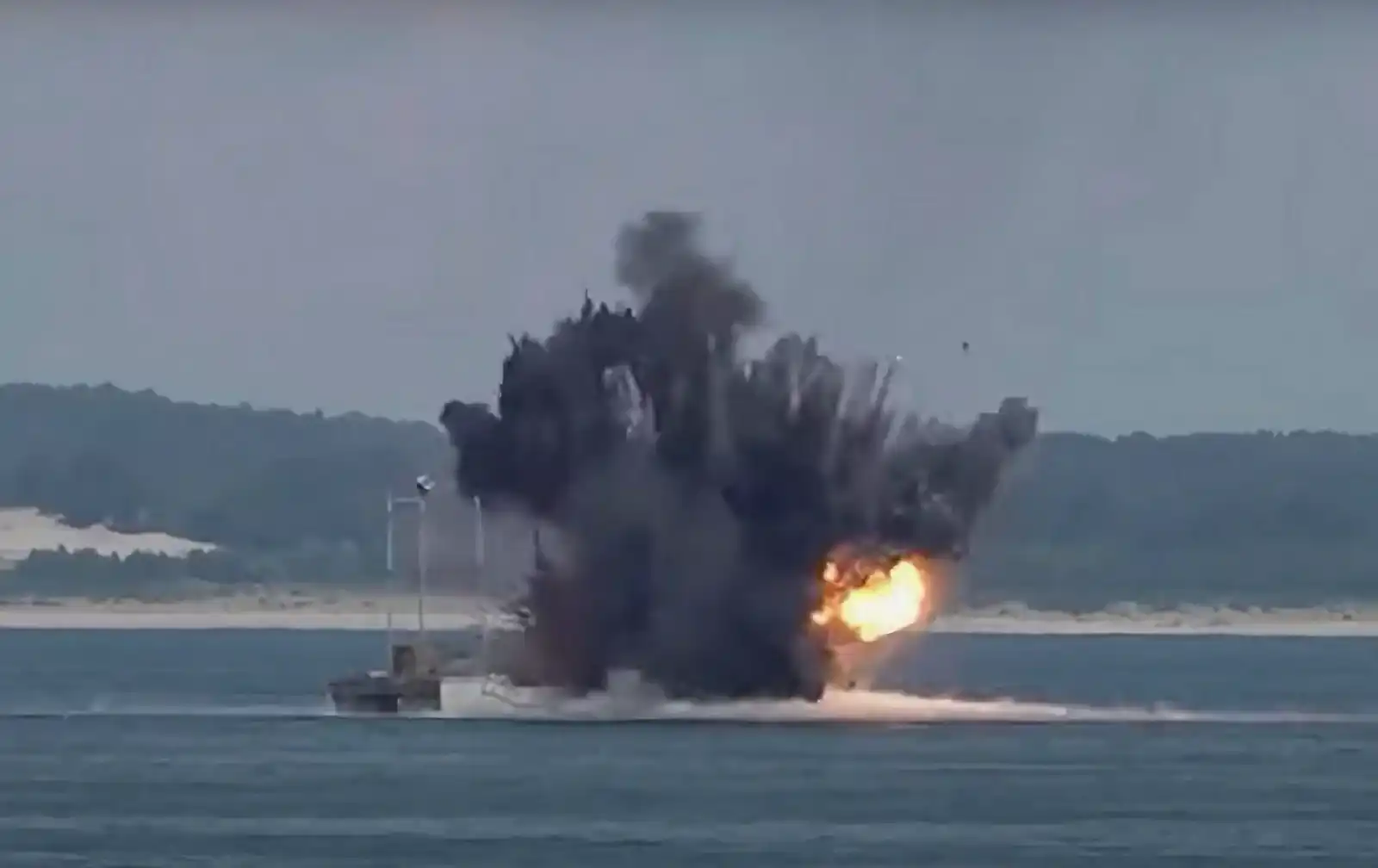
Russia has escalated its naval warfare capabilities by expanding the deployment of explosive-laden unmanned surface vessels (USVs) and autonomous underwater drones, shaped significantly by tactical lessons gleaned from Ukraine’s aggressive drone warfare in the Black Sea. The shift was publicly unveiled during “July Storm 2025”, a massive multi-theater naval exercise that spanned from July 23 to 27, involving over 150 warships, 120 aircraft, and 15,000 personnel across the Pacific, Arctic, Baltic, and Caspian regions.
The centerpiece of this high-profile demonstration was the deployment of kamikaze USVs in live-fire scenarios. These drones were seen speeding across the surface of the sea before colliding into target vessels with devastating explosive payloads, captured in high-definition by the Russian Ministry of Defense. The precision and power of these attacks confirmed that autonomous maritime systems are no longer experimental tools—they are now core instruments of Russian naval doctrine.
From Reactive to Proactive: Russia Emulates and Evolves Ukrainian Tactics
The influence of Ukrainian naval drone tactics is unmistakable. Ukraine’s innovative use of explosive-laden drones, particularly the MAGURA V5 and Sea Baby, successfully disabled or damaged several Russian vessels in 2023 and 2024. The asymmetric nature of these attacks—low-cost drones sinking or crippling multimillion-dollar warships—forced Moscow to fundamentally reassess its maritime strategies.
However, Russia has not merely copied Ukraine’s tactics; it has scaled and integrated them into a larger combat framework. Where Ukraine employed isolated strikes, Russia now seeks swarming, coordinated assaults involving multiple unmanned and manned systems.
Key Russian Platforms: Vizir, Orkan, and Ghrachonok Variants
During the July Storm drills, multiple new-generation Russian naval drones made their public debut. Among the most notable were:
- Vizir USV: A prototype designed for both surveillance and strike roles, this platform is reportedly capable of real-time targeting and payload delivery, potentially allowing it to loiter near enemy formations before engaging.
- Orkan USV: A high-speed kamikaze drone, the Orkan was seen operating in coordinated waves, equipped with explosive warheads and designed for precision strikes against warships.
- Ghrachonok USV variant: Derived from the counter-saboteur patrol boat series, this platform is undergoing transformation into an autonomous vehicle tasked with port patrol, anti-sabotage, and mine-clearance missions.
Each of these drones operates under remote or semi-autonomous control, with many reportedly featuring GPS-denied navigation systems using visual and inertial cues—a direct response to Ukrainian and NATO jamming tactics.
Subsea Expansion: Klavesin and Vityaz Lead Deep-Water Integration
Russia’s ambitions extend well beneath the ocean surface. Underwater systems demonstrated during the exercise included the Klavesin-2R-PM and the Vityaz-D, both of which are being repurposed or upgraded for multi-role naval warfare:
- Klavesin-2R-PM: Originally developed for scientific purposes, this vehicle now features configurations for reconnaissance, mine-laying, and sensor deployment, able to operate at significant depths.
- Vityaz-D: A proven deep-sea platform, having reached the Mariana Trench, the Vityaz-D is now slated for expanded missions involving strategic undersea reconnaissance, surveillance of submarine routes, and covert sabotage operations.
In parallel, visual evidence from the July Storm drills confirmed underwater drone activity near harbor installations, a sign of possible future emphasis on port sabotage, covert ISR, and minefield seeding. These developments are consistent with Moscow’s desire to deny access to strategic waters without direct confrontation.
Integrated Swarm Warfare: A New Naval Doctrine Emerges
What sets Russia’s approach apart is not the technology itself, but the doctrinal transformation accompanying it. The July Storm exercise was not a demonstration of standalone systems—it showcased multi-domain warfare, where kamikaze USVs, attack helicopters, electronic warfare, and manned destroyers were all part of synchronized strikes against simulated high-value naval targets.
This shift toward “network-centric warfare” mirrors trends observed in the U.S. and Chinese militaries but marks a particularly aggressive pivot in Russia’s case. The use of cheap, disposable, and hard-to-detect drones as the first wave of attack aims to saturate ship defenses, paving the way for conventional platforms to exploit the chaos.
Given the increasing sophistication of Western naval air defenses, this strategy could prove difficult to counter, particularly in littoral waters, where radar performance is degraded and drone silhouettes are easily lost in sea clutter.
Implications for Global Naval Powers: A Strategic Wake-Up Call
Russia’s leap forward in naval autonomy and kamikaze strike integration is not occurring in a vacuum. Other major militaries are investing in similar capabilities:
- The United States Navy is actively deploying autonomous vessels under the Ghost Fleet Overlord program, including Sea Hunter and Ranger, for long-endurance operations.
- Israel is advancing its BlueWhale underwater drone, while Rafael’s Blue Spear loitering naval munition continues active development.
- Turkey’s ULAQ series and China’s stealthy JARI-USV indicate a global consensus on the inevitability of unmanned maritime warfare.
Yet what distinguishes Russia’s posture is its integration of these systems into large-scale exercises and a willingness to deploy them offensively, not just defensively or for ISR purposes.
Russia’s Future Battlefield: Drones, Depth, and Doctrine
The July Storm 2025 exercise signals not just a technology demonstration, but the arrival of a new operational paradigm. With systems like Vizir, Orkan, Klavesin-2R-PM, and Vityaz-D either in deployment or advanced testing stages, Russia is building a layered, networked, and resilient naval force that could prove highly disruptive in contested theaters.
From the Arctic to the Black Sea, Russia now possesses the ability to:
- Conduct saturation attacks on capital ships without risking crewed assets
- Perform strategic reconnaissance in deep-sea environments beyond enemy detection
- Interdict harbors and chokepoints with low-cost expendable drones
- Blend autonomous and manned elements into unified maritime combat groups
Western analysts and defense planners will be forced to respond, as traditional maritime superiority becomes increasingly threatened by cheap, fast, and intelligent platforms operating in environments designed to neutralize conventional strengths.
The rise of Russian kamikaze naval drones is not simply a tactical shift—it is a doctrinal revolution, one that has redefined naval warfare in a matter of years. From now on, the shape of fleets and the structure of battles at sea will have to accommodate a new, deadly reality: the era of autonomous maritime swarms has begun.