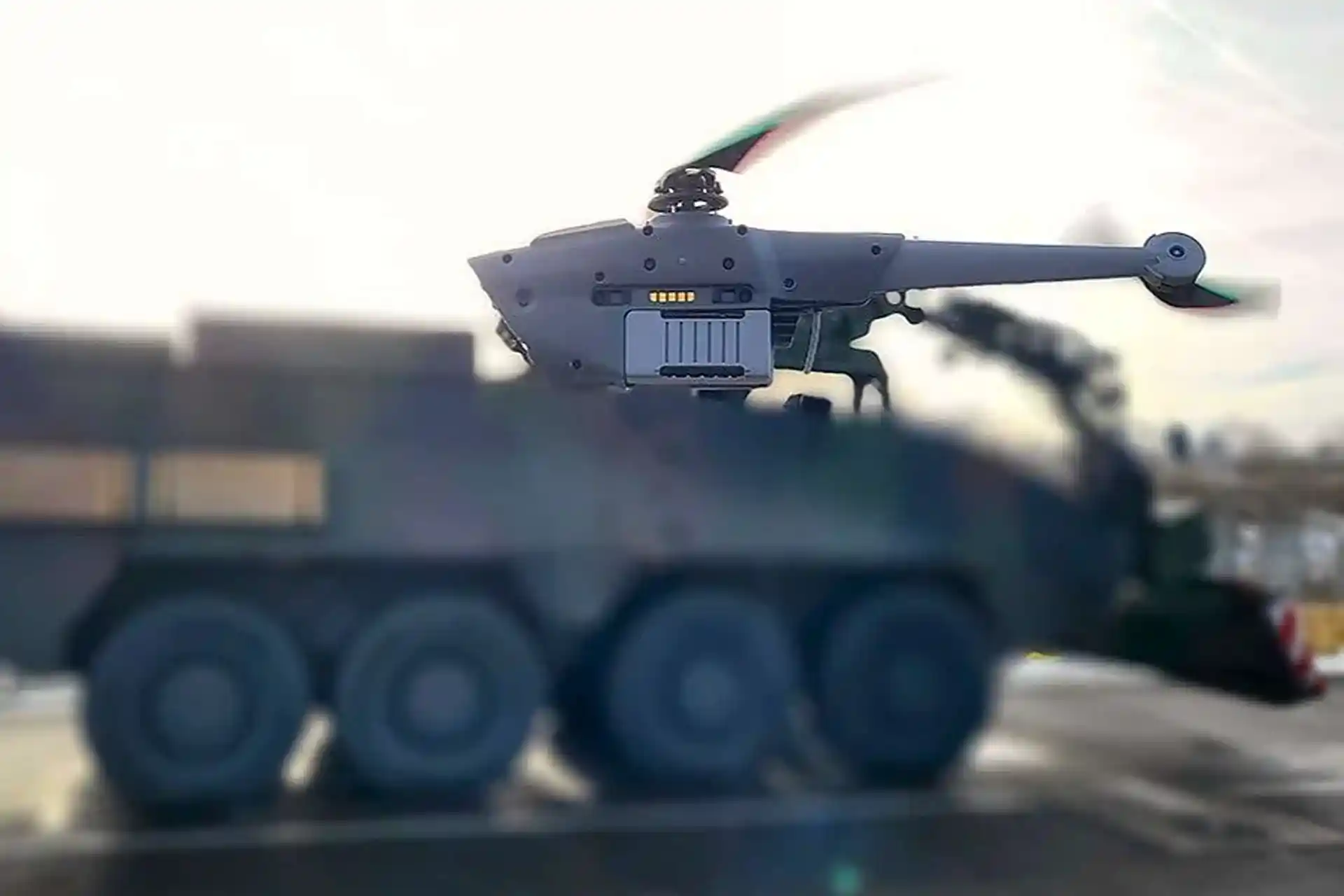
Switzerland has taken a decisive step toward digitized ground combat by ordering Black Hornet 4 nano-drones to deliver live intelligence directly into its Piranha 8×8 armored vehicle fleet. The $17.5 million procurement, confirmed by Teledyne FLIR Defense and managed by armasuisse, reflects a clear operational priority: pushing reconnaissance data instantly to crews and dismounted soldiers at the tactical edge, without delay, fragmentation, or manual relay.
The decision moves beyond simply buying a small drone. It embeds a hand-launched ISR sensor into the armored vehicle’s digital nervous system, ensuring reconnaissance becomes a shared, vehicle-level capability rather than a siloed tool carried by a single operator. In practical terms, the Black Hornet 4 becomes another sensor inside the Piranha’s mission system, feeding commanders, gunners, and dismount leaders with the same real-time picture.
The contract covers a large number of Black Hornet 4 Personal Reconnaissance Systems, selected specifically for the Piranha 8×8 armored engineering vehicle program. Vehicle-integrated systems were delivered during 2025, with additional deliveries continuing through 2026, signaling a transition from testing to operational fielding across Swiss Army units.
Digital Integration Turns Nano-Drones into Vehicle Sensors
At the core of the Swiss program is not airframe performance alone, but software integration. Teledyne FLIR Defense adapted the Black Hornet’s control architecture to connect seamlessly with the Piranha 8×8 digital mission system, allowing live video and telemetry to appear directly on vehicle workstations. Rather than relying on verbal updates or handheld screens, crews see drone feeds exactly where they make tactical decisions.
The integration aligns with standardized military interfaces and connects to the Integrated Combat Solution supplied by Kongsberg Defence & Aerospace. This approach treats the nano-drone as a fully recognized sensor node, enabling target coordinates, imagery, and situational-awareness data to flow through the same digital pathways as other onboard systems. The result is a coherent operational picture shared instantly across the crew.
Critically, the integration is designed to remain detachable. Operators can launch the drone from within or beside the vehicle, share the feed with the crew, and then dismount with the same control tablet without interrupting the mission. Reconnaissance continues seamlessly as the tactical situation evolves.
Enhancing Engineering and Maneuver Operations
For an armored engineering vehicle, organic airborne reconnaissance carries outsized value. Route clearance, obstacle approaches, choke points, and suspected threat zones can be scanned before vehicles or soldiers are committed. The Black Hornet 4 enables rapid over-the-hill and around-the-corner reconnaissance, reducing exposure during some of the most dangerous phases of ground movement.
Live drone data can also feed into remote weapon station workflows, allowing detected points of interest to be shared immediately with gunners or commanders. This shortens the sensor-to-decision loop, helping crews respond faster while minimizing guesswork. In dense terrain, urban areas, or restricted visibility, that time compression can translate directly into improved survivability.
Black Hornet 4 Performance in Contested Environments
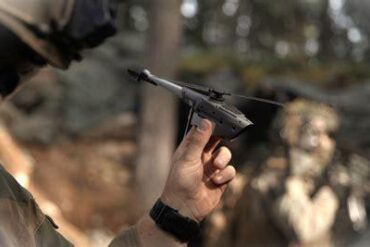
Teledyne FLIR Defense describes the Black Hornet 4 as a 70-gram nano-UAS optimized for close-range, low-signature operations. Despite its size, the system carries a 12-megapixel daylight camera paired with a high-resolution thermal imager, providing day-and-night coverage from the same platform. This dual-sensor configuration allows operators to detect heat signatures, concealed personnel, and environmental cues that would otherwise remain invisible.
The system is designed to function in GPS-denied or contested environments, a requirement increasingly central to modern European defense planning. With an endurance exceeding 30 minutes, a range beyond three kilometers, and the ability to operate in 25-knot winds and rain, the drone offers persistence well beyond what its size might suggest. Obstacle-avoidance functions further support low-altitude flight in cluttered terrain, reducing operator workload during critical moments.
Institutionalizing Nano-UAS in Armored Doctrine
Switzerland’s approach reflects a broader doctrinal shift. Small drones are no longer treated as optional accessories carried by specialized teams. Instead, they are being institutionalized as standard sensors within armored formations. By embedding nano-UAS feeds into vehicle mission systems, commanders eliminate information gaps between drone operators and decision-makers.
This shared awareness reduces the risk of misinterpretation and accelerates collective understanding of the battlefield. It also aligns with wider NATO and European trends toward networked combat architectures, where data from multiple sensors—large and small—feeds a unified operational picture.
Strategic Implications for European Land Forces
The Swiss Black Hornet 4 program illustrates how relatively small investments can generate disproportionate operational impact. By focusing on integration rather than experimentation, Switzerland is fielding a mature capability that supports real missions today. The emphasis on standardized interfaces and modular integration also positions the Piranha fleet for future upgrades, whether with additional sensors or evolving command-and-control tools.
In an era defined by electronic warfare, information overload, and compressed decision cycles, the value of immediate, shared ISR cannot be overstated. Switzerland’s move signals that nano-drones are no longer peripheral gadgets. They are becoming indispensable elements of armored combat systems, quietly reshaping how crews see, decide, and act under pressure.