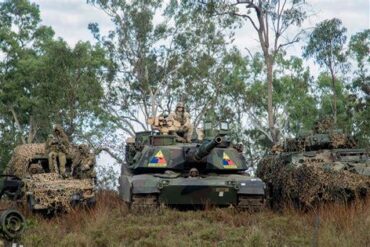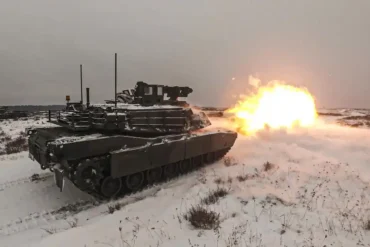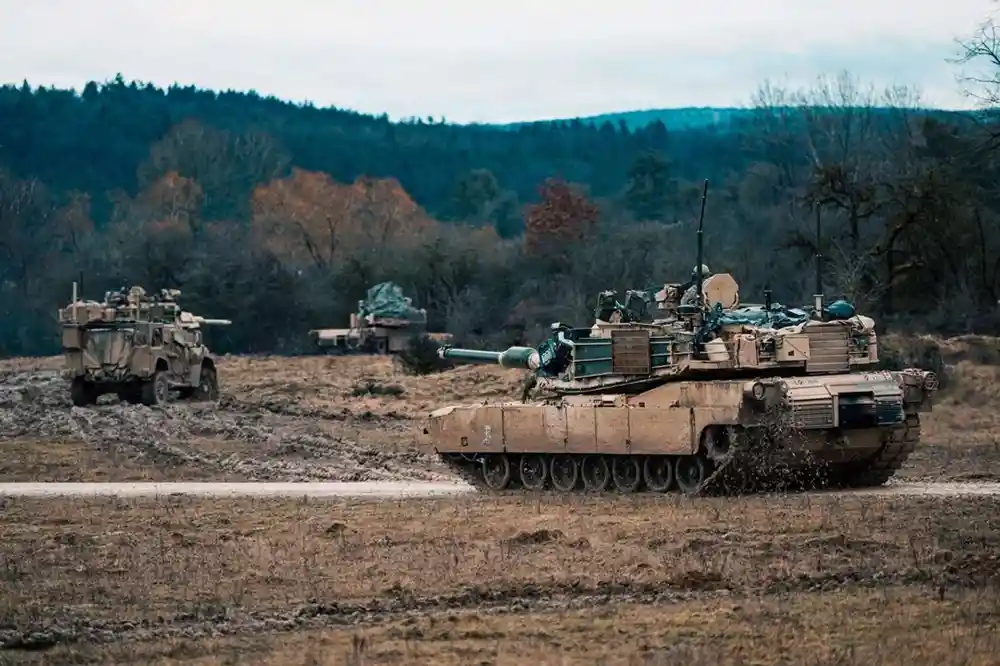
U.S. Army armored forces have once again placed the M1A2 Abrams main battle tank at the center of NATO’s deterrence strategy, this time during the demanding Combined Resolve 26-05 rotation at Germany’s Joint Multinational Readiness Center (JMRC) in Hohenfels. Designed as a full-spectrum, high-intensity combat rehearsal, the exercise brought together more than 3,400 personnel under realistic battlefield conditions intended to mirror the friction, uncertainty, and tempo of large-scale ground warfare on Europe’s eastern flank.
The rotation focused on the 1st Armored Brigade Combat Team “Devils,” 1st Infantry Division, which served as the primary training audience. Rather than rehearsing isolated tactical drills, the brigade was evaluated as a complete fighting formation—tested across maneuver, sustainment, mission command, and combined-arms synchronization. The objective was clear: ensure that a U.S. heavy brigade stationed or rapidly deployed to Europe can fight immediately and credibly alongside NATO allies in a contested environment.
Heavy Armor at the Core of NATO’s Forward Defense
The strategic backdrop to Combined Resolve 26-05 is NATO’s renewed emphasis on large-scale ground combat operations. With alliance defense planning now centered on rapid reinforcement and forward deterrence, heavy armored formations remain indispensable. The M1A2 Abrams is not a symbolic presence; it is a decisive instrument designed to close with, destroy, and exploit under fire.
At Hohenfels, Abrams crews maneuvered through terrain engineered to replicate Europe’s complex operational landscape—rolling woodlands, urban clusters, and obstacle-dense corridors. The JMRC environment intentionally injects degraded communications, dispersed logistics, electronic interference, and a dedicated opposing force to stress decision-making at every echelon.
U.S. Army soldiers from the 1st Battalion, 4th Infantry Regiment executed the opposing force mission, providing commanders with a thinking adversary rather than scripted outcomes. The result is a training ecosystem that forces adaptation in real time, sharpening the brigade’s ability to maintain tempo under pressure.
The M1A2 Abrams: Mobility, Firepower, and Shock Effect
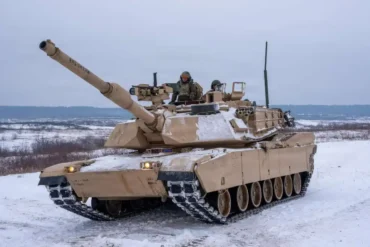
The M1A2 Abrams remains one of the most capable main battle tanks in service worldwide. Operated by a four-person crew, it is centered on the manually loaded 120mm M256 smoothbore cannon, supported by advanced fire control systems that allow accurate engagement while on the move. With a governed road speed of approximately 42 mph and a cruising range of roughly 265 miles, the Abrams combines mobility with endurance suited for rapid counterattacks or exploitation phases.
Mobility, however, extends beyond raw speed. The platform’s engineering enables trench-crossing capabilities of approximately nine feet and vertical obstacle negotiation of around 42 inches—performance characteristics essential for breaching fortified defensive belts. In contemporary European defense planning, where layered obstacles and anti-armor ambushes define potential battlefields, these capabilities enable armored formations to regain freedom of maneuver.
During Combined Resolve, tank crews rehearsed deliberate breach operations with engineers and infantry, integrating suppressive fires, obstacle reduction, and rapid penetration tactics. The Abrams functions as the brigade’s shock system—absorbing, delivering, and redirecting force at decisive points along the line of contact.
Survivability in the Era of Drones and Precision Fires
Modern battlefields present threats that differ markedly from those of previous decades. Anti-tank guided missiles, top-attack munitions, and drone-enabled targeting have reshaped armored warfare. The U.S. Army’s modernization trajectory reflects these realities.
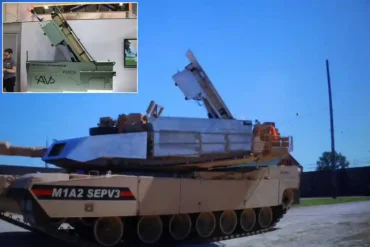
Upgrades to the Abrams SEPv2 and SEPv3 variants include improved power generation, networking enhancements, and integration of the Trophy Active Protection System (APS). Trophy is designed to detect and defeat incoming anti-tank projectiles before impact, significantly enhancing survivability against rocket-propelled grenades and guided missiles. While configurations may vary across individual platforms, training rotations assume exposure to the full spectrum of modern anti-armor threats.
At JMRC, survivability extends beyond hardware. Crews practice signature management, dispersion techniques, and rapid displacement drills to counter persistent surveillance and drone-enabled reconnaissance. The lesson is unmistakable: armor that remains static or predictable becomes vulnerable. Armor that maneuvers, integrates, and adapts retains its battlefield dominance.
Combined Arms Synchronization Under Realistic Battlefield Friction
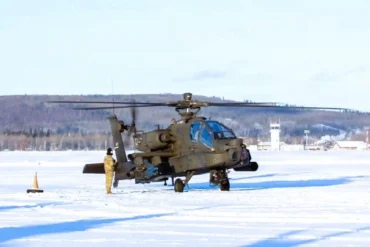
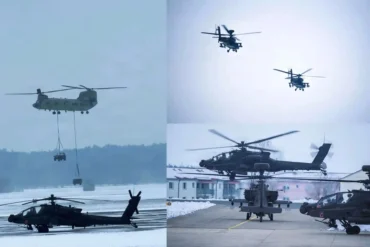
Abrams tanks do not fight in isolation. High-intensity warfare demands precise synchronization between armored units, dismounted infantry, artillery, engineers, aviation assets, and electronic warfare elements. Combined Resolve 26-05 emphasized these relationships, pushing battalions through rapid transitions between defensive postures and counterattacks.
In restrictive terrain, fields of fire can shift dramatically due to vegetation, elevation, and urban structures. Commanders must manage timing, fires coordination, and maneuver corridors with precision. The Abrams provides a stabilized direct-fire platform capable of suppressing strongpoints and enabling infantry to advance under protection. When synchronized effectively, heavy armor becomes the anchor around which combined-arms momentum builds.
Mission command was also tested under degraded communications. Leaders were forced to rely on disciplined initiative and clearly understood intent when digital networks were disrupted. This friction replicates the contested electromagnetic environment expected in peer conflict scenarios.
Multinational Interoperability as a Strategic Imperative
Combined Resolve is not solely a U.S. Army event; it is structured to enhance NATO interoperability. The exercise integrates allied and partner forces into shared operational frameworks, reinforcing standardized reporting formats, common operational graphics, and coordinated fires procedures. This interoperability ensures that multinational brigades can function cohesively under time pressure.
At the operational level, NATO’s regional defense plans hinge on the alliance’s ability to reinforce threatened sectors quickly. Exercises like Combined Resolve validate that reinforcement is not merely theoretical. A U.S. armored brigade can deploy, integrate, and fight within a NATO-informed command architecture without delay.
The presence of heavy U.S. armor in Germany signals more than training intent. It reinforces a broader deterrence posture rooted in readiness and demonstrated capability. The capacity to generate combat power rapidly—and prove it under observation—strengthens alliance credibility.
Continuous Transformation and the Future of Heavy Warfare
Combined Resolve 26-05 also aligns with the U.S. Army’s continuous transformation initiative, which integrates emerging technologies into operational formations. In Europe, modernization increasingly emphasizes a layered defensive architecture that blends heavy armor with attritable uncrewed systems, AI-enabled targeting networks, and expanded sensor coverage.
For Abrams units, this means operating within a broader “kill web” that connects sensors to shooters across domains. Tanks may receive targeting cues from drones, share data through networked command systems, and maneuver under the umbrella of electronic protection. Heavy armor remains decisive, but its effectiveness grows when integrated into a digitally enabled ecosystem.
The Hohenfels rotation demonstrated that transformation does not displace the Abrams; it enhances it. The tank’s firepower and survivability anchor maneuver forces, while networked technologies expand situational awareness and speed decision cycles.
Deterrence Measured in Capability, Not Presence
NATO has identified Russia’s war of aggression against Ukraine as the gravest threat to Euro-Atlantic security in decades. In response, the alliance has shifted toward stronger forward defense and the capacity for rapid reinforcement. Combined Resolve 26-05 illustrates how these strategic concepts translate into tactical readiness.
An armored brigade that can maneuver under contested conditions, sustain operations, and integrate seamlessly with allied formations provides tangible deterrence. The Abrams embodies that capability. Its presence in Germany during high-intensity exercises underscores NATO’s commitment to credible heavy combat power on short notice.
Ultimately, deterrence rests not on declarations but on demonstrated readiness. At Hohenfels, the M1A2 Abrams once again proved its relevance in modern warfare—delivering mobility, survivability, and decisive firepower within a multinational framework designed to meet the demands of contemporary conflict.