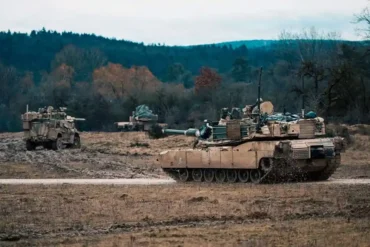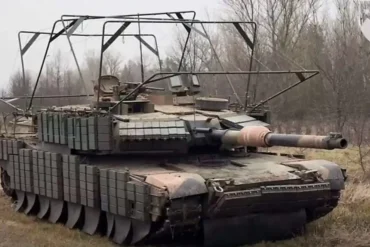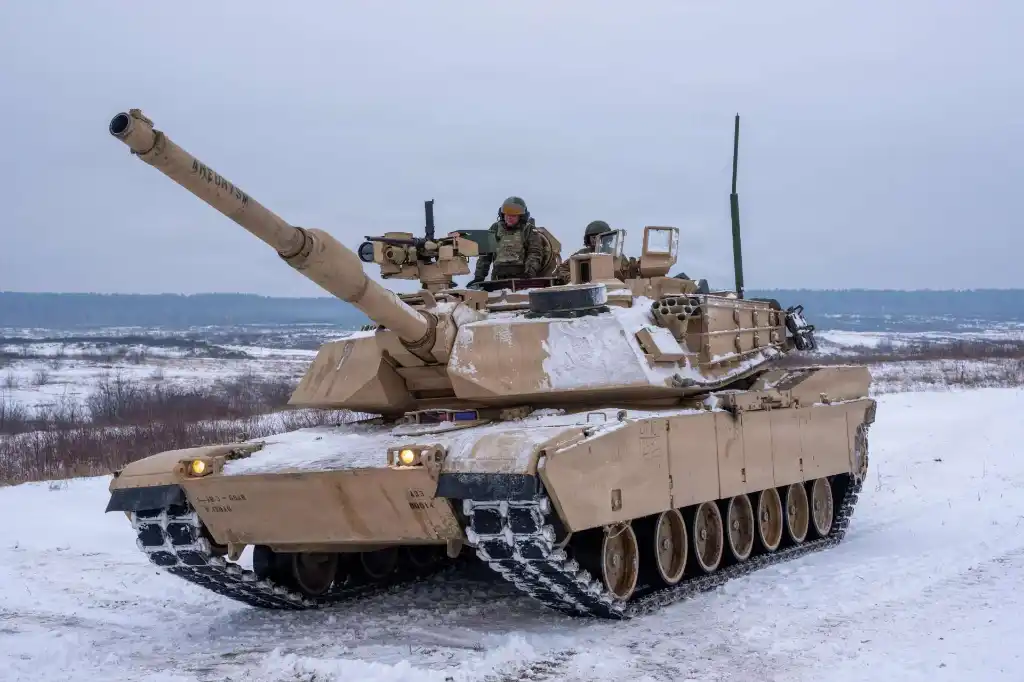
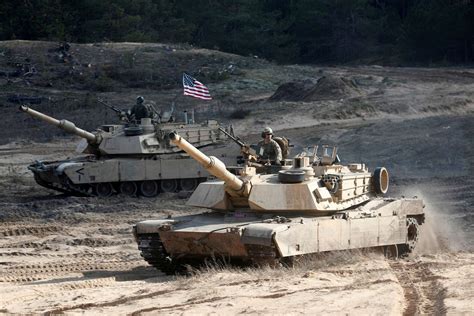
The announcement that U.S. M1A2 Abrams main battle tanks will rotate into Romania is not a routine force movement. It is a carefully calibrated signal that NATO’s eastern flank is being upgraded in quality, not quantity, with combat power placed precisely where response time, geography, and escalation dynamics matter most. Confirmed by Romania’s Chief of the Defense Staff, General Gheorghiță Vlad, the deployment underscores a shift toward higher lethality and faster readiness without increasing overall troop numbers, reframing how deterrence is expressed along the Black Sea frontier.
Romania has long been a frontline state by geography, but this move elevates it from host nation to operational hinge. The Abrams-equipped detachment embeds a premier U.S. armored capability directly into the southeastern theater, compressing timelines for reinforcement and complicating any adversary’s planning assumptions. In a region shaped by maritime pressure in the Black Sea, long-range fires from occupied Crimea, and the persistent shadow of the war in Ukraine, the presence of heavy armor changes the equation from symbolic reassurance to credible warfighting posture.
The significance lies in the distinction between presence and potency. A rotational force that brings heavy steel, modern sensors, and sustainment depth can exert a disproportionate deterrent effect. By emphasizing capability over headcount, Washington is demonstrating that posture debates about “reductions” miss the point: deterrence is measured in effects, not numbers. An Abrams detachment on the ground signals readiness to contest high-intensity conflict, even as it preserves escalation management through rotational basing.
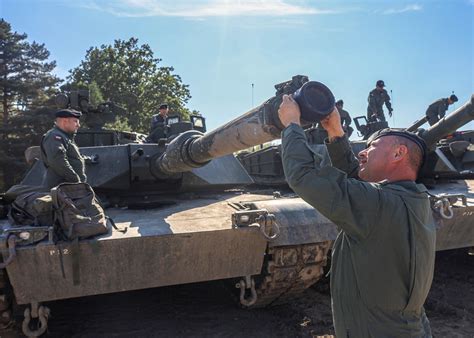
Strategic Weight Beyond the Headlines
For NATO, the eastern flank is not monolithic. The Baltic front and the Black Sea approach present different geometries, distances, and risk profiles. Romania sits at the crossroads of the Danube corridor, Black Sea access routes, and air and missile trajectories emanating from Crimea. Placing Abrams tanks here is less about tank-on-tank duels and more about anchoring combined-arms options where they can be rapidly scaled.
This posture adjustment also carries political logic. Late-2025 reporting highlighted a slimmer U.S. footprint in Romania, fueling speculation about a broader drawdown in Europe. The Abrams deployment reframes that narrative. It shows how fewer troops can still deliver stronger deterrence when equipped with platforms designed for decisive ground combat. Presence becomes less theatrical and more consequential, emphasizing readiness to fight rather than visibility alone.
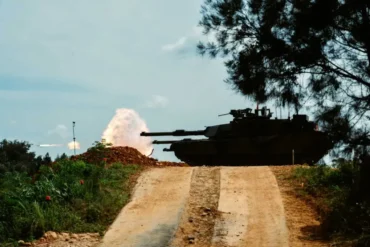
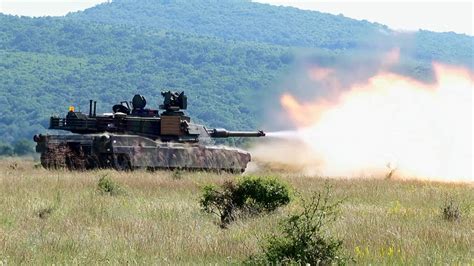
The timing reinforces the message. Days before Bucharest’s confirmation, U.S. armored units from the 1st Infantry Division were observed conducting combined-arms live-fire exercises at Novo Selo Training Area in Bulgaria, integrating Abrams tanks with M2A3 Bradley infantry fighting vehicles. The choreography matters. It demonstrates the ability to deploy, integrate, and sustain heavy forces across the southeastern arc, then position that capability one border away in Romania. Exercises become rehearsal; posture becomes proof.
The Abrams as a Deterrence Instrument
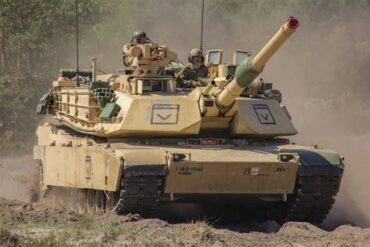
The M1A2 Abrams remains the U.S. Army’s benchmark for direct-fire dominance. Its 120 mm M256 smoothbore cannon, advanced fire-control system, and stabilized optics deliver first-round effects at range, day or night. Survivability is built into the design, pairing heavy composite armor with onboard fire suppression and NBC protection. Mobility is powered by a 1,500-horsepower gas turbine engine, enabling rapid repositioning that complements its role in maneuver warfare, even as it demands robust fuel and maintenance support.
In Romania, the Abrams’ value extends beyond its specifications. It forces an adversary to plan for armored counter-maneuver, not just static defense or standoff fires. It strengthens multinational formations by providing a heavy core around which infantry, engineers, air defense, electronic warfare, and fires can synchronize. In an era defined by drones, electronic attack, and long-range precision strikes, heavy armor remains relevant precisely because it compels integration across domains.
Romania’s Role as an Operational Hinge
Romania is not merely hosting Abrams tanks; it is preparing to field them. Bucharest has committed to acquiring 54 Abrams tanks from U.S. stocks, with a broader modernization package encompassing training, spares, simulators, and ammunition. A U.S. Abrams detachment rotating into Romania functions as a live bridge to that future force. It acclimates Romanian infrastructure to turbine-powered heavy armor, tests range capacity, and deepens interoperability at the crew and maintenance levels.
This matters because interoperability is not abstract. It is measured in compatible procedures, shared logistics, and practiced habits under realistic conditions. A rotational Abrams presence accelerates Romania’s learning curve and embeds it more deeply into NATO’s armored ecosystem. Over time, this transforms Romania from a transit state into a regional anchor for heavy forces, capable of hosting, sustaining, and integrating allied armor at speed.
Logistics as Strategy
Heavy armor reveals truths that lighter forces can obscure. Tanks demand fuel, rail capacity, ports, recovery vehicles, and maintenance depth. By deploying Abrams to Romania, NATO is implicitly committing to stress-testing its southeastern logistics architecture. This is a strategic act in itself. Persistent reporting has highlighted Europe’s challenges in moving heavy equipment across borders, from infrastructure limitations to bureaucratic friction. An Abrams detachment becomes a forcing function to fix those seams.
If deterrence is to be credible, sustainment must be rehearsed in peacetime. Railheads must be cleared, bridges certified, depots stocked, and host-nation support synchronized. Romania’s ports and transport corridors, already vital to Black Sea security, gain added importance as arteries for armored mobility. In this sense, the tanks are both capability and catalyst.
Escalation Management and Signaling
The deployment is calibrated to avoid unnecessary provocation while removing dangerous ambiguity. By upgrading lethality without expanding troop numbers, Washington balances escalation optics with deterrent clarity. The message is not about massing forces for offense; it is about denying opportunities for short-warning coercion. A credible heavy element already on the ground compresses response timelines and raises the cost of miscalculation.
From Moscow’s perspective, Romania occupies a sensitive seam between maritime and land domains. The presence of Abrams tanks complicates any attempt to exploit gaps along the Black Sea flank, especially under the cover of hybrid pressure or rapid escalation. Deterrence works best when it is boring and expensive for the adversary—boring because options are closed off, expensive because every move carries higher risk.
Combined-Arms Reality in 2026
The war in Ukraine has underscored that modern conflict is neither purely technological nor purely numerical. It is combined-arms warfare under constant surveillance, where armor, infantry, drones, and fires must operate in concert. The Abrams is not a relic of a bygone era; it is a node in a networked fight. When paired with mechanized infantry, air defense, and ISR, it restores balance against long-range fires and unmanned threats.
Exercises in Bulgaria and posture changes in Romania illustrate that NATO is internalizing these lessons. Live-fire integration is not theater; it is adaptation. By placing Abrams tanks on the southeastern flank, the alliance signals that it is prepared to contest high-intensity scenarios across domains, not merely manage crises from afar.
A Posture Correction, Not a One-Off
Seen together, the recent exercises and the Romanian deployment form a pattern. This is posture correction, aligning capability with geography. The southeastern flank demands forces that can move, fight, and sustain under pressure, and the Abrams brings that credibility. The decision also affirms Romania’s growing centrality within NATO’s regional plans, positioning it as a workshop where readiness is built, tested, and refined.
Deterrence in 2026 will not be achieved by counting flags on bases or issuing declaratory statements. It will be achieved by ensuring that the heaviest systems are present, practiced, and connected to a resilient logistics backbone. The Abrams tanks heading to Romania embody that philosophy. They turn reassurance into readiness and presence into power, reinforcing NATO’s eastern flank with substance that adversaries must respect.