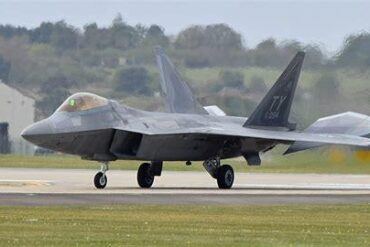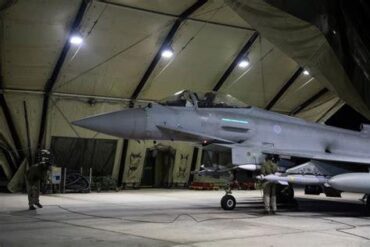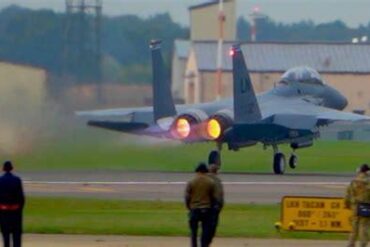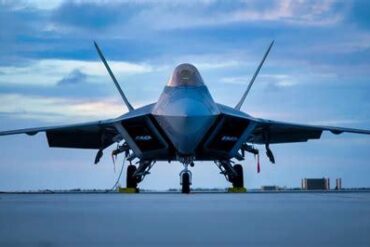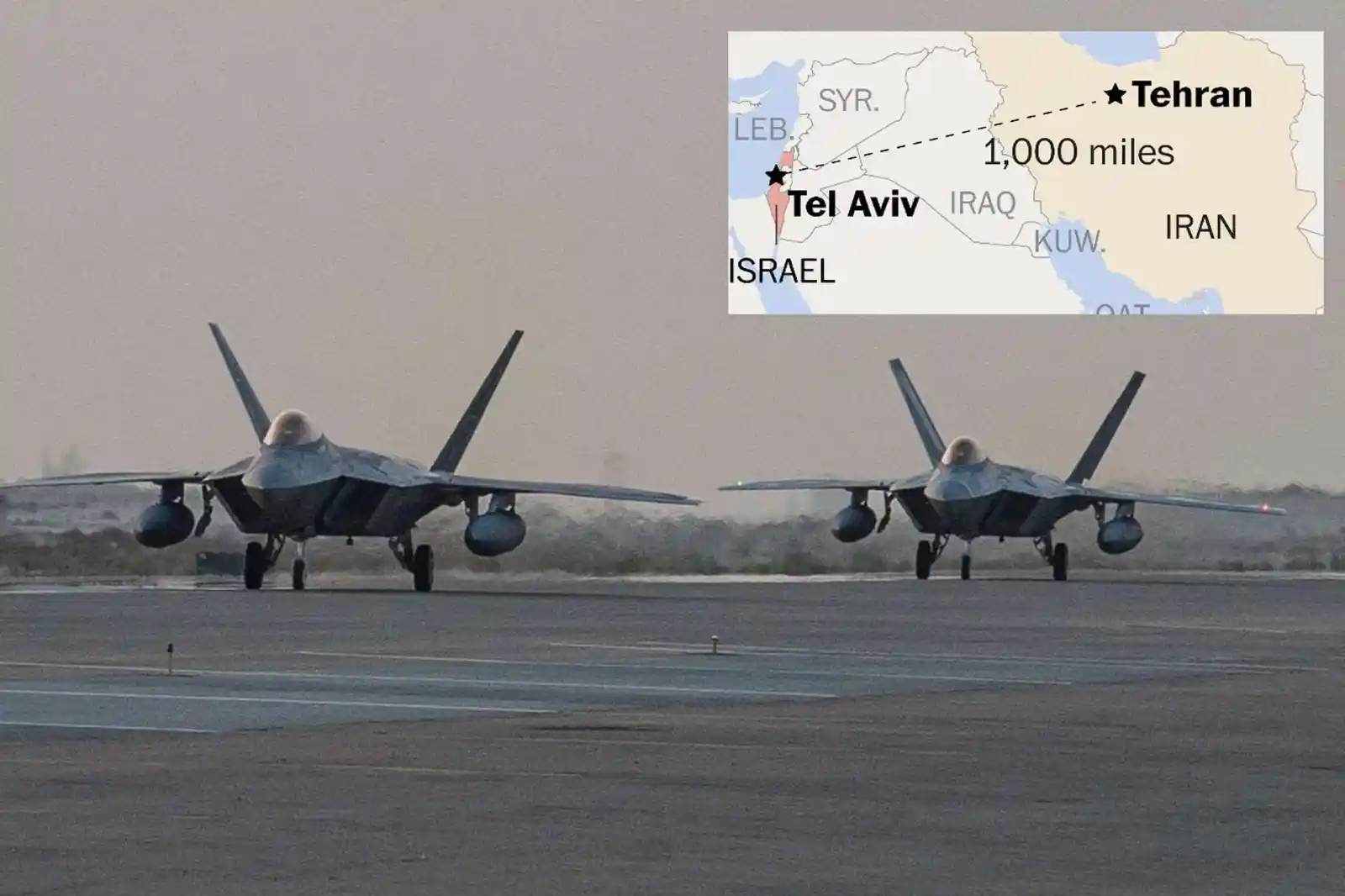
Reports emerging on February 25, 2026, indicate that U.S. Air Force F-22 Raptor stealth fighters have landed in Israel following their departure from RAF Lakenheath in the United Kingdom, marking a potentially significant shift in American force posture in the Middle East. While officials in Washington and Jerusalem have not publicly confirmed the deployment, multiple media outlets have described the arrival of approximately twelve fifth-generation aircraft as part of a broader regional reinforcement effort amid rising tensions with Iran.
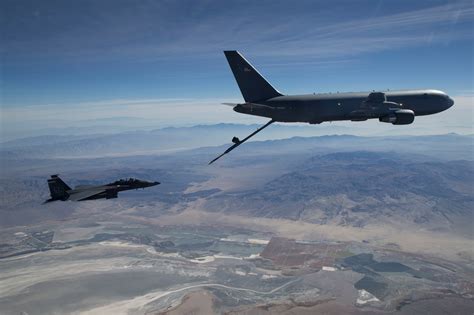
The movement reportedly began on February 24, when twelve F-22 Raptors departed RAF Lakenheath under the protection and logistical support of U.S. Air Force tanker aircraft. Observers tracking open-source flight data noted the presence of KC-46A Pegasus and KC-135 Stratotanker refueling platforms accompanying the transiting formation. The fighters themselves became less visible on public tracking systems during portions of the flight, a pattern often associated with operational security measures during sensitive deployments.
If confirmed, the reported landing of F-22s in Israel would represent one of the most strategically charged forward deployments of U.S. airpower in the region in recent years. The F-22 Raptor is not exported to allied nations, making its presence abroad particularly noteworthy. Its deployment tends to signal not routine rotation, but deliberate deterrence and readiness messaging in high-stakes geopolitical environments.
Strategic Context: Iran Tensions and Regional Force Posture
The reported arrival of the F-22s comes amid heightened diplomatic and military friction involving Iran, particularly surrounding ongoing concerns about Tehran’s nuclear program and broader regional activity. In such an environment, force posture adjustments carry dual significance: operational readiness and political signaling.
Forward-deploying stealth aircraft into Israel would shorten response timelines and expand operational flexibility across the U.S. Central Command area of responsibility. Even without direct engagement, the presence of high-end air superiority assets alters strategic calculations. Deterrence functions not only through declared policy, but through visible capability.
From a military planning perspective, positioning aircraft closer to potential flashpoints reduces transit distances and increases sortie generation rates. In a region where rapid escalation is always a possibility, time becomes a decisive factor. Forward basing enhances options without requiring immediate action.
The Operational Bridge from RAF Lakenheath
RAF Lakenheath serves as a primary European hub for U.S. Air Force F-22 operations. The reported departure of twelve Raptors from the United Kingdom suggests a coordinated, tanker-supported long-range repositioning rather than an ad hoc transfer.
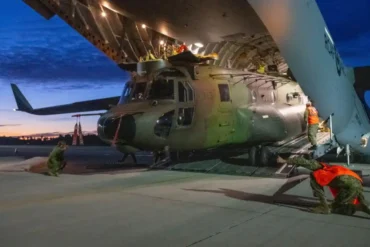
Aerial refueling is central to this equation. The KC-46A Pegasus and KC-135 Stratotanker aircraft enable sustained long-distance movement while preserving flexibility in routing and timing. Tanker support allows stealth fighters to traverse continents without intermediate stops, maintaining operational momentum and minimizing exposure.
Such coordinated deployments demonstrate the logistical backbone underpinning fifth-generation airpower. The fighters may dominate headlines, but the refueling architecture makes rapid global repositioning possible. Without tankers, stealth remains grounded by geography.
The F-22 Raptor: Capabilities and Significance
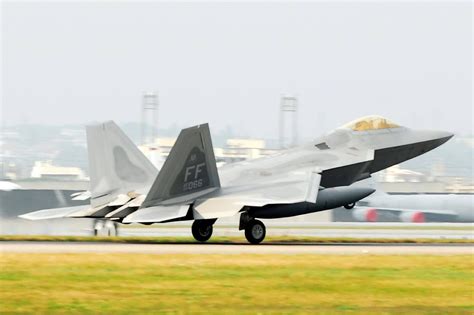
The F-22 Raptor remains one of the most advanced air superiority fighters ever fielded. Designed during the Cold War but matured in the post-9/11 era, it integrates stealth shaping, advanced avionics, and supercruise capability—allowing sustained supersonic flight without afterburners.
Stealth shaping reduces radar cross-section, making detection and tracking more difficult. Internally carried air-to-air missiles preserve low observability while maintaining combat lethality. Sensor fusion integrates radar, electronic surveillance, and communications data into a single coherent operational picture for the pilot.
In a regional contingency involving Iran, the F-22’s most immediate roles would likely include:
- Air dominance and defensive counter-air missions
- Escort protection for strike packages
- Forward sensing and battlespace awareness
- Suppression or deterrence of adversary aircraft operations
Its presence complicates adversary planning. Even if never employed in combat, the aircraft’s mere positioning can influence strategic behavior.
Geographic Calculations and Operational Reach
Open-source discussions have suggested that if the aircraft are operating from southern Israel—potentially Ovda Air Base—their operational geometry changes substantially compared to European basing.
Approximate straight-line distances from southern Israel place key Iranian locations within a range that is tactically manageable with tanker support. Distances in the range of 1,500 to 1,700 kilometers to sites such as Bushehr, Natanz, or Tehran illustrate the feasibility of sustained air operations with aerial refueling.
These figures do not represent actual combat routes, which would depend on airspace permissions, threat avoidance corridors, and tanker track positioning. However, they demonstrate why forward deployment significantly alters mission planning assumptions. Reduced transit time means increased loiter time and faster response windows.
Forward basing also strengthens defensive posture. Combat air patrols can be sustained more efficiently, and rapid-response sorties can be launched with shorter lead times. In high-intensity scenarios, minutes matter.
Infrastructure and Preparedness
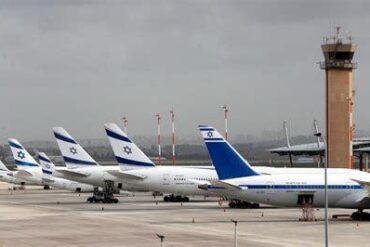
Recent reporting has highlighted infrastructure activity at certain Israeli air bases, including runway and facility upgrades. While such improvements can serve multiple purposes, infrastructure readiness is a crucial component of surge operations and temporary high-end deployments.
Hosting fifth-generation aircraft requires secure facilities, specialized maintenance capabilities, and integrated command-and-control connectivity. The integration of U.S. stealth assets into allied basing environments reflects years of interoperability development between the two air forces.
This kind of preparedness underscores a broader reality of modern military strategy: crisis response depends not only on aircraft availability but on hardened infrastructure, logistics pipelines, and data-sharing networks.
Deterrence Signaling Without Official Confirmation
Notably, neither the U.S. Department of Defense nor Israeli defense officials have formally confirmed the reported arrival of the F-22s. Yet in contemporary geopolitics, the absence of confirmation does not diminish strategic messaging.
Modern defense reporting increasingly draws from open-source flight tracking, satellite imagery, and local observation. These tools create a transparent operational environment in which movements can become publicly visible even before official statements are issued.
In this context, the combination of tanker tracking data, media reporting, and prior departure announcements forms a coherent narrative of forward positioning. The message—intentional or incidental—is one of readiness.
Deterrence functions on perception as much as capability. A small number of highly advanced stealth fighters can reshape the perceived balance of power more effectively than larger formations of conventional aircraft.
Regional Implications and Escalation Dynamics
The Middle East remains a region where military signaling must be calibrated carefully. Reinforcement aimed at deterrence can also be interpreted as escalation, depending on perspective.
The reported deployment suggests Washington is prepared to reinforce allies rapidly while maintaining flexibility. It reassures partners and complicates adversary calculations simultaneously. The strategic art lies in demonstrating resolve without triggering unintended confrontation.
For Iran, the presence of F-22 Raptors within closer operational range introduces uncertainty into defensive planning. For regional allies, it reinforces confidence in U.S. commitments. For the broader international community, it underscores how quickly high-end airpower can be repositioned in response to geopolitical stress.
A Calculated Adjustment in Airpower Posture
The reported landing of U.S. F-22 stealth fighters in Israel, following their departure from RAF Lakenheath, represents more than a simple aircraft relocation. It illustrates the dynamic nature of modern force posture, where advanced capabilities can be shifted across theaters within days.
Whether publicly confirmed or not, the operational pattern described aligns with deterrence signaling during a period of heightened Iran-related tensions. The integration of tanker support, forward basing infrastructure, and fifth-generation air dominance assets reflects deliberate planning rather than routine movement.
In an era defined by rapid information flow and compressed decision timelines, even a dozen stealth fighters can reshape strategic calculations. Their presence alone serves as a reminder that airpower remains a central instrument of influence in the Middle East—capable not only of combat operations, but of shaping events long before the first missile is ever launched.