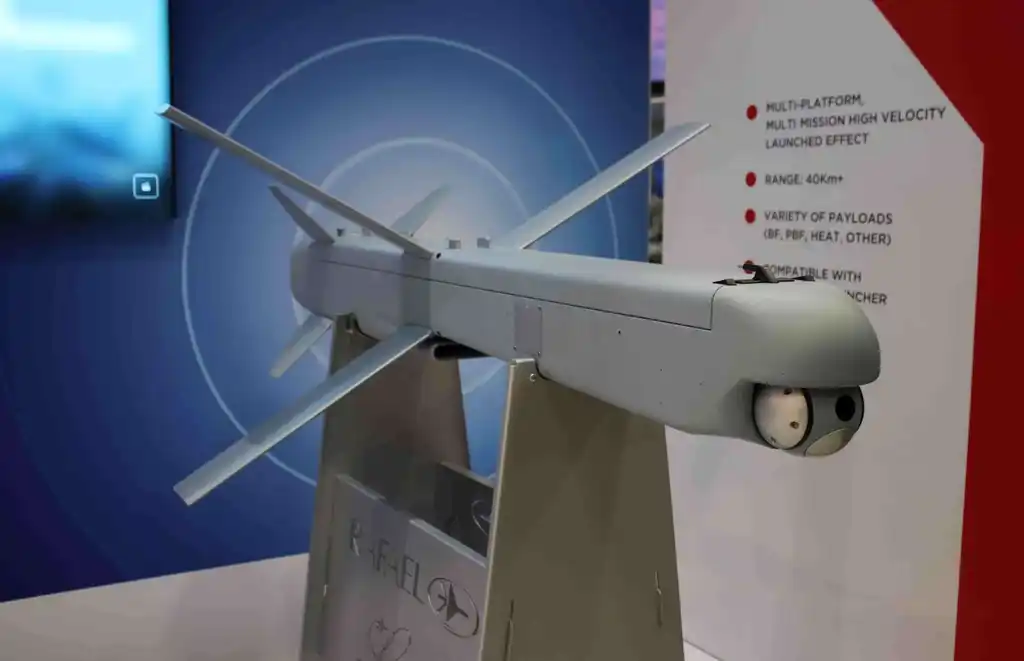
At AUSA 2025 in Washington, Rafael Advanced Defense Systems introduced the L-Spike 4X, a next-generation “launched effect” system that bridges the performance gap between missiles and loitering munitions. Designed to meet the demands of U.S. and allied forces operating in highly contested environments, the L-Spike 4X merges missile-class dash speed with a 25-minute loiter capability, offering a decisive blend of speed, persistence, and precision.
Unlike traditional drones that trade velocity for endurance, the L-Spike 4X compresses the kill chain by sprinting to target zones within five minutes, maintaining on-station persistence, and engaging targets within a 40-kilometer envelope. This hybrid architecture positions it as one of the fastest and most survivable precision effects in its class.
A Purpose-Built Loitering Missile for Contested Airspace
The L-Spike 4X redefines the “loitering missile” category with a propulsion system optimized for both dash and endurance. Upon launch, it executes a high-velocity sprint to the target area, minimizing exposure to enemy defenses. Once in position, it transitions into a low-signature loiter mode, granting operators extended time for target confirmation, identification, and strike authorization.
This dual-phase profile gives commanders flexibility unmatched by conventional UAVs or slow loitering munitions. In fast-moving battlespaces where seconds count, the L-Spike 4X can reach critical grid coordinates in minutes — an ability that compresses decision cycles and improves strike survivability against radar-guided or EW-driven countermeasures.
Technical Architecture and Warhead Options
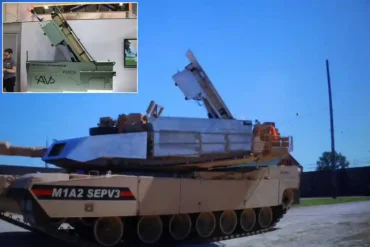
Rafael’s technical literature describes the L-Spike 4X as a 50-kilogram class munition, including canister, and capable of salvo-firing four rounds from a single multi-platform launcher. This launcher is adaptable to land vehicles, naval decks, and airborne pylons, offering cross-domain versatility.
The system supports two primary warhead configurations:
- Tandem HEAT (High-Explosive Anti-Tank) for defeating armor and hardened vehicles.
- Multi-purpose blast/fragmentation for use against light structures, field fortifications, and personnel concentrations.
Such modularity ensures the weapon remains relevant across mission profiles — from anti-armor strikes and SEAD (Suppression of Enemy Air Defenses) to precision destruction of mobile command nodes.
AI-Enhanced Targeting and Multi-Round Coordination
One of the L-Spike 4X’s most groundbreaking capabilities lies in its AI-enabled target recognition and multi-munition control interface. A single operator can command up to four munitions simultaneously, each capable of autonomous target acquisition while maintaining a human-in-the-loop for final engagement authorization.
This feature dramatically reduces manpower requirements while increasing tactical throughput. Operators can prosecute multiple targets within a single battery or convoy, or even redirect a trailing missile for a re-attack sequence — a flexibility that legacy systems cannot match.
Its EO/IR seeker, paired with GPS-hardened communication links, ensures reliable performance even in GPS-denied or jammed environments. The multi-mode guidance suite also supports autonomous navigation, helping the system sustain precision strikes despite the presence of electronic warfare interference.
Operational Integration and Platform Synergy
Rafael has demonstrated the L-Spike 4X’s compatibility with existing Spike launcher architectures, ensuring a seamless transition for forces already fielding Spike NLOS and related variants. Notably, an Apache-mounted firing animation showcased during AUSA 2025 revealed potential integration with AH-64 attack helicopters, offering rotary-wing formations a standoff strike capability without exposing aircrews to short-range air defenses.

This interoperability aligns directly with the U.S. Army’s launched-effects initiative, which prioritizes modular, rapid-response, and survivable precision fires for multi-domain operations. When cued by radar, EW, or ISR (Intelligence, Surveillance, Reconnaissance) feeds, the L-Spike 4X can be launched, reach the target area within minutes, and hold position overhead until strike clearance is granted — effectively bridging the speed gap between intelligence and firepower.
Strategic Context: The Loitering Weapon Renaissance
The unveiling of the L-Spike 4X comes amid a global renaissance in loitering weapon design, driven by operational lessons from Ukraine, Gaza, and other theaters where electronic warfare and rapid redeployment dictate survival. Western militaries have discovered that traditional slow drones are too vulnerable to modern counter-UAS networks and pop-up air defenses.
Rafael’s new design directly addresses these realities — combining speed to beat intercept windows with on-station persistence to ensure accurate target identification. The L-Spike 4X’s autonomy, modularity, and interoperability embody the evolution from expendable loitering drones to networked precision-effectors capable of reshaping brigade-level engagement tempo.
As the U.S. Army pivots from large-scale rotorcraft programs toward incremental modernization, systems like the L-Spike 4X deliver a scalable path to enhanced standoff lethality and distributed strike power.
A New Benchmark for Precision Fires
With its missile-grade performance, AI-driven autonomy, and multi-platform flexibility, the Rafael L-Spike 4X sets a new benchmark in the field of loitering precision weapons. It encapsulates the emerging doctrine of high-speed, long-loiter, human-authorized autonomy — a synthesis that could redefine how Western forces fight in the 2030s.
As launched effects gain strategic traction, the L-Spike 4X is not merely a new weapon; it is a manifestation of the next era of precision warfare, one where speed, persistence, and intelligence converge in a single, lethal platform.